Quaderns de Psicologia | 2026, Vol. 28, Nro. 2, e2281 | ISSN: 0211-3481 | 
 https://doi.org/10.5565/rev/qpsicologia.2281

Spanish Adaptation of the Coach-Athlete Attachment Scale (Sp-CAAS)
Adaptación al castellano de la Escala de Apego Entrenador-Atleta (Sp-CAAS)
María Valls-Barberá
Alejandro Magallares
Patricia Recio
Universidad Nacional de Educación a Distancia (UNED)
Louise Davis
Universidad de Umeå
Abstract
The Coach-Athlete Attachment Scale (CAAS) is a sport-specific self-report instrument designed to assess athletes’ attachment styles toward their coach. This study aimed to validate the Spanish version (Sp-CAAS) using a sample of 301 football players from Fundació Albinegra (Castellón). Confirmatory Factor Analysis supported a trifactorial structure with good model fit. Longitudinal measurement invariance indicated that the factor structure remained stable over time. Intraclass correlation coefficients showed strong test-retest reliability. Additionally, the three subscales—avoidant, anxious, and secure—demonstrated high internal consistency.
Overall, the findings suggest that the Sp-CAAS has solid psychometric properties and is suitable for use within the Spanish-speaking scientific community. Nevertheless, further research is needed to confirm its content validity and to examine its applicability across diverse Spanish-speaking populations.
Keywords: Attachment; Coach-Athlete; Football; Questionnaires; Psychometrics
Resumen
La Escala de Apego Entrenador-Atleta (CAAS) es un instrumento de autoinforme específico del ámbito deportivo diseñado para evaluar los estilos de apego de los deportistas hacia su entrenador. Este estudio tuvo como objetivo validar la versión española (Sp-CAAS) utilizando una muestra de 301 futbolistas de la Fundació Albinegra (Castellón). El análisis factorial confirmatorio respaldó una estructura trifactorial con un buen ajuste del modelo. La invarianza de medida longitudinal indicó que la estructura factorial se mantuvo estable a lo largo del tiempo. Los coeficientes de correlación intraclase mostraron una alta fiabilidad test-retest. Además, las tres subescalas —evitativo, ansioso y seguro— presentaron una alta consistencia interna.
En conjunto, los resultados sugieren que la Sp-CAAS posee sólidas propiedades psicométricas y es adecuada para su uso en la comunidad científica de habla hispana. No obstante, se requieren más estudios para confirmar su validez de contenido y examinar su aplicabilidad en diversas poblaciones hispanohablantes.
Palabras clave: Apego; Cuestionarios; Fútbol; Entrenador-atleta; Psicometría
Introduction
The construct of attachment was originally used to characterize the close emotional bond between a child and his or her caregiver (e.g., usually the parents). John Bowlby (1977) defined attachment as “the propensity of human beings to make strong affectional bonds to particular others” (p. 201). Mary Ainsworth et al. (1978) employed the “Strange Situation” procedure to investigate individual differences in infant attachment to primary caregivers. This research led to the identification of distinct attachment styles.
Ainsworth et al. (1978) established a link between consistent, attentive, responsive, and supportive caregiving and the development of secure attachment in infants. Conversely, consistently unresponsive, distant, and aloof caregiving was associated with the development of an insecure-avoidant attachment style (Ainsworth et al., 1978). Furthermore, unpredictable and inconsistent caregiving behaviors were found to promote an insecure-anxious attachment style (Ainsworth et al., 1978).
The attachment system, initially conceptualized by Bowlby (1977) and Ainsworth et al. (1978), has been subsequently broadened to encompass relationships beyond infancy, extending into adolescence and adulthood (Fraley et al., 2005). This perspective has spurred substantial research over the past two decades (see Mikulincer & Shaver, 2013, for a review). More recently, numerous self-report measures have been developed to assess attachment styles across various relational contexts (see Justo-Núñez et al., 2022, for a review), including romantic relationships (e.g., Experiences in Close Relationships Scale, Brennan et al., 1998) and adolescent friendships (e.g., Adolescent Friendship Attachment Scale, Wilkinson, 2008).
Within organized sport, it has been suggested that athletes’ relationships with their coaches may become an important aspect of development and growth (Jowett & Cockerill, 2003), and that attachment theory can supply a sound theoretical framework for studying individual differences within the interpersonal relational context formulated by the coach and the athlete (Davis & Jowett, 2010).
To expedite research on coach-athlete attachment, and to address limitations of existing instruments designed for different contexts (e.g., adolescence) and attachment figures (e.g., romantic partners), Louise Davis and Sophia Jowett (2013) developed the Coach-Athlete Attachment Scale (CAAS). This instrument measures athletes’ attachment to their coaches across the three mentioned primary attachment styles.
The CAAS (19 items) was designed to measure athletes’ secure (5 items, e.g., “I know I can rely on my coach”), anxious (7 items, e.g., “I worry that I won’t fulfill my coaches’ expectations”), and avoidant (7 items, e.g., “I do not turn to my coach for reassurance”) attachment styles. Although the original study focused on measuring the three attachment styles (secure, anxious, and avoidant), Davis and Jowett (2013) also derived a measure of attachment security based on athletes reporting low levels of both attachment avoidance and anxiety. This approach to inferring security from low avoidance and anxiety has precedent in adult attachment measures (e.g., the Experiences in Close Relationships Scale; Brennan et al., 1998).
As noted by Davis and Jowett (2013), the development of the Coach-Athlete Attachment Scale (CAAS) as a new instrument for measuring attachment within the sport context was carried out in three phases. In the first phase, items were generated based on pre-existing self-report attachment instruments, adapted specifically for the sporting context to reflect the attachment styles of both coaches and athletes. In the second phase, a panel of experts evaluated the content validity of the items, which allowed for the construction of a final version of the scale.
Finally, in the third phase, the CAAS was administered to a sample of 703 participants (405 coaches and 298 athletes), and a confirmatory factor analysis (CFA) was conducted to determine the final structure of the scale.
The bifactorial structure comprising 14 items, assessing insecure-anxious and avoidant attachment in both athletes and coaches, showed satisfactory goodness-of-fit indices (athletes; SRMR = 0.06, RMSEA = 0.05, RCFI = 0.96, RNNFI = 0.95), (coaches; SRMR = 0.06, RMSEA = 0.06, RCFI = 0.94, RNNFI = 0.89), as did the three-factor model of 19 items assessing secure, anxious, and avoidant attachment in athletes (SRMR = 0.06; RMSEA = 0.04; RCFI = 0.97; RNNFI = 0.97), and in coaches (SRMR = 0.06; RMSEA = 0.06; RCFI = 0.90; RNNFI = 0.89).
Subsequently, the CAAS has been adapted to other languages and cultures and has been validated in Chinese (Peng et al., 2020), Swedish (Davis et al., 2022), and Turkish (Bastık & Gümüşdağ, 2022). The Chinese version (Peng et al., 2020) consisted of only two subscales (anxiety and avoidance), and its reduced version exhibited good psychometric properties, including reliability and validity. The Swedish (Davis et al., 2022) and Turkish (Bastık & Gümüşdağ, 2022) versions of the CAAS kept all three subscales (with 19 items), and their analysis further confirmed the reliability and validity of the questionnaire. However, to date and to our knowledge, there has been no research that has attempted to validate a Spanish version of the CAAS.
In relation to the structure of the CAAS, the literature has proposed two models of measurement. On the one hand, the bifactorial model, composed of anxious and avoidant attachment, allows security to be inferred from low scores in both dimensions, in line with adult attachment measures such as the ECR (Brennan et al., 1998). On the other hand, the trifactorial model directly evaluates the three attachment styles (secure, anxious, and avoidant), consistent with Ainsworth et al. (1978) classification and with Davis and Jowett (2013) initial validation of the CAAS. Both structures have shown acceptable psychometric properties in international adaptations (Peng et al., 2020; Davis et al., 2022; Bastık & Gümüşdağ, 2022). Therefore, it is relevant to contrast both models in the Spanish adaptation, to determine which provides a more robust measurement in this context.
In addition, a recent systematic review compiling 16 international studies has highlighted that the CAAS is the most widely used instrument for assessing attachment in the sporting context, showing how secure attachment in athletes directly impacts their subjective psychological well-being through variables such as vitality, performance, and self-esteem. It also reports higher satisfaction rates with the athlete-coach relationship and has a positive impact on physical and psychological health, preventing burnout, recovery from injuries, or eating disorders in athletes, while insecure-anxious and avoidant styles represent a challenge in the sports context due to their excessive emotional dependence on the coach or, conversely, their distancing and marked autonomy from the coach and technical staff (See more in Valls-Barberá & Magallares, 2025).
Likewise, the same review shows how language represents a barrier to the assessment of attachment style in athletes. For example, in the study by Nayara Caruzzo et al. (2021), it is indicated that some of the participants in the beach volleyball world championship were unable to participate in the study because they did not understand English, which reinforces the need to validate the CAAS in as many languages as possible so that all athletes can participate in the measurements. Therefore, considering the usefulness of a self-report instrument specifically designed to assess athletes’ attachment styles, the objective of this research was to adapt the CAAS to Spanish (Sp-CAAS) in a sample of soccer players.
In this sense, validating the CAAS in Spanish not only addresses a linguistic gap but also allows researchers to advance the study of how attachment shapes the coach–athlete relationship, a central relational context in sport. Moreover, by incorporating longitudinal measurement invariance and test–retest reliability analyses—approaches that have not been applied to the CAAS so far—this study provides a novel methodological contribution that strengthens the evidence for the instrument’s psychometric properties.
Research overview
Considering the utility of a self-report instrument designed to assess athletes’ attachment styles, the aim of this research was to adapt the CAAS to Spanish (Sp-CAAS) in a sample of football players. Given the global prevalence of Spanish, with approximately 600 million speakers worldwide (Eberhard et al., 2022), and the significant number of football players in Spanish-speaking countries, such as Spain’s 1,248,511 federated players (Ministry of Education, 2024), we believe that measures developed specifically for Spanish-speaking populations, for athletes and, in the context of this study, for soccer players, are very valuable. Therefore, the main objective of this research was to adapt the CAAS into Spanish to develop a Spanish version while maintaining the same factor structure and number of items as the original scale, resulting in the Sp-CAAS using the translation/back-translation methodology and following the guidelines for cross-cultural adaptations (Hernández et al., 2020).
In addition, taking into account the variability in the factor structure of the scale, we set out to evaluate the two original factor structures of the scale proposed by Davis and Jowett (2013), the two-factor scale of insecure attachment (anxious and avoidant) and the three-factor scale (secure, anxious, and avoidant).
As a novelty, and to advance our understanding of the psychometric properties of the CAAS, we conducted a test-retest reliability analysis. Moreover, to assess the temporal stability of the CAAS, we employed Longitudinal Measurement Invariance (LMI). This innovative approach, previously unexplored with the CAAS, allowed us to examine the extent to which the attachment construct measured by the CAAS remained invariant over time (Millsap & Cham, 2012).
Finally, to study the convergent and discriminant validity of the CAAS, the Basic Needs Satisfaction in Sport Scale (Jowett & Ntoumanis, 2004) and the Coach-Athlete Relationship Questionnaire (Ng et al., 2011) were measured, as previous research has found that the CAAS was positively related to athletes’ basic psychological needs satisfaction (Davis et al., 2021) and to athletes’ meta-perceptions of the quality of the coach-athlete relationship (Davis et al., 2022).
Method
Participants
The sample (n = 301) was composed of football players from an academy of a Spanish football club (CD Castellón) (M age = 15.76, SD = 3.61) being 234 male ([77.7%], M age = 15.18, SD = 2.95) and 67 females ([22.3%], M age = 17.81, SD = 4.81). Of the total 301 participants (see Table 1), 188 players (62.5%) were from the main club (male = 121[64.4%], female = 67[35.6%], M age = 16.68, SD = 4.07) and 113 (37.5%) were players from the subsidiary club (male = 113[100%], M age = 14.24, SD = 1.89).
Table 1. Sample characteristics
Category |
Age Range |
Sex |
Total |
|
Club 1 |
Junior youth (Infantil) |
12-13 |
Male Female |
32 12 |
Cadets (Cadete) |
14-15 |
Male Female |
35 19 |
|
Senior youth (Juvenil) |
16-18 |
Male Female |
38 8 |
|
Adult category (Senior) |
19-28 |
Male Female |
16 28 |
|
Club 2 |
Junior youth (Infantil) |
12-13 |
Male |
48 |
Cadets (Cadete) |
14-15 |
Male |
36 |
|
Senior Youth (Juvenil) |
16-18 |
Male |
29 |
|
Total |
n = 301 |
Instruments
Coach-Athlete Attachment Scale (CAAS; Davis & Jowett, 2013). The CAAS contains 19-items designed to measure the three attachment styles proposed by Bowlby (1977). Specifically, the CAAS measures athletes’ secure attachment (5 items, e.g., “I know I can rely on my coach”), avoidant attachment (7 items, e.g., “I do not turn to my coach for reassurance”), and anxious attachment (7 items, e.g., “I worry that I won’t fulfill my coaches’ expectations”). The scale has two versions, one for coaches and one for athletes, but in this study only the version for athletes was analyzed. The scale measures the attachment style that the athlete feels towards his or her coach through responses using a Likert-type scale from 1 to 7, where 1 is “strongly disagree” and 7 is “strongly agree”. Cronbach’s alphas of the original study (Davis & Jowett, 2013) for each of the attachment dimensions of the athlete scales were as follows: avoidant attachment α = .86, anxious attachment α = .82, and secure attachment α = .86.
Basic Needs Satisfaction in Sport Scale (BNSS; Ng et al., 2011; Spanish version: De Francisco et al., 2020). The BNSS is a 20-item scale that assesses athletes’ basic psychological needs satisfaction in sport. Specifically, the psychological needs of autonomy (10 items, e.g., “In football, I have the opportunity to make decisions”), competence (5 items, e.g., “I think I am good at football”), and relatedness (5 items, e.g., “In football, I have good relationships with my teammates”). It presents a Likert-type response format from (1) “Not at all true” to (7) “Totally true”. In our study, it was found an adequate Cronbach’s alpha for the autonomy factor (α=.73), the competence subscale (α=.86), and the relatedness factor (α=.78).
The Coach-Athlete Relationship Questionnaire (CART-Q; Jowett & Ntoumanis, 2004; Spanish version: Sanz-Fernández et al., 2023). The CART-Q is an 11-item scale that evaluates the quality of the coach-athlete relationship through three factors: closeness (4 items, e.g., “I appreciate my coach”), commitment (3 items, e.g., “I am close to my coach”), and complementarity (2 items, e.g., “I adopt a friendly attitude when training with my coach”). The questionnaire, with a Likert scale response format, presents seven options ranging from 1 (“totally disagree”) to 7 (“totally agree”). In this study we found appropriate Cronbach’s alphas for the factor commitment (α=.70), for closeness (α=.86), and complementarity (α=.73).
Procedure
The research project was presented to the club (CD Castellón) and the university (UNED), and after being reviewed and approved by the institutions, a document was signed certifying the authorization to collect a sample of players until the end of the research project, with a reference assigned (MVB2023). Subsequently, upon consent, the research personnel contacted coaches at the club and informed them of the purpose of the study. Coaches were asked to provide each player and their families with an information sheet explaining the purpose of the study as well as consent forms for those who voluntarily wished to participate. Additionally, parental consent was sought via an additional informed consent form for those athletes who were under the age of 18.
A convenient time and date were arranged to visit the athletes at one of their training camps, where the research personnel, upon receiving the informed consent forms, asked the players to complete the questionnaire. All questionnaires were filled out independently in paper and pencil format, in the presence of the researcher. This ensured that all athletes were able to receive clarity on any questions they did not understand and ensured the confidentiality and anonymity of the participants’ answers. The data were collected anonymously, and results were reported in aggregate form only so that participants could not be identified individually. Upon completion of the survey, participants were thanked for their contribution and debriefed about the purposes of the study. Finally, to ensure the stability of the Sp-CAAS, the scale was randomly administered to 71.5% of the total sample again after 12 weeks. On both occasions the same procedure was followed in attempts to ensure consistent conditions across timepoints.
Adaptation procedure
Following the translation-back-translation process proposed by Hernández et al. (2020), the initial English-to-Spanish translation of the questionnaire was conducted by one of the study authors. This translation was independently reviewed by another author to ensure accuracy and clarity, particularly for semantically and grammatically complex items. Subsequently, a bilingual English translator, unaware of the original English scale, back-translated the agreed-upon Spanish version to English. This back-translation was then reviewed by experts in the field of attachment. To ensure content validity, the Spanish version was reviewed by a panel of experts composed of four psychologists with extensive experience in the study of attachment, all of whom had published scientific work in this field. The group included a methodologist with expertise in the validation and adaptation of psychometric instruments, a specialist in social psychology, an expert in sport psychology, and the author of the original version of the CAAS. This multidisciplinary panel ensured a thorough theoretical, methodological, and contextual review of the items. Finally, the Sp-CAAS was pilot-tested with a small sample of acquaintances to assess clarity and comprehensibility. Participants were asked to identify any ambiguous or unintelligible items. The items of the Sp-CAAS are presented in Table 2.
Table 2. Items of the CAAS: English and Spanish version
English (CAAS) |
Spanish (Sp-CAAS) |
|
1 |
I do not usually discuss my problems or concerns with my coach |
No suelo hablar de mis problemas o preocupaciones con mi entrenador/a |
2 |
I do not turn to my coach for reassurance |
No acudo a mi entrenador/a para que me tranquilice |
3 |
I avoid discussing personal issues with my coach |
Evito hablar de temas personales con mi entrenador/a |
4 |
I do not rely on my coach when I have a problem to solve |
No confío en mi entrenador/a cuando tengo un problema que resolver. |
5 |
I do not turn to my coach when I need to get something off my chest. |
No acudo a mi entrenador/a cuando necesito desahogarme |
6 |
I do not ask my coach for advice and help |
No pido consejo ni ayuda a mi entrenador/a |
7 |
I do not seek out my coach when things go wrong |
No busco a mi entrenador/a cuando las cosas van mal |
8 |
I often wonder if my coach cares about me as an athlete |
A menudo me pregunto si mi entrenador/a se preocupa por mí como deportista |
9 |
I often worry that my coach does not value me as much as I value him/her |
A menudo me preocupa que mi entrenador/a no me valore tanto como yo le valoro a él/ella |
10 |
I worry a fair amount about my coach leaving me to coach elsewhere |
Me preocupa bastante que mi entrenador/a me deje para entrenar en otro sitio |
11 |
I am concerned that my coach will find another athlete that he/she prefers |
Me preocupa que mi entrenador/a encuentre otro deportista que prefiera |
12 |
I often worry that my coach does not want to coach me anymore |
A menudo me preocupa que mi entrenador/a ya no quiera entrenarme |
13 |
Sometimes I worry that my coach is not as committed to me as I am to them. |
A veces me preocupa que mi entrenador/a no esté tan comprometido conmigo como yo lo estoy con ellos |
14 |
I worry that my coach does not respect me as much as I respect him/her |
Me preocupa que mi entrenador/a no me respete tanto como yo a él/ella |
15 |
I know that my coach is loyal to me |
Sé que mi entrenador/a me es leal |
16 |
I feel confident that our coach-athlete relationship will last. |
Confío en que nuestra relación entrenador/a-deportista será duradera |
17 |
I find it easy to interact with my coach |
Me resulta fácil relacionarme con mi entrenador/a |
18 |
I know my coach likes me. |
Sé que le caigo bien a mi entrenador/a |
19 |
I know I can rely on my coach |
Sé que puedo confiar en mi entrenador/a |
Note: 1–7 = anxious attachment; 8–14 = avoidant attachment; 15–19 = secure attachment. 7-point Likert scale ranging from 1 (strongly disagree) to 7 (strongly agree).
Data analysis
The R program (version 4.3.0) was used for Confirmatory Factor Analysis (CFA) and internal consistency analyses (R Core Team, 2020). All remaining analyses were performed with SPSS (IBM Corp, 2020). Multivariate normality was evaluated using Mardia’s (1970) multivariate kurtosis coefficient, which had a value of 21.15. This result indicated that there was no multivariate normality, as a critical ratio of kurtosis < 5.0 indicates multivariate normality. Therefore, estimates were obtained using WLSMV estimator (a robust variant of Diagonally Weighted Least Squares) and the polychoric correlation matrix, implemented from the Lavaan package in R.
The model fit was assessed by using the Comparative Fit Index (CFI), Tucker–Lewis Index (TLI), Root Mean Square Error of Approximation (RMSEA), and Standardized Root Mean Square Residual (SRMR). CFI and TLI values between .90 and .95 indicate an acceptable model fit, with values greater than .95 indicating a close model fit (Hu & Bentler, 1999). Values of SRMR and RMSEA below .08 indicate a fair fit. We decided to test a two- and a three-factor model. Both structures were plausible, as the reviewed literature presented in the introduction suggested.
Longitudinal CFA was used to assess measurement invariance over time. Firstly, a baseline model (either a two- or three-factor model, depending on the results from the model comparison in the CFA) was established, testing the factorial structure separately at time point 1 and time point 2. We then evaluated LMI across time using a series of nested models. Configural invariance tested whether the same general pattern of factor loadings held across time; metric invariance constrained the corresponding factor loadings to be equal across occasions, while scalar invariance required both factor loadings and intercepts to be identical across time points. Item residual variances (unicities) were freely estimated across time in all models, and residual covariances between corresponding items across time were explicitly modeled (e.g., CAAS1_T1~~ CAAS1_T2, CAAS2_T1 ~~CAAS2_T2, …). These item-level residual covariances account for item-specific stability and potential method/item wording effects and were included in the configural model and retained in the subsequent metric and scalar models. Including correlated residuals for the same indicator across waves is recommended in longitudinal CFA when item-level temporal dependencies are expected (Little, 2013; Newsom, 2015).
To assess invariance at each level, we calculated a chi-square difference test. However, due to the sensitivity of this test to small parameter changes in large samples (Chen, 2007), it was not used as the main criterion. Instead, we relied on changes in CFI (ΔCFI), with differences smaller than .01 indicating that the more restrictive and less restrictive models were equivalent (Chen, 2007; Cheung & Rensvold, 2002), and changes in RMSEA, with differences (ΔRMSEA) of .015 or higher, were considered indicative of a lack of measurement invariance. Finally, test-retest reliability was estimated using the Intra-class Correlation Coefficient (ICC) of the agreement type to assess the degree of absolute consistency in subscale scores across the two time points.
The internal consistency of the scale was evaluated using Cronbach’s alpha coefficient. Additionally, internal consistency was estimated using categorical omega coefficients (Green & Yang, 2015), based on factor loadings from confirmatory factor analysis models estimated with the WLSMV estimator, which is appropriate for ordinal data. Finally, to evaluate convergent and discriminant validity, we computed Pearson’s correlation coefficients between the subscales of the CAAS and the factors of the BNSS and the CART-Q.
Results
Internal structure validity
The bifactorial and trifactorial structures of the scale were tested, with both cases showing a poor fit due to RMSEA values exceeding .08. The global fit indices for the bifactorial structure (14 items), excluding the secure attachment dimension, were as follows: CFI = .973, TLI = .967, RMSEA = .088, and SRMR = .072. In the case of the 19-item trifactorial structure, the indices were also not adequate (CFI = .972, TLI = .969, RMSEA = .087, and SRMR = .079).
Following Rex Kline’s recommendations (2015), the model was re-specified, incorporating changes sequentially. Lagrange multipliers indicated the need to correlate errors between items 1 (“I do not usually discuss my problems or concerns with my coach”) and 2 (“I do not turn to my coach for reassurance”), justified by their similar content (Gerbing & Anderson, 1984). After incorporating this change (very similar to the Swedish version, Davis et al., 2022), the fit for both models became acceptable. Indices were satisfactory for both the trifactorial structure (CFI = .977, TLI = .974, RMSEA = .078, and SRMR = .073) and the bifactorial structure (CFI = .979, TLI = .974, RMSEA = .079, and SRMR = .067).
It is worth noting that the need to correlate residuals between items 1 and 2 has not been consistently observed in other international adaptations of the CAAS. For instance, the Swedish (Davis et al., 2022) and Turkish (Bastık & Gümüşdağ, 2022) versions reported satisfactory model fits without correlating residuals within the avoidant factor, whereas the Chinese version (Peng et al., 2020) adopted a reduced two-factor model. These differences may reflect linguistic and cultural nuances influencing how avoidance-related expressions are interpreted. Importantly, during the pilot testing phase, none of the Spanish football players reported difficulties understanding or distinguishing the meaning of items 1 and 2, suggesting that the correlation observed between them is not due to a lack of comprehension but rather to their conceptual proximity within the avoidant attachment dimension. Consequently, future studies should examine whether this residual covariance between items 1 and 2 replicates across samples and in other Spanish-speaking populations, as variations between European and Latin American Spanish may lead to subtle differences in meaning or connotation.
Comparing the fit of both models revealed similar results, with a ΔCFI of .002 and a ΔRMSEA of -.005, both falling below the established criteria of .010 and .015 for these changes, respectively. Therefore, eliminating the secure attachment dimension was not necessary, as there was no significant improvement in the fit. The final trifactorial structure is depicted in Figure 1.
Figure 1. CFA model of the Sp-CAAS Principio del formulario
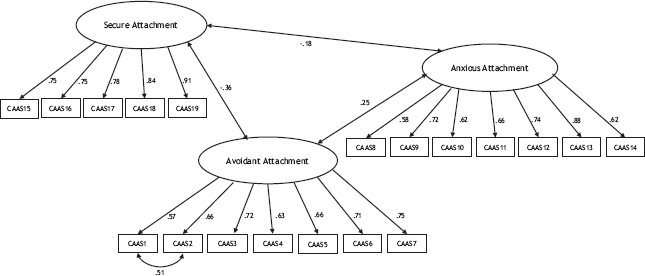
All factor loadings were statistically significant at p < .001, ranging from .57 to .91. As expected, secure attachment showed a negative correlation with avoidant attachment (r = -.36, p = .000) and anxious attachment (r = -.18, p = .002), whereas the correlation between avoidant and anxious attachment was positive (r = .25, p = .000).
Longitudinal measurement invariance
LMI across time was assessed in several steps (see Table 3). First, we evaluated the fit of the model at each time point independently. The model fit values were adequate for both time points, with CFI values above .90 and RMSEA values below .08, indicating a good fit for the Sp-CAAS on each occasion.
Table 3. LMI model fit statistics
Model |
χ2 |
df |
CFI |
RMSEA (90% CI) |
∆ χ2 |
∆ df |
∆CFI |
∆RMSEA |
Configural |
1324.08 |
629 |
.931 |
.072 (.067, .078) |
||||
Metric |
797.60 |
342 |
.944 |
.079 (.072. .086) |
526.48 |
287 |
.013 |
.007 |
Scalar |
774.17 |
328 |
.945 |
.080 (.073, .087) |
23.43 |
14 |
.001 |
.001 |
Note: df = degrees of freedom; ∆ χ2, change in χ2 relative to the preceding model; ∆CFI, change in comparative fit index relative to the preceding model; ∆RMSEA, change in root mean square error of approximation relative to the preceding model.
Then, we tested configural invariance by allowing all parameters to vary freely across time. The configural model showed a good fit (CFI = .931, RMSEA = .072), suggesting that the general factor structure of the Sp-CAAS was stable over time. We then proceeded to examine metric invariance by constraining the factor loadings to be equal across time. The metric model demonstrated satisfactory fit (CFI = .944, RMSEA = .079), with an improvement in CFI compared to the configural model (∆CFI = .013) and a minor increase in RMSEA (∆RMSEA = .007), well below the critical threshold of .015. These results supported the metric invariance of the Sp-CAAS across time points.
Finally, we tested for scalar invariance by adding constraints to make the item intercepts equal across time. The scalar model also fit the data well (CFI = .945, RMSEA = .080), with negligible changes in fit indices compared to the metric model (∆CFI = .001 and ∆RMSEA = .001). These results indicated that the Sp-CAAS exhibited scalar invariance, meaning that both the factor loadings and item intercepts were stable over time.
Reliability
The internal consistency of the three subscales exhibited high reliability at both time points, with values ranging from .78 to .88 (see Table 4). When evaluated using Omega instead of the alpha coefficient, the reliability estimates for the anxious and secure attachment subscales were slightly higher, whereas the avoidant attachment subscale showed a lower estimate. Considering the widely accepted threshold of .70 for reliability indices, the values obtained for the three subscales clearly indicate a satisfactory level of reliability (Taber, 2018). In addition, the ICCs between the CAAS subscales across the two test occasions were .87 for avoidant attachment, .89 for anxious attachment, and .79 for secure attachment. These values indicated greater temporal stability or test-retest reliability.
Table 4. Descriptive statistics and reliability of the Sp-CAAS
Subscale |
Mean |
SD |
Alpha |
Omega |
AVE |
ICC |
|||||
T1 |
T2 |
T1 |
T2 |
T1 |
T2 |
T1 |
T2 |
T1 |
T2 |
||
Avoidant attachment |
3.53 |
3.38 |
1.29 |
1.16 |
.83 |
.85 |
.79 |
.78 |
.42 |
.42 |
.87 |
Anxious attachment |
3.20 |
2.93 |
1.32 |
1.09 |
.83 |
.85 |
.84 |
.86 |
.48 |
.51 |
.89 |
Secure attachment |
5.36 |
5.25 |
1.24 |
1.22 |
.87 |
.88 |
.88 |
.88 |
.65 |
.64 |
.79 |
Note: T1=Time 1, T2=Time 2, AVE = Average Variance Extracted, ICC=Intraclass Correlation Coefficient.
Discriminant and convergent validity
As illustrated in Table 5, secure attachment exhibited significant positive correlations with all the remaining subscales. Anxious attachment, on the other hand, showed no significant correlations with the subscales except for closeness, where a negative correlation was observed (p < .05). Avoidant attachment displayed significant negative correlations with all the subscales of the other tests utilized, except in the case of the autonomy subscale.
Table 5. Pearson correlations among variables
Subscales |
1 |
2 |
3 |
4 |
5 |
6 |
7 |
8 |
9 |
1. Secure attachment (CAAS) |
--- |
-.12* |
-.25** |
.43** |
.38** |
.42** |
.55** |
.55** |
.53** |
2. Anxious attachment (CAAS) |
--- |
.23** |
.01 |
-.01 |
-.05 |
-.05 |
-.14** |
-.10 |
|
3. Avoidant attachment (CAAS) |
--- |
-.11 |
-.12* |
-.14* |
-.29** |
-.18* |
-.14* |
||
4. Autonomy (BNSS) |
--- |
.71** |
.64** |
.48** |
.42** |
.41** |
|||
5. Competence (BNSS) |
--- |
.48** |
.39** |
.31** |
.32** |
||||
6. Relatedness (BNSS) |
--- |
.40** |
.42** |
.43** |
|||||
7. Commitment (CART-Q) |
--- |
.66** |
.63** |
||||||
8. Closeness (CART-Q) |
--- |
.85 |
|||||||
9. Complementarity (CART-Q) |
--- |
Note: CAAS = Coach-Athlete Attachment Scale, BNSS = Basic Needs Satisfaction in Sport Scale, CART-Q = The Coach-Athlete Relationship Questionnaire. * p < .05 ** p < .01.
Discussion
The aim of this study was to investigate the psychometric properties of the CAAS with a sample of Spanish athletes for its adaptation into Spanish, allowing Spanish-speaking athletes to participate in the measurement of attachment styles, thus overcoming the language barrier that has conditioned studies with international athletes such as that of Caruzzo et al. (2021). In addition to contributing its Spanish version, the availability of the Sp-CAAS in Spain provides literature and support to Spanish-speaking countries, being at the forefront with the results obtained in the systematic review by María Valls-Barberá and Alejandro Magallares (2025), which showed that this instrument is the most widely used internationally for the assessment of attachment styles as a relational personality variable, joining the English, Chinese, Swedish, and Turkish versions.
Likewise, in fulfilling our objective of adapting the coach-athlete attachment scale, this study contributes to current and future lines of research aimed at promoting the use of specific attachment measurement instruments in the field of sports (Davis & Carr, 2024).
Based on the theoretical evidence related to Bowlby’s attachment theory (1977) and Ainsworth et al.’s (1978) classification of attachment into two broad clusters, which include two styles of insecure attachment (anxious and avoidant) and secure attachment, two measurement models were tested to assess the three styles. First, the findings from the CFA of the two-factor model, which includes the dimensions of anxiety and avoidance, showed an acceptable fit, meeting the criteria of several goodness of fit indexes and aligning with measures that assess adult attachment in close and romantic/marital relationship contexts such as the Experiences in Close Relationships Scale (Brennan et al., 1998). Specifically, the two-dimensional Sp-CAAS focuses on directly assessing insecure attachment styles (avoidant and anxious), whilst the secure attachment style is inferred by athletes rating low scores on both the anxious and avoidant attachment dimensions.
Furthermore, the CFA from the three-factor model, which includes the dimensions of avoidance, anxiety, and security, also revealed an acceptable fit to the data. Although the two-factor model allows for inferring attachment security, the three-dimensional measure (avoidant, anxious, and secure styles) allows for the direct measurement of all three attachment styles that underline individual differences in terms of relating, communicating, and interacting within the dyadic coach-athlete context. This follows the work of Ainsworth and colleagues (1978), and Davis and Jowett’s (2013) initial validation of the CAAS. Together, both the two-factor and three-factor models illustrate an acceptable means of tapping into the three dimensions of attachment.
However, considering that the three-factor model allows for the direct assessment of secure attachment, rather than inferring it from low anxiety and avoidance, it may provide a more comprehensive measurement of athletes’ attachment styles. Therefore, although both models are supported, the trifactorial structure appears to be the most suitable option for the Spanish adaptation of the CAAS.
In line with the model respecification reported in the results section, the correlated residuals between items 1 and 2 within the avoidant attachment factor likely reflect their conceptual overlap rather than a misunderstanding of item meaning. During the pilot testing, none of the football players reported any difficulty distinguishing between the two statements, supporting this interpretation. Nevertheless, because this adjustment was specific to the Spanish sample, future studies should examine whether it replicates across other Spanish-speaking populations to further support the cross-cultural validity of the Sp-CAAS.
As a novel contribution to the literature, we conducted the first-ever assessment of both the test-retest reliability and the longitudinal factorial stability of the CAAS using CFA. Unlike previous studies, neither the original (Davis & Jowett, 2013) nor adapted versions of the CAAS (Bastık & Gümüşdağ, 2022; Davis et al., 2022; Peng et al., 2020) have incorporated such rigorous longitudinal analyses. We believe that our findings demonstrate the instrument’s excellent temporal stability. We contend that LMI offers a robust and reliable foundation for longitudinal comparisons, as outlined by Roger Millsap and Heining Cham (2012).
The reliability of the three subscales (avoidant, anxious, and secure) was found to be high, consistent with the original English version (Davis & Jowett, 2013) and subsequent adaptations in Swedish (Davis et al., 2022) and Turkish (Bastık & Gümüşdağ, 2022). Specifically, the Chinese version of the CAAS-14 (excluding secure attachment items) also demonstrated comparable Cronbach’s alpha values (Peng et al., 2020). While the Cronbach’s alpha values for our adaptation ranged from .78 to .88, the Swedish CAAS (Davis et al., 2022) reported values between .88 and .89, the Turkish version (Bastık & Gümüşdağ, 2022) yielded values between .70 and .75, and the reduced Chinese CAAS-14 (Peng et al., 2020) exhibited satisfactory reliability with values ranging from .72 to .81. Lastly, it is important to highlight that as a novelty in this research, in addition to calculating Cronbach’s alpha, omega coefficients were also estimated to measure the reliability of the Sp-CAAS.
Finally, evidence of convergent and discriminant validity was established. The three dimensions of the Sp-CAAS were significantly correlated with athletes’ satisfaction of basic psychological needs (Davis et al., 2021) and their meta-perceptions of coach-athlete relationship quality (Davis et al., 2022), aligning with existing literature. These findings suggest that athletes’ secure attachment orientations towards their coaches play a crucial role in fostering feelings of autonomy, competence, and relatedness (measured by the BNSS; Davis et al., 2021), as well as closeness, commitment, and complementarity (assessed by the CART-Q; Davis et al., 2022).
Based on these results, the Sp-CAAS appears to be a useful tool for measuring athletes’ attachment styles. According to the results obtained in our study, the Sp-CAAS can be considered a valid and reliable tool that can be used successfully in Spain to assess athletes’ relational personality and thus provide sufficient information to enable coaching staff, sports psychologists, and other sports professionals involved to create an optimal sporting environment where athletes are treated with the caution required by anxious styles in terms of excessive emotional dependence and constant demand for attention, with the flexibility to provide the autonomy required by avoidant styles, as well as working with insecure styles to improve their overall well-being and create an environment of trust where the coach can become a secure base for the athlete and thus reduce their relational limitations. At the same time, it enhances the competence, relationship, autonomy, closeness, complementarity, and commitment of secure styles (Valls-Barberá & Magallares, 2025).
Limitations
Despite the strengths of this study, several limitations should be acknowledged. First, there was a gender imbalance in the sample, with 78% of participants being male. However, although more girls are now participating in football, a significant gender gap remains (Martínez-Andrés et al., 2017).
Second, self-report measures may limit the accuracy of assessing attachment styles, although they do not require a full understanding of relational dynamics to be valid (Brennan et al., 1998).
Third, the study focused exclusively on athletes, and therefore psychometric properties of the coach version of the CAAS were not examined. Given the bidirectional nature of the coach–athlete relationship (Davis & Carr, 2024), future research should validate the coach version of the instrument.
In addition, the post hoc correlation between items 1 and 2 of the avoidant factor, although theoretically justified and improving model fit, requires replication in new samples as it was based on the same dataset. Finally, although the longitudinal CFA supported the stability of the instrument over time, replication with larger samples would strengthen the generalizability of the findings.
Future research
Cross-cultural research is essential to validate the applicability of measures designed to assess athletes’ attachment styles. Previous studies have revealed systematic cultural differences in response styles to scale items (Harzing, 2006). Consequently, future research should consider adapting the Sp-CAAS to diverse sociocultural contexts (e.g., South America).
Furthermore, given the current limitations of attachment theory research in sport, the validation of the Sp-CAAS (either the two- or three-dimensional measure) could be effectively used to assess longitudinal changes in athletes’ attachment over time. The results of the longitudinal CFA and test-retest support the idea that the Sp-CAAS is a reliable tool for assessing changes in attachment styles over time. Of particular interest would be to study the extent to which athletes’ attachment styles have the capacity to influence their performance on the football pitch over time.
Finally, future research could explore the generalizability of the Sp-CAAS to other sports. Given its demonstrated utility in football, as evidenced in the current study, it would be valuable to investigate its applicability to a variety of sports, like. for example, volleyball (Caruzzo et al., 2021).
Conclusions
This research provides evidence that the Sp-CAAS is an appropriate tool for measuring the athletes’ attachment styles with Spanish speakers. The present study highlights only marginal differences between the English and the Spanish versions of the CAAS, suggesting that this scale can capture athletes’ attachment styles across diverse cultural contexts. Nevertheless, further studies are recommended to confirm its content validity and to test its psychometric performance across other Spanish-speaking populations to ensure its cross-cultural robustness.
Ethical concerns
This study was conducted in accordance with the Declaration of Helsinki and the Ethical Standards in Sport and Exercise Science Research.
Funding
No funding was received.
Authors’ contributions
Valls-Barberá and Magallares contributed to the study’s conception and design. Data collection and material preparation were carried out by Valls-Barberá. Data analysis was performed by Patricia Recio. The initial draft of the manuscript was written by Magallares, with contributions from Valls-Barberá and Recio for the Methods and Results sections. The manuscript was subsequently reviewed in detail by Davis. All authors read and approved the final manuscript.
Data availability
The datasets generated during and/or analyzed during the current study are available from the corresponding author on reasonable request.
Conflict of interest
The authors have no potential conflicts of interest to disclose.
Acknowledgements
We would like to thank all the football players who collaborated on our project.
References
Ainsworth, Mary; Blehar, Mary; Waters, Everett, & Wall, Sally. (1978). Patterns of attachment: Assessed in the strange situation and at home. Erlbaum.
Bastık, Canan, & Gümüşdağ, Hayrettin. (2022). Investigation of attachment styles and levels of athletes in different branches to their coaches. Journal of Educational Issues, 8(3), 14–24. https://doi.org/10.5296/jei.v8i3.20110
Bowlby, John. (1977). The making and breaking of affectional bonds: 1. Aetiology and psychopathology in the light of attachment theory. British Journal of Psychiatry, 130(3), 201–210. https://doi.org/10.1192/bjp.130.3.201
Brennan, Kelly; Clark, Catherine, & Shaver, Philip. (1998). Self-report measurement of adult romantic attachment: An integrative overview. In Steven Rholes, & Jeffry Simpson (Eds.), Attachment theory and close relationships (pp. 46–76). Guilford Press.
Caruzzo, Nayara; Vissoci, Joao; Contreira, Andressa; Caruzzo, Aryelle, & Fiorese, Lenamar. (2021). Leadership, mental toughness, and attachment relationship in the World Beach Volleyball context. Sustainability, 13(19), 10748. https://doi.org/10.3390/su131910748
Chen, Fang. (2007). Sensitivity of goodness of fit indexes to lack of measurement invariance. Structural Equation Modeling, 14(3), 464–504. https://doi.org/10.1080/10705510701301834
Cheung, Gordon, & Rensvold, Roger. (2002). Evaluating goodness-of-fit indexes for testing measurement invariance. Structural Equation Modeling, 9(2), 233–255. https://doi.org/10.1207/S15328007SEM0902_5
Davis, Louise; Brown, David J.; Arnold, Rachel, & Gustafsson, Henrik. (2021). Thriving through relationships in sport: The role of the parent-athlete and coach-athlete attachment relationship. Frontiers in Psychology, 12, 694599. https://doi.org/10.3389/fpsyg.2021.694599
Davis, Louise, & Carr, Sam. (2024). Applying attachment theory to the study of relationships in sport. In Louise Davis, Richard Keegan, & Sophia Jowett (Eds.), Social Psychology in Sport (2nd ed. pp. 33–48). Human Kinetics.
Davis, Louise, & Jowett, Sophia. (2010). Investigating the interpersonal dynamics between coaches and athletes based on fundamental principles of attachment theory. Journal of Clinical Sport Psychology, 4(2), 112–132. https://doi.org/10.1123/jcsp.4.2.112
Davis, Louise, & Jowett, Sophia. (2013). Attachment styles within the coach-athlete dyad: Preliminary investigation and assessment development. Journal of Clinical Sport Psychology, 7(2), 120–145. https://doi.org/10.1123/jcsp.7.2.120
Davis, Louise; Jowett, Sophia; Sörman, Daniel, & Ekelund, Rebecka. (2022). The role of quality relationships and communication strategies for the fulfilment of secure and insecure athletes’ basic psychological needs. Journal of Sports Sciences, 40(21), 2424–2436. https://doi.org/10.1080/02640414.2022.2162240
De Francisco, Cristina; Parra-Plaza, Francisco, & Vílchez, Pilar. (2020). Basic psychological needs in Spanish athletes: Validation of the “Basic Needs Satisfaction in Sport Scale”. Apunts. Educación Física y Deportes, 141(3), 11–20. https://doi.org/10.5672/apunts.2014-0983.es.(2020/3).141.02
Eberhard, David; Simons, Gary, & Fennig, Charles. (2022). Summary by language size. Ethnologue. SIL International.
Fraley, Chris; Brumbaugh, Claudia, & Marks, Michael. (2005). The evolution and function of adult attachment: A comparative and phylogenetic analysis. Journal of Personality and Social Psychology, 89(5), 731–746. https://doi.org/10.1037/0022-3514.89.5.751
Gerbing, David, & Anderson, James. (1984). On the meaning of within-factor correlated measurement errors. Journal of Consumer Research, 11(1), 572–580. https://doi.org/10.1086/208993
Green, Samuel, & Yang, Yanyun. (2015). Evaluation of dimensionality in the assessment of internal consistency reliability: Coefficient alpha and omega coefficients. Educational Measurement: Issues and Practice, 34(4), 14–20. https://doi.org/10.1111/emip.12100
Harzing, Anne. (2006). Response styles in cross-national survey research: A 26-country study. International Journal of Cross-Cultural Management, 6(2), 243–266. https://doi.org/10.1177/1470595806066332
Hernández, Ana; Hidalgo, Dolores; Hambleton, Ronald, & Gómez-Benito, Juana. (2020). International Test Commission guidelines for test adaptation: A criterion checklist. Psicothema, 32(3), 390–398. https://doi.org/10.7334/psicothema2019.306
Hu, Li, & Bentler, Peter. (1999). Cut-off criteria for fit indexes in covariance structure analysis: Conventional criteria versus new alternatives. Structural Equation Modeling, 6(1), 1–55. https://doi.org/10.1080/10705519909540118
IBM Corp. (2020). IBM SPSS Statistics for Windows (Version 27.0.) [Computer software].
Jowett, Sophia, & Cockerill, Ian. (2003). Olympic medalists’ perspective of the coach-athlete relationship. Psychology of Sport and Exercise, 4(4), 313–331. https://doi.org/10.1016/S1469-0292(02)00011-0
Jowett, Sophia, & Ntoumanis, Nikos. (2004). The Coach-Athlete Relationship Questionnaire (CART-Q): Development and initial validation. Scandinavian Journal of Medicine & Science in Sports, 14(4), 245–257. https://doi.org/10.1111/j.1600-0838.2003.00338.x
Justo-Núñez, Miranda; Morris, Lydia, & Berry, Katherine. (2022). Self‐report measures of secure attachment in adulthood: A systematic review. Clinical Psychology & Psychotherapy, 29(6), 1812–1842. https://doi.org/10.1002/cpp.2756
Kline, Rex. (2015). Principles and practice of structural equation modeling. Guilford.
Little, Todd. (2013). Longitudinal structural equation modeling. Guilford Press.
Mardia, Kantilal. (1970). Measures of multivariate skewness and kurtosis with applications. Biometrika, 57(3), 519–530. https://doi.org/10.1093/biomet/57.3.519
Martínez-Andrés, María; Bartolomé-Gutiérrez, Raquel; Rodríguez-Martín, Beatriz; Pardo-Guijarro, Maria, & Martínez-Vizcaíno, Vicente. (2017). “Football is a boys’ game”: Children’s perceptions about barriers for physical activity during recess time. International Journal of Qualitative Studies on Health and Well-being, 12(sup2), 1379338. https://doi.org/10.1080/17482631.2017.1379338
Mikulincer, Mario, & Shaver, Philip. (2013). Adult attachment and happiness: Individual differences in the experience and consequences of positive emotions. In Susan David, Ilona Boniwell, & Amanda Conley Ayers (Eds.), The Oxford handbook of happiness (pp. 834–846). Oxford University Press.
Millsap, Roger, & Cham, Heining. (2012). Investigating factorial invariance in longitudinal data. In Brett Laursen, Todd Little, & Noel Card (Eds.), Handbook of developmental research methods (pp. 109–126). The Guilford Press.
Ministry of Education. (2024). Yearbook of Sports Statistics 2024. Ministry of Education.
Newsom, Jason. (2015). Longitudinal structural equation modeling: A comprehensive introduction. Routledge.
Ng, Johan; Lonsdale, Chris, & Hodge, Ken. (2011). The Basic Needs Satisfaction in Sport Scale (BNSSS): Instrument development and initial validity evidence. Psychology of Sport and Exercise, 12(3), 257–264. https://doi.org/10.1016/j.psychsport.2010.10.006
Peng, Jiaxi; Zhang, Jiaxi; Zhao, Luming; Fang, Peng, & Shao, Yongcong. (2020). Coach-Athlete attachment and the subjective well-being of athletes: A multiple-mediation model analysis. International Journal of Environmental Research and Public Health, 17(13), 4675. https://doi.org/10.3390/ijerph17134675
R Core Team. (2020). R: A language and environment for statistical computing. R Foundation for Statistical Computing, Vienna, Austria. https://www.R-project.org/
Sanz-Fernández, Cristina; Alonso-Arbiol, Itziar, & Pérez-Albéniz, Alicia. (2023). The Coach-Athlete Relationship: Psychometric properties of the Spanish version of the CART-Q. Revista Internacional de Medicina y Ciencias de la Actividad Física y el Deporte, 23(89), 184–198. https://doi.org/10.15366/rimcafd2022.89.013
Taber, Keith. (2018). The use of Cronbach’s alpha when developing and reporting research instruments in science education. Research in Science Education, 48(1), 1273–1296. https://doi.org/10.1007/s11165-016-9602-2
Valls-Barberá, María, & Magallares, Alejandro. (2025). Influencia de los Estilos de Apego en el deportista de competición: Una Revisión Sistemática PRISMA. Revista de Psicología Aplicada al Deporte y al Ejercicio Físico, 10(1), Article e6. https://doi.org/10.5093/rpadef2025a6
Wilkinson, Ross. (2008). Development and properties of the adolescent friendship attachment scale. Journal of Youth and Adolescence, 37(10), 1270–1279. https://doi.org/10.1007/s10964-006-9141-7
María Valls-Barberá
She holds a BSc in Psychology from Universitat Jaume I in Castellón and a PhD in Psychology from the Universidad Nacional de Educación a Distancia (UNED), specializing in the study of attachment styles and their influence on athletic performance.
mvalls29@alumno.uned.es
https://orcid.org/0009-0009-1257-5390.
Alejandro Magallares
He holds a BSc in Psychology from the Universidad Autónoma de Madrid (UAM) and a PhD in Psychology from the Universidad Nacional de Educación a Distancia (UNED). He is currently an Associate Professor in the Department of Social and Organizational Psychology at UNED.
amagallares@psi.uned.es
https://orcid.org/0000-0003-0633-9809
Patricia Recio
Holds a PhD in Psychology from the Complutense University of Madrid. She has previously worked at San Pablo CEU University and the Complutense University of Madrid. Currently, she is an Associate Professor in the Department of Behavioral Sciences Methodology at UNED.
reciop@psi.uned.es
https://orcid.org/0000-0002-0530-4404
Louise Davis
Davis is an associate professor in the Department of Psychology and a member of the sport and physical activity research group. She earned her BSc (Hons) in Sport and Exercise Science from Bangor University, Wales, UK, and received her PhD in the Social Psychology of Sport from Loughborough University in 2012.
louise.davis@umu.se
Formato de citación
Valls-Barberá, María; Magallares, Alejandro; Recio, Patricia, & Davis, Louise. (2026). Spanish Adaptation of the Coach-Athlete Attachment Scale (Sp-CAAS). Quaderns de Psicologia, 28(2), e2281. https://doi.org/10.5565/rev/qpsicologia.2281
Historia editorial
Recibido: 2025-02-11
1ª revisión: 2025-07-01
2ª revisión: 2025-09-12
Aceptado: 2025-11-08
Publicado: 2026-08-17