Quaderns de Psicologia | 2026, Vol. 28, Nro. 2, e2336 | ISSN: 0211-3481 | 
 https://doi.org/10.5565/rev/qpsicologia.2336

Institutional Ethical Climate, Bullying, and Mental Health: Evidence from Brazilian Undergraduates
Clima ético institucional, acoso y salud mental: evidencia en estudiantes universitarios brasileños
Loriane Trombini
Federal University of Paraná
ABSTRACT
This study examined whether the institutional ethical climate and its dimensions predict reduced bullying and cyberbullying victimization and whether such victimization affects students’ well-being, anxiety, and depression. Participants were 413 undergraduates (mean age = 24.50, SD = 8.94) from a public university in Southern Brazil. Structural equation modeling revealed that three climate dimensions significantly predicted bullying victimization: perceived institutional safety and embracement of diversity (negative effects) and institutional violence indicators (positive effect). None of the eight climate dimensions significantly predicted cyberbullying victimization. Bullying victimization moderately predicted increased anxiety and depression and decreased well-being. Cyberbullying victimization also had moderate effects on mental health indicators—positively associated with well-being but negatively with anxiety and depression, indicating a contradictory pattern. Findings highlight the institutional ethical climate as a protective factor against violence. They also underscore the importance of policies fostering safe, inclusive, and diversity-oriented academic environments to support mental health and reduce victimization.
Keywords: Campus climate; Policies; Morale; Cyberbullying
RESUMEN
Este estudio examinó si el clima ético institucional y sus dimensiones predicen una reducción en la victimización por acoso y ciberacoso, y si estos afectan el bienestar, la ansiedad y la depresión del alumnado. Participaron 413 estudiantes (edad media = 24.50, DE = 8.94) de una universidad pública del sur de Brasil. El análisis de ecuaciones estructurales reveló que tres dimensiones del clima predijeron la victimización por acoso: percepción de seguridad y aceptación de la diversidad (efectos negativos) e indicadores de violencia (efecto positivo). Ninguna dimensión predijo la victimización por ciberacoso. La victimización por acoso se asoció moderadamente con mayor ansiedad y depresión, y menor bienestar. El ciberacoso tuvo efectos moderados y contradictorios: positivos sobre el bienestar y negativos sobre ansiedad y depresión. El clima ético se destaca como factor protector frente a la violencia. Los datos refuerzan la necesidad de políticas que promuevan entornos seguros, inclusivos y diversos.
Palabras clave: Clima Universitario; Políticas; Moral; Ciberacoso
INTRODUCTION
The national and international literature has consistently shown that the occurrence of violent situations, such as bullying and cyberbullying, in educational settings is related to the institutional climate (Lima & Peres, 2022; Marchante et al., 2022; Souza et al., 2019; Zhao et al., 2021). Tragic outcomes related to violence and mental health in universities, along with cyberbullying, have increased concern about the issue in higher education (Bibi et al., 2021; Frick & Zechi, 2020; Sheldon et al., 2021; Trombini-Frick, Zechi & Cortez, 2023; Vogt & Trombini-Frick, 2024). Educational institutions and researchers are working to understand how the phenomenon affects university students (Souza et al., 2018; Trombini-Frick, Zechi & Cortez, 2023) and the potential or existing intervention policies and practices in this context (Campbell, 2016; Frick & Zechi, 2020; Myers & Cowie, 2019; Vaill et al., 2020).
Bullying is a form of violence that differs from others in being intentional and repetitive, occurring within a relationship of imbalanced power (perceived or real) between the perpetrator and the victim (Gaffney et al., 2021; Olweus, 2013). Although cyberbullying shares these same basic characteristics, its occurrence in a virtual environment introduces distinct nuances. Aggression may happen once or repeatedly due to the ease of online dissemination. The power imbalance involves the target’s difficulty in defending themselves and can manifest in various ways, as in traditional bullying (physical strength, popularity, age, socioeconomic status, among others). In the virtual environment, this imbalance may stem from the aggressor’s greater technological knowledge, the speed at which information spreads, the difficulty in tracking and removing content, and the inability to avoid attacks, which can occur at any time and place (Patchin & Hinduja, 2015; Smith, 2012; Smith et al., 2012).
The institutional climate is understood as a collective set of perceptions and experiences shared by various members of the educational community regarding the practices and policies promoted within the university context (Garvey et al., 2018; Hemer et al., 2019; Ryder & Mitchell, 2013; Souza et al., 2019). An ethical climate materializes at the institutional level when it demonstrates indicators of ethical coexistence (Trombini-Frick, Zechi, Stelko-Pereira et al., 2023), contributing to ethical-civic formation (Naval et al., 2011), values education, and the development of moral autonomy (Kohlberg, 1992; La Taille, 2019; Menin, 2019; Piaget, 1932/1994). It is widely acknowledged that if moral values, such as mutual respect, justice, dialogue, human dignity, and solidarity, are experienced and perceived collectively in the institution’s policies and practices, it will be perceived as a safe, inclusive space that embraces diversity, fosters non-violence, and addresses violent situations fairly. Besides that, it will be perceived as promoting mental health, prioritizing academic development, providing support and care relationships, and building adequate working relationships and conditions.
A positive institutional climate can be a protective factor against instances of violence and profoundly influences students’ mental, emotional, and physical health (Thapa et al., 2013), while a negative institutional climate intensifies problems in interpersonal relations (Vinha et al., 2016). Institutional climate assessment is a method used to identify issues and necessary changes in the educational environment (Trombini-Frick, Zechi, Stelko-Pereira et al., 2023; Vinha et al., 2016). Loriane Trombini-Frick, Juliana A. M. Zechi, Ana Carina Stelko-Pereira et al. (2023) conducted one research study with 3,500 undergraduate students of a public institution in the Southern Brazilian region. They evidenced that the ethical campus climate can contribute to better relationships. Six factors of ethical campus climate predicted respect and no discrimination between undergraduate students (adjusted R² = 31.10%): safety, institutional embracing of diversity, institutional academic engagement, victimization indicators, policies and practices to combat abuse or harassment, and perceived social and institutional support.
In this study, the institutional ethical climate is assessed across eight dimensions: violence indicators in the institution; institutional policies and practices to combat violence; institutional student engagement; institutional embracement of diversity; institutional policies to promote psychological well-being; perception of institutional safety; teachers’ student engagement; and perceived social and institutional support. A systematic review of meta-analyses highlights a positive school climate as one of the environmental variables that predict lower rates of bullying and cyberbullying victimization among children and adolescents (Zych et al., 2019). The literature demonstrates some potential relationships between climate dimensions and bullying/cyberbullying victimization, though not all are direct.
Environments with a high prevalence of different forms of violence (e.g., violent hazing, sexual, verbal, and moral harassment, racism, homophobia, ableism, and discrimination, among others) may exacerbate bullying and cyberbullying (Azeredo et al., 2015; Trombini-Frick, Zechi, Stelko-Pereira et al., 2023) and are often perceived by students as permissive spaces. Conversely, institutional policies and practices to combat violence can communicate the institution’s stance on understanding, tolerance, and consequences regarding such behaviors (Álvarez-García et al., 2015). Even if an institution has resources to address violence, it will be of little value if it is unknown, unused, or untrusted (Gardner et al., 2016). Assertive, effective, and fair responses to violence embody the values of respect and justice upheld by the institution. Preventing and combating bullying and cyberbullying requires fostering an environment where everyone feels safe to learn and work (Álvarez-García et al., 2015; Jenaro et al., 2018; Souza et al., 2018; Tashkandi et al., 2023; Zych et al., 2019).
If bullying and cyberbullying victimization can harm academic performance and engagement, even leading to early school leaving (Zych et al., 2019), educational environments with high levels of institutional student engagement may act as protective factors (Tashkandi et al., 2023). This concept entails the perception that the institution is attentive and responsive to student concerns, such as violence, by promoting policies and practices that ensure retention and foster academic development and engagement.
More vulnerable groups, such as those marginalized due to race, ethnicity, sexual/affective identity, or disability, face higher risks of bullying (Lewis & Ericksen, 2016; Lund & Ross, 2017; Myers & Cowie, 2016; West, 2015). Belonging to a minority group related to sexual/affective identity or disability is also a risk factor for cyberbullying (Jenaro et al., 2018). Suffering prior discrimination can predict higher cyberbullying victimization (Trombini-Frick, Zechi & Cortez, 2023). Thus, educational environments that actively embrace diversity, recognizing, supporting, and respecting different identities and groups, especially underrepresented ones, can mitigate such practices (Esteves, 2019; Schultze-Krumbholz et al., 2020). Anti-bullying programs already include diversity acceptance as a core component (Gaffney et al., 2021). Therefore, universities, as educational spaces, must not only address the needs of these groups but also uphold diversity as a core value in institutional relationships and practices (Esteves, 2019).
Similarly, institutional policies to promote psychological well-being may also function as direct or indirect protective factors against bullying and cyberbullying (Gaffney et al., 2021). We conceptualize this as encompassing institutional members’ perceptions of how various aspects of university life, such as interpersonal relationships, policies, pedagogical practices, and daily activities, impact engagement, sense of purpose, optimism about the future, and overall well-being. Furthermore, although bullying and cyberbullying negatively affect mental health (Aricak, 2016; Giovazolias & Malikiosi-Loizos, 2016; Yubero et al., 2023), studies suggest that individuals with pre-existing mental health issues (e.g., hostility and psychotic symptoms) are more likely to become victims of such violence (Aricak, 2016).
Academic achievement is a predictor of lower bullying victimization (Kljakovic & Hunt, 2016; Zych et al., 2019). Teachers who are actively engaged in and committed to their students’ academic progress (teachers’ student engagement) may serve as an indirect protective factor against these forms of violence. This requires educators to be attentive to potential relational challenges, such as bullying and cyberbullying, and willing to support students in addressing them. This aligns with the final dimension assessed: perceived social and institutional support, which refers to the university community’s perception of the level of care, esteem, and assistance available within the academic environment. Such support may come from peers (friends and classmates) or authority figures (teachers, coordinators, administrators, etc.). Literature reviews highlight the role of social support in preventing and mitigating bullying and cyberbullying (Azeredo et al., 2015; Gaffney et al., 2021; Tashkandi et al., 2023; Zych et al., 2019). Recognizing institutional support for addressing violence can both reduce the negative effects of victimization and empower targets and bystanders to seek help (Gardner et al., 2016). Additionally, it signals to perpetrators that collective concern for well-being exists.
Beyond identifying institutional factors contributing to such violence, understanding its consequences is critical. Studies show that bullying among university students correlates with higher rates of depression and anxiety (Aricak, 2016; Pörhölä et al., 2019; Reid et al., 2016) and lower well-being (Giovazolias & Malikiosi-Loizos, 2016; Yubero et al., 2023). For cyberbullying, the research emphasizes its association with increased depression (Jenaro et al., 2018; Peled, 2019; Resett & Putallaz, 2018) and anxiety (Castro Castañeda et al., 2020; Myers & Cowie, 2019; Peled, 2019; West, 2015), and reduced well-being (Bussu et al., 2025; Kwan et al., 2020; Yubero et al., 2023).
Therefore, considering the complexity of these issues and the need to supplement studies about bullying (K. Fonseca et al., 2017; Frick & Zechi, 2020) and cyberbullying (Trombini-Frick, Zechi & Cortez, 2023; Souza et al., 2018; Souza et al., 2022) in the Brazilian university context, it is essential to examine their relation with the institutional climate in university settings (Tashkandi et al., 2023). Such understanding is crucial for developing policies and practices to enhance coexistence, reduce violence such as bullying and cyberbullying, and promote students’ well-being and better learning conditions.
For this reason, in the current study, we verified whether the campus climate and its dimensions predict reduced bullying and cyberbullying victimization and if bullying and cyberbullying victimizations impact students’ well-being, anxiety, and depression indicators. The study hypotheses were H1: All dimensions of institutional ethical climate predict less bullying and cyberbullying victimization; and H2: Bullying and cyberbullying victimization predict less anxiety and depression indicators and more well-being.
METHOD
Participants
The participants were 413 undergraduate students of a public institution in the Southern Brazilian region. Our sample (24.50 mean age, SD = 8.94) declared themselves manly as female (64%, n = 265), men (31%, n = 127), heterosexual (62%, n = 257), and non-heterosexual (38%, n = 156). Regarding ethnic diversity, the self-declared ethnic composition of the students was as follows: white (75%, n = 310), brown (“pardo”) (17%, n = 71), black (5%, n = 21), Asian-descendant (“yellow”) (2%, n = 10), and native Brazilian (“indigenous”) (2%, n = 1). Considering functional status, 5% (n = 19) reported autism, 4% (n = 15) reported visual disability, 1% (n = 5) reported hearing disability, 0.7% (n = 3) reported intellectual disability, and 0.5% (n = 2) reported physical disability. The majority reported having a good socioeconomic condition (65%, n = 269), while 35% (n = 144) reported having difficulties satisfying their fundamental necessities.
Instruments
Institutional Ethical Climate Scale
An instrument adapted from the University Ethical Climate Scale (UECS) (Trombini-Frick, Zechi, Stelko-Pereira et al., 2023), which assesses community members’ perceptions regarding the policies and practices promoted in the institutional context. The scale comprises 41 items that evaluate the following dimensions: violence indicators in the institution (9 items; ω = .87; α = .89), institutional policies and practices to combat violence (6 items; ω = .93; α = .93), institutional student engagement (6 items; ω = .82; α = .82), institutional embracement of diversity (5 items; ω = .89; α = .89), institutional policies to promote psychological well-being (4 items; ω = .85; α = .85), perception of institutional safety (4 items; ω = .81; α = .81), teachers’ student engagement (4 items; ω = .86; α = .87), perceived social and institutional support (3 items; ω = .66; α = .65). We utilized a Likert-type response scale, ranging from 1 to 4, where 1 is “never” and 4 is “always”. In this study, the items’ factor loading ranged between .90 and .42. The fit indices of the instrument were satisfactory, suggesting the adequacy of the scale: CFI = .99, TLI = .99, SRMR = .05, RMSEA = .02 (.02 - .03) e 𝜒2 = 913.130, df = 751, with p < .001. The Cronbach’s alpha and McDonald’s omega coefficients were adequate, as we described.
Bullying victimization scale
An instrument with 4 items on bullying victimization (inspired by Barrio et al., 2008) and 3 items on cyberbullying victimization (inspired by Calvete et al., 2010; Del Rey et al., 2015; Patchin & Hinduja, 2015), with a 4-point Likert-type response scale, where 1 is “never” and 4 is “always”. The items’ factor loading ranged between .99 and .55 in this sample. The fit indices of the instrument were satisfactory, suggesting the adequacy of the scale: CFI = .98, TLI = .96, SRMR = .02, RMSEA = .07 (.042 - .105) e 𝜒2 = 25.266, df = 8, with p < .001. The Cronbach’s alpha and McDonald’s’ omega coefficients were adequate: bullying victimization (ω = .80; α = .79) and cyberbullying victimization (ω = .85; α = .84).
Brief mental health marker scale
This scale, consisting of 10 items, measures depression and anxiety indicators. The five items about depression indicators are from the Patient Health Questionnaire - 9 (PHQ-9) (Kroenke et al., 2001), and the Patient Health Questionnaire - 2 (PHQ-2) (Kroenke et al., 2003). The five items regarding anxiety indicators are from the Generalized Anxiety Disorder - 7 Questionnaire (GAD-7) (Spitzer et al., 2006). We used a Likert-type response scale, ranging from 1 to 4, where 1 is “never” and 4 is “always”. The items’ factor loading ranged between .89 and .63 in this sample. The fit indices of the instrument were satisfactory, suggesting the adequacy of the scale: CFI = .99, TLI = .99, SRMR = .05, RMSEA = .03 (.00 - .05), 𝜒2 = 43.787, df = 34 with p > .05. The Cronbach’s alpha and McDonald’s omega coefficients were adequate: depression indicators (ω = .88 and α = .87) and anxiety indicators (ω = .86 and α = .87).
Flourishing scale - FS (Diener et al., 2009)
The scale is unifactorial and assesses well-being in seven items. This scale was adapted to the undergraduate Brazilian student’s context for Patrícia N. D. Fonseca et al. (2015). We used a Likert-type response scale, ranging from 1 to 4, with 1 corresponding to “strongly disagree” and 4 to “strongly agree”. In this study, the items’ factor loading ranged between .84 and .68. The fit indices of the instrument were satisfactory, suggesting the adequacy of the scale: CFI = .99, TLI = .99, SRMR = .04, RMSEA = .05 (.02 - .08), 𝜒2 = 26.434, df = 14, with p < .05. The Cronbach’s alpha and McDonald’s omega coefficients were adequate: ω = .88 and α = .87.
Sociodemographic questionnaire
The research team of the Observatory of Institutional Climate and Prevention of Violence in Educational Contexts – Xará prepared this instrument, which includes questions regarding race/ethnicity, affective-sexual identity, gender identity, disability or special needs, socioeconomic conditions, and year of entry at university.
Procedures
Data collection and ethical considerations
Data was collected from September to October 2023. The students responded to the online questionnaire on the platform OnlinePesquisa. We invited all undergraduate students to participate (around 28389 enrolled students). The approach was conducted via posters, emails, and in-person at campuses, classrooms, and lines at the university restaurants. After accessing the questionnaire link, the participants were informed about the research aims, risks, and benefits, described in the Informed Consent Form. Participation was voluntary. They spent around 20 minutes answering the questionnaire. On the questionnaire’s final page, they could find information to support at university (psychological support, where and how to report violence). The project underwent review by the Research Ethics Committee with Human Subjects (CAEE: 61369722.1.0000.0214).
Data analysis
We assessed each scale’s data normality using the Kolmogorov-Smirnov test. Considering the non-normal data normality, we performed Spearman’s rho correlations to correlate the scale scores (Goodwin & Leech, 2006). We didn’t find multicollinearity in the data. We performed these analyses in the Statistical Package for the Social Sciences - Version 29.0 (SPSS 29.0).
The Structural Equation Modelling (SEM) was implemented in the statistical software JASP version 0.18.3. We used the Robust Diagonally Weighted Least Squares (RDWLS) estimation method, which is adequate for category data (DiStefano & Morgan, 2014; C.-H. Li, 2016), for testing the hypothesis. We used these fit indices: 𝜒2, Comparative Fit Index (CFI), Tucker-Lewis Index (TLI), Standardized Root Mean Residual (SRMR), and Root Mean Square Error of Approximation (RMSEA). Values of 𝜒2 must not be significant; values of CFI and TLI must be ≥ 0,90 and, especially above .95; values of RMSEA must be ≤.08 or, preferably ≤.06, with confidence interval (upper limit) ≤.10 (Brown, 2015).
RESULTS
Table 1 shows the descriptive data and correlations between variables. We identified significant statistical relationships between bullying and cyberbullying victimization and all dimensions of institutional ethical climate. Most of them were low-to-moderate and negative. Violence indicators in the institution showed a low-to-moderate and positive association with bullying victimization and a low-to-moderate and positive association with cyberbullying victimization. Bullying victimization showed a positive and low-to-moderate significant relationship with anxiety and depression indicators. Well-being had a low and negative association with bullying and cyberbullying victimization.
Table 1. Descriptive Statistics and Spearman’s Rho Correlations Between Institutional Ethical Climate Dimensions, Bullying Victimization, Cyberbullying Victimization, Well-being, and Anxiety and Depression Indicators (n=413)
Constructs |
M (SD) |
1 |
2 |
3 |
4 |
5 |
6 |
7 |
8 |
9 |
10 |
11 |
12 |
1. C1 |
25.27 (5.50) |
||||||||||||
2. C2 |
14.09 (4.04) |
-.45** |
|||||||||||
3. C3 |
15.97 (3.46) |
-.27** |
.47** |
||||||||||
4. C4 |
13.27 (3.41) |
-.40** |
.41** |
.32** |
|||||||||
5. C5 |
10.14 (2.65) |
-.22** |
.28** |
.53** |
.25** |
||||||||
6. C6 |
11.44 (2.37) |
-.27** |
.29** |
.35** |
.24** |
.30** |
|||||||
7. C7 |
9.61 (2.69) |
-.40** |
.39** |
.62** |
.32** |
.37** |
.28** |
||||||
8. C8 |
7.93 (2.05) |
-.19** |
.23** |
.38** |
.19** |
.40** |
.21** |
.47** |
|||||
9. BUL |
5.93 (2.25) |
.29** |
-.20** |
-.25** |
-.24** |
-.29** |
-.26** |
-.25** |
-.25** |
||||
10. CYBER |
3.34 (1.07) |
.13* |
-.14** |
-.18** |
-.10* |
-.10* |
-.12* |
-.11* |
-.12* |
.39** |
|||
11. WB |
23.18 (4.23) |
-.18** |
.25** |
.31** |
.26** |
.40** |
.25** |
.24** |
.38** |
-.14** |
-.10* |
||
12. DI |
13.22 (3.48) |
.31** |
-.30** |
-.32** |
-.24** |
-.46** |
-.28** |
-.29** |
-.31** |
.23** |
.06 |
-.56** |
|
13. AI |
14.06 (3.90) |
.19** |
-.19** |
-.16** |
-.16** |
-.24** |
-.30** |
-.12* |
-.07 |
.23** |
.09 |
-.36** |
.63** |
Note: C1: violence indicators in the institution; C2: institutional policies and practices to combat violence; C3: institutional student engagement; C4: institutional embracement of diversity; C5: institutional policies to promote psychological well-being; C6: perception of institutional safety; C7: teachers’ student engagement; C8: perceived social and institutional support; BUL: bullying victimization; CYBER: cyberbullying victimization; WB: well-being; AI: anxiety indicators; DI: depression indicators.
** p < .01; * p < .05.
To further assess the results, we modeled a structural equation to evaluate whether the eight institutional ethical climate dimensions predict reduced bullying and cyberbullying victimization (H1). We still investigated if bullying and cyberbullying victimizations impact students’ well-being, anxiety, and depression indicators (H2). The fit indices in the final model were satisfactory (𝜒2 = 4275.552, df = 1961, 𝜒2/df = 2.18, p < .001, CFI = .98, TLI = .98, SRMR = .07, RMSEA (90% CI) = .054 [.051 - .056]), suggesting the model’s acceptability.
As shown in Figure 1, we confirmed partially the H1. Considering the eight institutional ethical climate dimensions, only perception of institutional safety (β = -.19, p < .01), institutional embracement of diversity (β = -.15, p < .01), and violence indicators in the institution (β = .16, p < .05) had a significant effect on the occurrence of bullying victimization. The institutional ethical climate dimensions did not significantly affect cyberbullying victimization.
Figure 1. The Explicative Model Tested in the Current Study (n = 413)
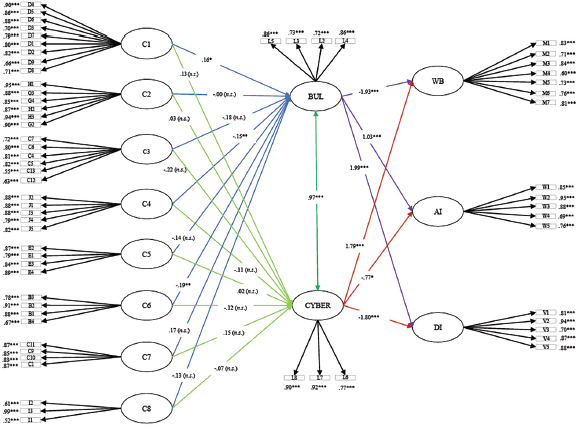
Note: C1: violence indicators in the institution; C2: institutional policies and practices to combat violence; C3: institutional student engagement; C4: institutional embracement of diversity; C5: institutional policies to promote psychological well-being; C6: perception of institutional safety; C7: teachers’ student engagement; C8: perceived social and institutional support; BUL: bullying victimization; CYBER: cyberbullying victimization; WB: well-being; AI: anxiety indicators; DI: depression indicators. ***p < .000, **p < .01; *p < .05.
Furthermore, we explored the relationship between bullying and cyberbullying victimization and well-being, as well as anxiety and depression indicators. We identified moderate effects of bullying victimization on depression indicators (β = 1.99, p < .001), well-being (β = -1.93, p < .001), and anxiety indicators (β = 1.03, p < .001), confirming the H2. The cyberbullying victimization dimension also had a significantly moderate effect on depression indicators (β = -1.80, p < .001), well-being (β = 1.79, p < .001), and anxiety indicators (β = -.77, p < .001). However, such effects were contradictory to those pointed out in the literature. Regarding literature evidence, we also found a correlation between bullying and cyberbullying victimization (r = .97, p < .001).
DISCUSSION
The results show a significant association between institutional climate and bullying/cyberbullying victimization, as demonstrated in the literature (Zych et al., 2019). Only indicators of violence within the institution showed a positive association with bullying and cyberbullying victimization. Although this relationship may be cyclical—a more positive climate reduces violence, and reduced violence may improve the climate—the literature shows that a positive institutional environment predicts lower bullying and cyberbullying victimization (Zych et al., 2019). We, therefore, explored this relationship by examining whether different dimensions of institutional ethical climate explained lower bullying levels. The analyzed model showed that three of the eight dimensions of institutional ethical climate explained bullying occurrence, partially confirming Hypothesis 1: perception of institutional safety, institutional embracement of diversity, and indicators of violence within the institution.
The “perception of institutional safety” explained lower levels of bullying victimization, consistent with the literature (Álvarez-García et al., 2015; Jenaro et al., 2018; Tashkandi et al., 2023; Zych et al., 2019). A sense of safety helps individuals feel comfortable within the institution, particularly those belonging to minority groups, while also inhibiting aggressive behaviors. In environments perceived as safe, there is greater confidence to confront violent situations, whether concerning oneself or others, and to seek help (Yano et al., 2021), as well as to strengthen respect and inclusion (Zych et al., 2019).
“Institutional embracement of diversity” also proved to be a protective factor against bullying. Belonging to minority groups may be a risk factor for bullying (Lewis & Ericksen, 2016; Lund & Ross, 2017; Menesini & Salmivalli, 2017; Myers & Cowie, 2016; Panúncio-Pinto et al., 2019; West, 2015). Culturally constructed and socially reproduced bias may motivate or contribute to making individuals from underrepresented groups more vulnerable to bullying, which in this case is termed bias-based bullying (BBB) in the literature (Eisenberg et al., 2021). It is therefore essential to understand the characteristics of the university community to identify potential risk factors. The sample in this study consisted predominantly of white, heterosexual students from moderate socioeconomic backgrounds with no special needs.
Although access to higher education in Brazil has become more democratic, particularly in recent decades, it remains an elitist level of education (Basso-Poletto et al., 2020). This means that inclusion policies, respect, and embracement of diversity require greater attention, ensuring not only access but also student retention. The latter materializes not only through academic aspects but also social, emotional, and moral ones. Moreover, policies and practices should recognize the intersectionality present in these experiences (Tashkandi et al., 2023), which may influence both the likelihood of occurrence and the different, complex impacts of victimization. That is, an individual may belong to different vulnerable groups, experiencing a multifaceted situation that requires a qualitative perspective, often not captured by statistical analyses (Panúncio-Pinto et al., 2019; Schihalejev et al., 2020).
The dimension “violence indicators in the institution” also showed a positive association with bullying victimization. The literature demonstrates this relationship by showing that environments with higher rates of violent hazing, sexual, verbal, and moral harassment, racism, homophobia, ableism, and other forms of discrimination may contribute to bullying, whether traditional or virtual (Azeredo et al., 2015; Trombini-Frick, Zechi & Cortez, 2023). Studies on polyvictimization suggest that experiencing one type of violence may be a risk factor for exposure to other forms of violence (Aizpurua et al., 2021; Cénat et al., 2021). We emphasize that our study focuses on macro-level environmental characteristics, rather than individual-level ones as in polyvictimization studies. This relationship still needs further exploration in analyses of institutional climate and bullying.
The dimensions “institutional policies and practices to combat violence”, “institutional student engagement”, “institutional policies to promote psychological well-being”, “teachers’ student engagement”, and “perceived social and institutional support” did not predict lower bullying victimization in the sample studied. Although we expected a predictive relationship, as indicated in the literature, we assume this result may be due to their indirect impact. Furthermore, these dimensions of institutional ethical climate may require improvement in terms of policies and practices to generate effective impact. As observed, institutional policies and practices to combat violence need to exist, be known, and be trusted to convey the message that the university stands against violence and works to inhibit and confront it (Álvarez-García et al., 2015; Gardner et al., 2016). Both “institutional student engagement” and “teachers’ student engagement” may act as indirect protective factors in preventing violence, including bullying and cyberbullying (Tashkandi et al., 2023). This occurs because when the institution, or specifically teachers, engage with students’ academic performance, they can identify difficulties associated with coexistence issues while also helping students feel more confident and engaged in their studies and the institution itself. And academic performance is a predictor of lower bullying victimization (Kljakovic & Hunt, 2016; Zych et al., 2019).
“Perceived social and institutional support” may be more relevant for mitigating the consequences of victimization and promoting victims’ well-being than for preventing bullying, although the literature provides evidence for both situations (Azeredo et al., 2015; Gaffney et al., 2021; Tashkandi et al., 2023; Zych et al., 2019). Similarly, “institutional policies to promote psychological well-being” did not explain lower levels of bullying victimization. As hypothesized for the previous variables, in this sample this indicator may be more relevant for mitigating the consequences of victimization (Gaffney et al., 2021).
Cyberbullying victimization was not explained by the dimensions of institutional ethical climate. We assume that the fact that some dimensions explained bullying victimization but not cyberbullying victimization is due to the latter occurring in the virtual environment. Although social relationships in this space are connected to the real world, it is not always easy to perceive and understand the impact of one dimension on another or the degree of proximity between them (Trombini-Frick, Zechi & Cortez, 2023). Indeed, when analyzed in isolation, cyberbullying appears distanced from the institutional context, and the institutional climate, in its macro dimensions, appears not to influence its occurrence. The model analyzed via SEM revealed a strong correlation between bullying and cyberbullying, almost as if they were the same variable, despite initial correlation analysis indicating a moderate relationship between them. The results therefore suggest the need to consider these two forms of victimization in an integrated manner.
The analyzed model also partially confirmed the second hypothesis. As indicated in the literature, we found that bullying victimization moderately explains well-being indicators (Giovazolias & Malikiosi-Loizos, 2016; Yubero et al., 2023), and is negatively associated with anxiety and depression (Aricak, 2016; Pörhölä et al., 2019; Reid et al., 2016). Regarding cyberbullying, we found contradictory effects: the analyzed model indicated a positive relationship with well-being and negative relationships with anxiety and depression indicators. That is, the greater the cyberbullying victimization, the higher the reported well-being and the lower the anxiety and depression scores. Contrary to these findings, the literature suggests that cyberbullying reduces well-being (Bussu et al., 2025; Kwan et al., 2020; Yubero et al., 2023) and contributes to higher levels of depression (Jenaro et al., 2018; C. Li et al., 2024; Resett & Putallaz, 2018) and anxiety (Castro Castañeda et al., 2020; Myers & Cowie, 2019; West, 2015).
One possible explanation for this finding involves the intersection between bullying and cyberbullying. Individuals experiencing both forms of victimization may suffer more intense mental health impacts, manifesting higher levels of depression and anxiety (C. Li et al., 2024). On the other hand, victimization exclusively in the virtual environment may not compromise overall well-being, allowing victims to maintain a positive perception of their offline lives. This result is consistent with the initial correlation analysis, which identified statistically significant associations between bullying victimization and anxiety/depression levels (both negative) and a positive correlation with well-being. Cyberbullying victimization only showed a statistically significant correlation with well-being, which was weak and negative.
Another hypothesis is that individuals exposed to cyberbullying are developing coping mechanisms that reduce mental health impacts. Cyberbullying occurs in digital environments, which may allow some emotional distancing from the aggression and provide temporary relief. Victims can disconnect from or block aggressors, as well as seek support in online communities with similar experiences. This social support may mitigate negative impacts and even promote increased well-being (Vogt & Trombini-Frick, 2024). The visibility of cyberbullying on social networks may also raise awareness and mobilize institutional resources, resulting in interventions that reduce feelings of isolation. Moreover, some victims may feel empowered when reporting online aggression, promoting a sense of control and empowerment.
Bullying, in turn, constitutes attacks in physical contexts, potentially resulting in intense and immediate suffering. Aggressions, whether physical or emotional, tend to negatively affect victims’ self-image and self-esteem. Students who experience bullying frequently suffer social rejection, loneliness, and exclusion-critical factors in reducing well-being. The constant fear of new aggressions harms mental health and academic performance, perpetuating a cycle of emotional deterioration. Furthermore, bullying may lead to the internalization of stigma, making victims believe they deserve the treatment received, which intensifies feelings of depression and hopelessness (Li et al., 2024).
Thus, differences in cyberbullying and bullying on mental health may be attributed to the nature of interactions (mediated vs. direct), type of available support (virtual vs. face-to-face), and victims’ emotional responses. While cyberbullying may, in some contexts, generate support and empowerment opportunities, bullying tends to result in direct suffering and social exclusion, with substantial negative impacts on well-being, potentially increasing anxiety and depression levels. These findings and considerations should be interpreted cautiously, as the literature shows that cyberbullying victims may have greater difficulty predicting and avoiding aggressions, which can occur at any time and have a much broader reach, leaving victims more vulnerable than in traditional bullying situations (Li et al., 2024; Patchin & Hinduja, 2015; Smith, 2012; Smith et al., 2012). Understanding these dynamics, particularly among university students, is essential for developing prevention and intervention strategies in educational and digital environments (Campbell, 2016).
We emphasize that this interpretation applies to the studied sample (face-to-face education). However, with the increasing virtualization of social interactions, cyberbullying’s impact may become more predominant. It is also crucial not to minimize cyberbullying’s effects on individuals, particularly those with conditions limiting face-to-face socialization, as in these cases, the absence of in-person interactions may increase virtual environment victimization impacts. A meta-analysis by Li et al. (2024) on bullying and cyberbullying’s mental health impacts on children and adolescents showed that experiencing both victimizations considerably increases risks for suicidal ideation and attempts, self-harm, and depression.
Based on the evidence presented, we recommend developing and promoting policies and practices that foster safe environments embracing diversity and confronting violence. Specifically, we suggest strategies demonstrating to the university community that dignity and respect for human life are fundamental values that can be experienced in interpersonal relationships. This involves developing policies and practices ensuring not only physical but also psychological safety (Álvarez-García et al., 2015; Jenaro et al., 2018; Souza et al., 2018; Tashkandi et al., 2023; Zych et al., 2019). It is essential that people perceive the institution cares and is committed to creating an environment that deters violent situations, promotes good coexistence, and ensures safety and freedom of movement. This requires adequate infrastructure to guarantee access, retention, and inclusive development, particularly for people with special needs and minority groups, plus spaces and trained professionals for effective psychological, pedagogical, and social support. As evidenced, promoting safe environments goes beyond implementing cameras, security personnel, and strategies inhibiting weapon carrying or unauthorized entry (Yano et al., 2021).
Human diversity should also be valued and experienced in interpersonal relationships (Esteves, 2019; Schultze-Krumbholz et al., 2020). Educational institutions must adopt policies and practices valuing inclusion and diversity, promoting respect, and recognizing and addressing different needs (Aizpurua et al., 2021; Esteves, 2019; Gaffney et al., 2021; Schultze-Krumbholz et al., 2020; Trombini-Frick, Zechi, Stelko-Pereira et al., 2023). Representatives from different groups should hold positions and participate in deliberative and consultative activities. All violence or bias manifestations should be curbed through effective policies and practices. Institutions can promote migrant integration policies, provide specialized centers for pedagogical guidance for people with special needs or different educational requirements, and foster discussion groups and collectives involving diverse educational community members, addressing and celebrating diversity and inclusion while maintaining cultural, sports, and leisure spaces encouraging coexistence. They may also implement specialized policies and professionals to support and guide violence against underrepresented groups (Lund & Ross, 2017; Myers & Cowie, 2016).
Additionally, institutions should develop policies and practices for effectively confronting different forms of violence, created with educational community participation. Furthermore, it is crucial to promote relationships based on respect, justice, cooperation, solidarity, empathy, and mutual aid (Trombini-Frick, Zechi, Stelko-Pereira et al., 2023). Reporting channels and guidance on confronting violence, including bullying and cyberbullying, should be widely known, objective, and easily accessible (Cismaru & Cismaru, 2018). Universities should invest in training the community (students, teachers, and technical staff) to provide effective, safe assistance in victimization situations (Lund & Ross, 2017). Institutional policies and practices should consider legal aspects of face-to-face and online aggressions, as well as different manifestation and confrontation dynamics (Campbell, 2016; Myers & Cowie, 2016). Moreover, they should better investigate and consider differences between virtual and physically occurring violence.
In summary, we advocate institutions promote practices enabling the experience of moral values like human dignity, respect, solidarity, cooperation, and dialogue in relationships, with institutional policies using these values as guiding principles. This may foster both practice and reflective processes, internalizing moral values, contributing to subjects’ moral autonomy development (Kohlberg, 1992; La Taille, 2019; Menin, 2019; Piaget, 1932/1994), ethical civic formation (Naval et al., 2011), and a more just and inclusive society.
CONCLUSIONS
In this study, we verified whether the campus climate and its dimensions predict reduced bullying and cyberbullying victimization; and investigated if bullying and cyberbullying victimizations impact students’ well-being, anxiety, and depression indicators. The findings demonstrate that a positive institutional climate, particularly regarding perceptions of safety, institutional embracement of diversity, and reduction of violence indicators, is associated with decreased bullying incidents. However, cyberbullying was not directly explained by institutional climate dimensions, suggesting its virtual nature requires specific approaches. Furthermore, bullying victimization was confirmed to negatively impact students’ mental health, with significant effects on anxiety and depression levels. Cyberbullying showed a paradoxical relationship with mental health, potentially due to coping mechanisms and social support available in virtual environments for this sample.
This study has several limitations that warrant consideration. Primarily, the sample consisted predominantly of white, heterosexual students, which may limit the generalizability of findings to minority groups. Future studies should include greater representation of these groups to permit a more comprehensive analysis of specific intersectionalities and vulnerabilities. Additionally, as the research was conducted at a public university, replications with private institution cohorts from other regions or countries could enhance understanding of the observed dynamics. Longitudinal studies would be valuable to examine the relationships between institutional climate, victimization, and mental health over time. Finally, expanding the sample size would improve understanding of cyberbullying victimization effects on university students’ mental health.
This study advances understanding of the relationships between institutional climate, victimization, and student mental health, providing evidence to inform preventive strategies and interventions that promote well-being and ethical coexistence in university settings. Institutions should adopt an ecological approach that considers legal, community, family, and individual factors when addressing bullying and cyberbullying, given their complexity. Active engagement of the educational community in developing and implementing these policies is essential for their effectiveness. Systematic, ongoing evaluations like this can serve as valuable tools in this process. Moreover, they may help institutions assess how well their policies and practices align with values education or education for ethical coexistence, thereby fostering moral autonomy among students and other community members.
ACKNOWLEDGEMENTS
The author acknowledges the Goldsmiths, University of London, especially Professor Peter K. Smith (in memoriam), for welcoming her as a visiting professor in the Department of Psychology. The author acknowledges financial support from the Brazilian Federal Foundation for Support and Evaluation of Graduate Education—CAPES with a Scholarship to a Visitant Professor from the CAPES—PRINT Program (Grant Process number 88887.935606/2024-00). No further funding was associated with this research.
DECLARATION OF COMPETING INTERESTS
The author declares no potential conflicts of interest from commercial or financial relationships during this research.
REFERENCES
Aizpurua, Eva; Caravaca-Sánchez, Francisco, & Stephenson, Andrew. (2021). Victimization status of female and male college students in Spain: Prevalence and relation to mental distress. Journal of Interpersonal Violence, 36, 1–23. https://doi.org/10.1177/0886260518802848
Álvarez-García, David; García, Trinidad, & Núñez, José C. (2015). Predictors of school bullying perpetration in adolescence: A systematic review. Aggression and Violent Behavior, 23, 126–136. https://doi.org/10.1016/j.avb.2015.05.007
Arıcak, Osman T. (2016). The relationship between mental health and bullying. En Helen Cowie, & Carrie A. Myers (Eds.), Bullying among university students: Cross-national perspectives (pp. 76–90). Routledge.
Azeredo, Catarina M.; Rinaldi, Ana Elisa M.; de Moraes, Claudia L.; Levy, Renata B., & Menezes, Paulo R. (2015). School bullying: A systematic review of contextual-level risk factors in observational studies. Aggression and Violent Behavior, 22, 65–76. https://doi.org/10.1016/j.avb.2015.04.006
Barrio, Cristina del; Martín, Elena; Montero, Ignacio; Gutiérrez, Héctor; Barrios, Ángela, & de Dios Pérez, María. (2008). Bullying and social exclusion in Spanish secondary schools: National trends from 1999 to 2006. International Journal of Clinical and Healthy Psychology, 8(3), 657–677. http://www.redalyc.org/comocitar.oa?id=33712016003
Basso-Poletto, Daniela; Efrom, Cora, & Beatriz-Rodrigues, Maria. (2020). Ações afirmativas no ensino superior: Revisão quantitativa e qualitativa de literatura. Revista Electrónica Educare, 24(1), 292–325. https://doi.org/10.15359/ree.24-1.16
Bibi, Akhtar; Blackwell, Simon E., & Margraf, Jürgen. (2021). Mental health, suicidal ideation, and experience of bullying among university students in Pakistan. Journal of Health Psychology, 26(8), 1185–1196. https://doi.org/10.1177/1359105319869819
Brown, Timothy. (2015). Confirmatory factor analysis for applied research (2nd ed.). Guilford Press.
Bussu, Anna; Pulina, Manuela; Ashton, Sally-Ann; Mangiarulo, Marta, & Molloy, Ellie. (2025). Cyberbullying and cyberstalking victimisation among university students: A narrative systematic review. International Review of Victimology, 31(1), 59–90. https://doi.org/10.1177/02697580241257217
Calvete, Esther; Orue, Izaskun; Estévez, Ana; Villardón, Lourdes, & Padilla, Patricia. (2010). Cyberbullying in adolescents: Modalities and aggressors’ profile. Computers in Human Behavior, 26(5), 1128–1135. https://doi.org/10.1016/j.chb.2010.03.017
Campbell, Marilyn. (2016). Policies and procedures to address bullying at Australian universities. En Helen Cowie, & Carrie A. Myers (Eds.), Bullying among university students: Cross-national perspectives (pp. 157–171). Routledge.
Castro Castañeda, Remberto; Vargas Jiménez, Esperanza, & Ciambelli Romero, Hugo C. (2020). Variables individuales y sociales en estudiantes universitarios ciberacosadores. Dilemas Contemporáneos: Educación, Política y Valores, 8(SPE5). https://doi.org/10.46377/dilemas.v8i.2502
Cénat, Jude M.; Smith, Kevin; Hébert, Martine, & Derivois, Daniel. (2021). Polyvictimization and cybervictimization among college students from France: The mediation role of psychological distress and resilience. Journal of Interpersonal Violence, 36(17–18), NP9252-NP9271. https://doi.org/10.1177/0886260519854554
Cismaru, Magdalena, & Cismaru, Romulus. (2018). Protecting university students from bullying and harassment: A review of the initiatives at Canadian universities. Contemporary Issues in Education Research (CIER), 11(4), 145–152. https://doi.org/10.19030/cier.v11i4.10208
Del Rey, Rosario; Casas, José A.; Ortega-Ruiz, Rosario; Schultze-Krumbholz, Anja; Scheithauer, Herbert; Smith, Peter; Thompson, Fran; Barkoukis, Vassilis; Tsorbatzoudis, Haralambos; Brighi, Antonella; Guarani, Annalisa; Pyżalski, Jacek, & Plichta, Piotr. (2015). Structural validation and cross-cultural robustness of the European Cyberbullying Intervention Project Questionnaire. Computers in Human Behavior, 50, 141–147. https://doi.org/10.1016/j.chb.2015.03.065
Diener, Ed; Wirtz, Derrick; Biswas-Diener, Robert; Tov, William; Kim-Pietro, Chu; Choi, Dong-won, & Oishi, Shigehiro. (2009). New measures of well-being. En Ed Diener (Ed.), Assessing well-being (pp. 247–266). Springer. https://doi.org/10.1007/978-90-481-2354-4_12
DiStefano, Christine, & Morgan, Grant B. (2014). A comparison of diagonal weighted least squares robust estimation techniques for ordinal data. Structural Equation Modeling, 21(3), 425–438. https://doi.org/10.1080/10705511.2014.915373
Eisenberg, Marla E.; Gower, Amy L.; Brown, Camille; Nam, Yoon-Sung, & Ramirez, Marizen R. (2021). School-based diversity education activities and bias-based bullying among secondary school students. Journal of Interpersonal Violence, 37(17–18). https://doi.org/10.1177/08862605211025016
Esteves, Pâmela. (2019). O bullying no contexto brasileiro: Notas e referências. Revista Educativa-Revista de Educação, 22, e6626-e6626. https://doi.org/10.18224/educ.v22i1.6626
Fonseca, Kellma B. C.; Micucci, Marina D.; Costa, Patrícia D. S.; Lemes, Sirlei; Santos, Nálbia D. A., & Cunha, Jacqueline V. A. D. (2017). Incidência do bullying nos cursos de administração e ciências contábeis. Psicologia Escolar e Educacional, 21, 79–92. https://doi.org/10.1590/2175-3539201702111079
Fonseca, Patrícia N. D.; Nascimento, Bruna D. S.; Barbosa, Larisse H. G. M.; Vione, Katia C., & Gouveia, Valdinei V. (2015). Flourishing scale: Evidence of its suitability to the Brazilian context. Social Inquiry Into Well-Being, 1(2). https://doi.org/10.13165/SIIW-15-1-2-07
Frick, Loriane T., & Zechi, Juliana Aparecida M. (2020). Bullying entre estudantes universitários. En Paula I. C. Gomide, & Ana Carina Stelko-Pereira (Orgs.), Bullying - perspectivas e propostas nacionais de intervenção (pp. 59–72). Juruá. https://doi.org/10.24824/978854443571.7
Gaffney, Hanna; Ttofi, Maria M., & Farrington, David P. (2021). Effectiveness of school-based programs to reduce bullying perpetration and victimization: An updated systematic review and meta-analysis. Campbell Systematic Reviews, 17(2), e1143. https://doi.org/10.1002/cl2.1143
Gardner, Dianne; O’Driscoll, Michael; Cooper-Thomas, Helena D.; Roche, Maree; Bentley, Tim; Catley, Bevan; Teo, Stephen T. T., & Trenberth, Linda. (2016). Predictors of workplace bullying and cyber-bullying in New Zealand. International Journal of Environmental Research and Public Health, 13(5), 448. https://www.mdpi.com/1660-4601/13/5/448
Garvey, Jason C.; Squire, Dian D.; Stachler, Brett, & Rankin, Susan. (2018). The impact of campus climate on queer-spectrum student academic success. Journal of LGBT Youth, 15(2), 89–105. https://doi.org/10.1080/19361653.2018.1429978
Giovazolias, Theodoros, & Malikiosi-Loizos, Maria. (2016). Bullying at Greek universities: An empirical study. En Helen Cowie, & Carrie A. Myers (Eds.), Bullying among university students (pp. 110–126). Routledge.
Goodwin, Laura D., & Leech, Nancy L. (2006). Understanding correlation: Factors that affect the size of r. The Journal of Experimental Education, 74(3), 249–266. https://doi.org/10.3200/JEXE.74.3.249-266
Hemer, Kevin M.; Reason, Robert D., & Ryder, Andrew J. (2019). Factors shaping students’ perceptions of campus climate for civic learning and engagement. Journal of Student Affairs Research and Practice, 56(5), 477–491. https://doi.org/10.1080/19496591.2019.1676763
Jenaro, Cristina; Flores, Noelia, & Frías, Cinthia P. (2018). Systematic review of empirical studies on cyberbullying in adults: What we know and what we should investigate. Aggression and Violent Behavior, 38, 113–122. https://doi.org/10.1016/j.avb.2017.12.003
Kljakovic, Moja, & Hunt, Caroline. (2016). A meta-analysis of predictors of bullying and victimisation in adolescence. Journal of Adolescence, 49, 134–145. https://doi.org/10.1016/j.adolescence.2016.03.002
Kohlberg, Lawrence. (1992). Psicología del desarrollo moral (Trad. Asun Zubiaur Zárate). Desclée de Brouwer.
Kroenke, Kurt; Spitzer, Robert L., & Williams, Janet B. (2001). The PHQ-9: Validity of a brief depression severity measure. Journal of General Internal Medicine, 16(9), 606–613. https://doi.org/10.1046/j.1525-1497.2001.016009606.x
Kroenke, Kurt; Spitzer, Robert L., & Williams, Janet B. (2003). The Patient Health Questionnaire-2: validity of a two-item depression screener. Med Care, 41(11), 1284–92. https://doi.org/10.1097/01.MLR.0000093487.78664.3C
Kwan, Irene; Dickson, Kelly; Richardson, Michelle; MacDowall, Wendy; Burchett, Helen; Stansfield, Claire; Brunton, Ginny; Sutcliffe, Katy, & Thomas, James. (2020). Cyberbullying and children and young people’s mental health: A systematic map of systematic reviews. Cyberpsychology, Behavior, and Social Networking, 23(2), 72–82. https://doi.org/10.1089/cyber.2019.0370
La Taille, Yves. (2019). A deliberação moral: Dimensões intelectuais e afetivas. Revista de Educação, 24(1), 5–14. https://doi.org/10.24220/2318-0870v24n1a4232
Lewis, Marilyn W., & Ericksen, Kirsten S. (2016). Improving the climate for LGBTQ students at an Historically Black University. Journal of LGBT Youth, 13(3), 249–269. https://doi.org/10.1080/19361653.2016.1185761
Li, Chao; Wang, Ping; Martin-Moratinos, Marina; Bella-Fernández, Marcos, & Blasco-Fontecilla, Hilario. (2024). Traditional bullying and cyberbullying in the digital age and its associated mental health problems in children and adolescents: A meta-analysis. European Child & Adolescent Psychiatry, 33(9), 2895–2909. https://doi.org/10.1007/s00787-022-02128-x
Li, Cheng-Hsien. (2016). Confirmatory factor analysis with ordinal data: Comparing robust maximum likelihood and diagonally weighted least squares. Behavioral Research Methods, 48(3), 936–49. https://doi.org/10.3758/s13428-015-0619-7
Lima, Daniel H., & Peres, Maria Fernanda T. (2022). Research on the school climate and health in Brazil-a scope review. Ciência & Saúde Coletiva, 27(9), 3475–3485. https://doi.org/10.1590/1413-81232022279.21842021
Lund, Emily M., & Ross, Scott W. (2017). Bullying perpetration, victimization, and demographic differences in college students: A review of the literature. Trauma, Violence, & Abuse, 18(3), 348–360. https://doi.org/10.1177/1524838015620818
Marchante, Marta; Coelho, Vítor A., & Romão, Ana M. (2022). The influence of school climate in bullying and victimization behaviors during middle school transition. Contemporary Educational Psychology, 71, 102111. https://doi.org/10.1016/j.cedpsych.2022.102111
Menesini, Ersilia, & Salmivalli, Christina. (2017). Bullying in schools: The state of knowledge and effective interventions. Psychology, Health & Medicine, 22(sup1), 240–253. https://doi.org/10.1080/13548506.2017.1279740
Menin, Maria Suzana S. (2019). Adesão a valores sociomorais na contemporaneidade: Um estudo com escolares de Ensino Fundamental e Médio. Schème - Revista Eletrônica de Psicologia e Epistemologia Genéticas, 11, 86–122. https://doi.org/10.36311/1984-1655.2019.v11esp.05.p86
Myers, Carrie-Anne, & Cowie, Helen. (2016). How can we prevent and reduce bullying amongst university students? International Journal of Emotional Education, 8(1), 109–119. https://www.um.edu.mt/library/oar//handle/123456789/10006
Myers, Carrie-Anne, & Cowie, Helen. (2019). Cyberbullying across the lifespan of education: Issues and interventions from school to university. International Journal of Environmental Research and Public Health, 16(7), 1217. https://doi.org/10.3390/ijerph16071217
Naval, Concepción; García, Rafaela; Puig, José, & Anxo Santos, Miguel. (2011). La formación ético-cívica y el compromiso social de los estudiantes universitarios. Encounters on Education, 12. https://doi.org/10.24908/eoe-ese-rse.v12i0.3174
Olweus, Dan. (2013). School bullying: Development and some important challenges. Annual Review of Clinical Psychology, 9, 751–780. https://doi.org/10.1146/annurev-clinpsy-050212-185516
Panúncio-Pinto, Maria Paula; Alpes, Matheus F., & Colares, Maria de Fátima. (2019). Interpersonal violence/bullying situations at the university: Academic daily life clippings among students from undergraduate health programs. Revista Brasileira de Educação Médica, 43(1), 537–546. https://doi.org/10.1590/1981-5271v43suplemento1-20190060.ING
Patchin, Justin W., & Hinduja, Sammer. (2015). Measuring cyberbullying: Implications for research. Aggression and Violent Behavior, 23, 69–74. https://doi.org/10.1016/j.avb.2015.05.013
Peled, Yehuda. (2019). Cyberbullying and its influence on academic, social, and emotional development of undergraduate students. Heliyon, 5(3). https://doi.org/10.1016/j.heliyon.2019.e01393
Piaget, Jean. (1932/1994). O juízo moral na criança (4. ed). Summus.
Pörhölä, Maili; Almonkari, Merja, & Kunttu, Kristina. (2019). Bullying and social anxiety experiences in university learning situations. Social Psychology of Education, 22(3), 723–742. https://doi.org/10.1007/s11218-019-09496-4
Reid, Gerald M.; Holt, Melissa K.; Bowman, Chelsey E.; Espelage, Dorothy L., & Green, Jennifer G. (2016). Perceived social support and mental health among first-year college students with histories of bullying victimization. Journal of Child and Family Studies, 25(11), 3331–3341. https://doi.org/10.1007/s10826-016-0477-7
Resett, Santiago, & Putallaz, Paula R. (2018). Cybervictimización y cyberagresión en estudiantes universitarios: Problemas emocionales y uso problemático de nuevas tecnologías. Revista Psicodebate: Psicología, Cultura y Sociedad, 18(2), 38–50. https://www.scielo.org.ar/scielo.php?script=sci_arttext&pid=S2451-66002018000200003&lng=es&tlng=es
Ryder, Andrew J., & Mitchell, Joshua J. (2013). Measuring campus climate for personal and social responsibility. New Directions for Higher Education, 2013(164), 31–48. https://doi.org/10.1002/he.20074
Schihalejev, Olga; Kuusisto, Arniika; Vikdahl, Linda, & Kallioniemi, Arto. (2020). Religion and children’s perceptions of bullying in multicultural schools in Estonia, Finland and Sweden. Journal of Beliefs & Values, 41(3), 371–384. https://doi.org/10.1080/13617672.2019.1686732
Schultze-Krumbholz, Anja; Ittel, Angela, & Scheithauer, Herbert. (2020). The association between in-class cultural diversity with empathy and bullying in adolescence: A multilevel mediation analysis. International Journal of Psychology, 55(5), 769–778. https://doi.org/10.1002/ijop.12700
Sheldon, Elena; Simmonds-Buckley, Melanie; Bone, Claire; Mascarenhas, Thomas; Chan, Natalie; Wincott, Megan; Gleeson, Hannah; Sow, Karmen; Hind, Daniel, & Barkham, Michael. (2021). Prevalence and risk factors for mental health problems in university undergraduate students: A systematic review with meta-analysis. Journal of Affective Disorders, 287, 282–292. https://doi.org/10.1016/j.jad.2021.03.054
Smith, Peter K. (2012). Cyberbullying: Challenges and opportunities for a research program—A response to Olweus. European Journal of Developmental Psychology, 9(5), 553–558. https://doi.org/10.1080/17405629.2012.689821
Smith, Peter K.; Del Barrio, Cristina, & Tokunaga, Robert S. (2012). Definitions of bullying and cyberbullying: How useful are the terms? En Sheri Bauman, Danna Cross, & Jenny Walker (Eds.), Principles of cyberbullying research: Definitions, measures, and methodology (pp. 26–40). Routledge.
Souza, Sidclay B.; Ferreira, Paula C.; Veiga Simão, Ana V., & Falla, Daniel. (2022). The dynamic of cyberbullying in university students: Moderating effects of gender and culture. REMIE: Multidisciplinary Journal of Educational Research, 12(3), 322–348. http://dx.doi.org/10.447/remie.8999
Souza, Sidclay B.; Veiga Simão, Ana M.; Ferreira, Aristides I., & Ferreira, Paula C. (2018). University students’ perceptions of campus climate, cyberbullying and cultural issues: Implications for theory and practice. Studies in Higher Education, 43(11), 2072–2087. https://doi.org/10.1080/03075079.2017.1307818
Souza, Sidclay B.; Veiga Simão, Ana M., & Ferreira, Paula C. (2019). Campus climate: The role of teacher support and cultural issues. Journal of Further and Higher Education, 43(9), 1196–1211. https://doi.org/10.1080/0309877X.2018.1467387
Spitzer, Robert L.; Kroenke, Kurt; Williams, Janet B., & Löwe, Bernd. (2006). A brief measure for assessing generalized anxiety disorder: The GAD-7. Archives of Internal Medicine, 166(10), 1092–1097. https://doi.org/10.1001/archinte.166.10.1092
Tashkandi, Yara; Hirsch, Jennifer S.; Kraus, Emily; Schwartz, Rachel, & Walsh, Kate. (2023). A Systematic review of campus characteristics associated with sexual violence and other forms of victimization. Trauma, Violence, & Abuse, 24(3), 1777–1796. https://doi.org/10.1177/15248380221078893
Thapa, Amrit; Cohen, Jonathan; Guffey, Shawn, & Higgins-D’Alessandro, Ann. (2013). A review of school climate research. Review of Educational Research, 83(3), 357–385. https://doi.org/10.3102/0034654313483907
Trombini-Frick, Loriane; Zechi, Juliana A. M., & Cortez, Pedro A. (2023). Cyberbullying entre estudantes universitários brasileiros: Evidências sobre o fenômeno e sua relação com a educação para a convivência ética. Schème: Revista Eletrônica de Psicologia e Epistemologia Genéticas, 15(1), 176–207. https://doi.org/10.36311/1984-1655.2023.v15.n1.p176-207
Trombini-Frick, Loriane; Zechi, Juliana A. M.; Stelko-Pereira, Ana Carina; Yano, Vitor A.; Cunha, Josafá M., & Cortez, Pedro A. (2023). Escala de Clima Ético Universitário (ECEU): Propriedades psicométricas. Revista Portuguesa de Educação, 36(2), e23044. https://doi.org/10.21814/rpe.31246
Vaill, Zoe; Campbell, Marily, & Whiteford, Chrystal. (2020). An analysis of British university student anti-bullying policies: How British universities compare with Australian universities. Policy Reviews in Higher Education, 5(1), 73–88. https://doi.org/10.1080/23322969.2020.1825990
Vinha, Telma P.; Morais, Alessandra; Tognetta, Luciene R. P.; Azzi, Roberta G.; Aragão, Ana Maria F. D.; Marques, Carolina D. A. E.; Silva, Lívia M. F.; Moro, Adriano; Vivaldi, Flávia M. C.; Ramos, Adriana M.; Oliveira, Mariana T. A., & Bozza, Thais C. L. (2016). School climate and respectful coexistence in educational institutions. Estudos em Avaliação Educacional, 27(64), 96–127. https://doi.org/10.18222/eae.v27i64.3747
Vogt, Rodrigo L., & Trombini-Frick, Loriane. (2024). Cyberbullying e suporte social percebido: Evidências e relações na percepção de estudantes universitários brasileiros. Revista @mbienteeducação, 17(00), e023057. https://doi.org/10.26843/ae.v17i00.1339
West, Dean. (2015). An investigation into the prevalence of cyberbullying among students aged 16–19 in post-compulsory education. Research in Post-Compulsory Education, 20(1), 96–112. https://doi.org/10.1080/13596748.2015.993879
Yano, Vitor A. N.; Frick, Loriane T.; Stelko-Pereira, Ana Carina; Zechi, Juliana A. M.; Amaral, Enzo L.; da Cunha, Josafá M., & Cortez, Pedro A. (2021). Validity evidence for the multidimensional scale of perceived social support at university and safety perception at campus questionnaire. International Journal of Educational Research, 107, 101756. https://doi.org/10.1016/j.ijer.2021.101756
Yubero, Santiago; de las Heras, Marta; Navarro, Raúl, & Larrañaga, Elisa. (2023). Relations among chronic bullying victimization, subjective well-being and resilience in university students: A preliminary study. Current Psychology, 42(2), 855–866. https://doi.org/10.1007/s12144-021-01489-x
Zhao, Zhanfeng; Liu, Guangzeng; Nie, Qian; Teng, Zhaojun; Cheng, Gang, & Zhang, Dajun. (2021). School climate and bullying victimization among adolescents: A moderated mediation model. Children and Youth Services Review, 131, 106218. https://doi.org/10.1016/j.childyouth.2021.106218
Zych, Izabela; Farrington, David P., & Ttofi, Maria M. (2019). Protective factors against bullying and cyberbullying: A systematic review of meta-analyses. Aggression and Violent Behavior, 45, 4–19. https://doi.org/10.1016/j.avb.2018.06.008
LORIANE TROMBINI
Professor in the Department of Theory and Foundations of Education and permanent faculty member of the Graduate Program in Education at UFPR. Ph.D. in Education (UNESP). Member of the research group at the Observatory of Institutional Climate and Prevention of Violence in Educational Contexts – Xará, UFPR.
loriane.trombini@ufpr.br
https://orcid.org/0000-0002-4151-4329
FORMATO DE CITACIÓN
Trombini, Loriane. (2026). Institutional Ethical Climate, Bullying, and Mental Health: Evidence from Brazilian Undergraduates. Quaderns de Psicologia, 28(2), e2336. https://doi.org/10.5565/rev/qpsicologia.2336
HISTORIA EDITORIAL
Recibido: 2025-05-22
1ª revisión: 2025-07-11
Aceptado: 2025-07-11
Publicado: 2026-08-17