Quaderns de Psicologia | 2026, Vol. 28, Nro. 2, e2301 | ISSN: 0211-3481 | 
 https://doi.org/10.5565/rev/qpsicologia.2301

Meaning of Work and Images of Old Age in Elderly-Related Services through Open Descriptors
Significado del trabajo e imágenes de la vejez en servicios para personas mayores a través de descriptores libres
Miguel Ángel Sahagún-Padilla
Paola del Rocío Villalobos Cárdenas
Universidad Autónoma de Aguascalientes
ABSTRACT
This study examines how meanings of work and images of old age are semantically connected in the representations of frontline personnel in elderly-related services. Open associative descriptors were collected from 240 workers in health care, residential care, day centers, and leisure services. Descriptors were coded by content and valence and analyzed through correspondence analysis to model the semantic field linking Meaning of Work (MoW) and Images of Old Age (IOA). Positively valenced descriptors predominated, especially for MoW. The most frequent MoW categories were Satisfaction and wellbeing, Commitment and motivation, and Ethics and humane behavior, while IOA was dominated by Experience, wisdom and legacy, and Warmth and kindness. Correspondence analysis revealed five coherent semantic sectors—Formality, Transactions, Relationships, Compassion, and Results—organizing how workers jointly conceptualize their occupational roles and older adults. Findings highlight the interdependence between work meanings and representations of aging, with implications for training, reflective practice, and organizational development.
Keywords: Frontline workers; Elderly-related services; Meaning of work; Ageism
RESUMEN
Este estudio examina cómo el significado del trabajo y las imágenes de la vejez se articulan semánticamente en el personal de primera línea de servicios para personas mayores. Se aplicaron descriptores asociativos abiertos a 240 trabajadores de servicios sanitarios, residenciales, centros de día y ocio, codificados por contenido y valencia. El análisis de correspondencias modeló el campo semántico que vincula el Significado del Trabajo (MoW) y las Imágenes de la Vejez (IOA). Predominaron los descriptores con valencia positiva, especialmente en MoW, donde las categorías más frecuentes fueron Satisfacción y bienestar, Compromiso y motivación, y Ética y trato humano; en IOA destacaron Experiencia, sabiduría y legado, y Calidez y amabilidad. Se identificaron cinco sectores semánticos —Formalidad, Transacciones, Relaciones, Compasión y Resultados— que articulan cómo los trabajadores conceptualizan su rol y a las personas mayores. Los hallazgos subrayan la interdependencia entre ambos dominios, con implicaciones para la formación, la reflexión y el desarrollo organizacional.
Palabras clave: Trabajadores de primera línea; Servicios relacionados con la tercera edad; Significado del trabajo; Edadismo
INTRODUCTION
Scholarly attention to the psychosocial dimensions of elderly care organizations has increased in recent years (e.g., Esmaeilzadeh & Oz, 2020; Kossek et al., 2019). Research addressing the meanings attributed to work and old age among personnel in such services is part of this broader interest and has a clear rationale. Studies on street-level bureaucrats—employees in public services who implement policies and programs at the operational level—show that workers who engage directly with service users play a decisive role in shaping how policies are enacted. The implementation of strategies, programs, and routines is largely contingent upon the practices of these frontline employees (Lipsky, 2010; Maupin, 1993). The transition from policy formulation to implementation is complex, with local culture and power relations as influential as the resources and technical knowledge (Ellis, 2015). Within it, meanings emerge as mediators of workers’ relationship with their professional roles (Engeström, 2014). Focusing on the meaning of working with older adults offers valuable insights into how concepts such as care and old age are constructed and transformed over time. The aim of this study is to examine how the meanings of work and old age are semantically related in the representations of frontline workers in elderly care, revealing the symbolic structures that connect professional identity with perceptions of aging.
Literature on Images of Old Age (IOA) within elderly-related services is focused on stereotypes (e.g., Bustillos-López & Fernández-Ballesteros, 2012; Franco et al., 2010; Hadjistavropoulos et al., 2000; Sarabia Cobo & Castanedo Pfeiffer, 2015). The Stereotype Content Model (Cuddy et al., 2005; Operario & Fiske, 2003) remains the most influential framework, synthesizing IOA along warmth and competence with older adults typically perceived as high in warmth but low in competence. Erdman Palmore (1999) identified nine recurrent traits shaping stereotypical representations of old age: ailment, cognitive impairment, depression, sickness, lack of mental health, ugliness, impotence, uselessness, and poverty. Subsequent research expanded this characterization to include dependency (Adams-Price & Morse, 2009; Angus & Reeve, 2006), childishness, nuisance, and idleness (Ansello, 1978), and disinterest (Romanov, 2014).
IOA are not confined to broad stereotypes. Stereotypes can also be examined as context-bound constructs, since different traits acquire relevance in different settings and social groups (Kornadt et al., 2016; Kornadt & Rothermund, 2011). Research conceptualizing IOA as context-dependent aims to emphasize the heterogeneity of representations surrounding old age. Studies on an activist group of older women in Canada illustrate how age-related meanings are redefined through collective action (Narushima, 2004; Sawchuk, 2009).
Barely examined regarding elderly-related services, the Meaning of Work (MoW) has been defined and studied through multiple conceptual lenses (Rosso et al., 2010), like the distinctions between instrumentality and expressivity (Morse & Weiss, 1955); values (Lyman, 1955); centrality and social norms (MoW International Research Team, 1987); meaningfulness (Pratt & Ashforth, 2003); and meanings as a life domain (Wrzesniewski et al., 2003). No single dimension can be privileged without reference to the specific context and research interests. Thus, MoW may be broadly defined as the dynamic ways individuals think and speak about, experience, and value their work life. Like IOA, these meaning structures form part of a semantic network through which individuals construct and relate to work experiences.
Research within elderly-related services that explicitly addresses meaning has focused on distinct objects, such as the service provided, withdrawal from care, job satisfaction, and professional competence. Deborah Kinnear et al. (2014) explored the meaning of dignified care among NHS professionals, defined as treating elders as individuals, ensuring their safety. Similarly, Anne Liveng (2012) described an “empathy at distance” in Danish elderly care employees, reflecting both anxiety toward the elders and a strong motivation for caregiving.
Turnover and nursing practice have also been analyzed in terms of meaning. A review by Margriet van Iersel et al. (2016) showed that nursing students perceive elderly care as an unattractive career path. Karin Blomberg et al. (2013) linked turnover among nurses to beliefs about older adults and feelings of limited influence over care delivery. Ayala Ben-Arie and Esther Iecovich (2014) similarly reported that working with elders with low functional status and cognitive impairment leads to stress and low job satisfaction among home care workers.
Other studies have addressed decision-making and professional competence. Campbell Killick and Brian Taylor (2009) found that elderly care professionals face moral dilemmas when dealing with abuse cases, requiring them to navigate ambiguity. Finally, Michael Kane et al. (2004) examined perceived adequacy among clinical social workers, showing that attitudes toward working with individuals with Alzheimer’s disease were the strongest predictor of self-assessed competence.
Meaning-making processes among professionals in elderly care have also been studied. Maria Wassermann et al. (2014) found that nurses’ capacity for meaning-making mediates the effects of working conditions on emotional exhaustion and vigor. Negotiating meaning also functions as a means of sustaining a positive professional identity. Annette Kamp and Pernille Bottrup (2009) identified four dimensions of meaning among home care assistants: being professional, being observant, acting as a nurse, and acting as a social care worker. Likewise, Elisabeth Häggström et al. (2005) observed a shift from dissatisfaction to satisfaction among Swedish nurses, facilitated by education, supervision, and open communication.
Broader frameworks have also emphasized the symbolic and relational dimensions of care. Catherine Buckley et al. (2014) proposed narrative practice as a means of understanding how professionals construct and sustain meaning in their work. Niklas Wällstedt (2017) underscored client focus as central to fostering professional values, while Belinda Dewar and Mike Nolan (2013), drawing on David Coghlan’s (2000) appreciative inquiry, advanced a relation-centered model of elderly care.
Gender and place of origin are also recognized as key factors shaping the meaning of elderly care. As Ester Gallo and Francesca Scrinzi (2016) observe, the increasing participation of male immigrant workers in care-giving often entails a distant, professional stance and a tendency to avoid “dirty work.” A survey-based study conducted by Adriana Ortega et al. (2010) found that Danish and Western immigrant workers reported higher levels of well-being at work than their non-Western counterparts. In contexts lacking such labor participation, the burden of care frequently falls on unpaid family women caregivers (Naldini et al., 2016).
Existing research tends to examine the Meaning of Work (MoW) and the Images of Old Age (IOA) as separate domains. Studies addressing IOA have primarily focused on stereotypes or context-specific representations of aging, while research on MoW has explored individual and organizational factors shaping work motivation, identity, and satisfaction. However, little is known about how these two dimensions intersect in the lived experience of frontline workers. This intersection is critical, as the meanings workers attribute to their activities and to the older adults they serve mediate both their engagement and the quality of care provided. The study aims to identify and interpret the underlying semantic structures linking the meanings of work and old age, thereby contributing to a deeper understanding of how care professionals construct symbolic relations between their occupational roles and the populations they serve.
The present study proposes an integrative framework connecting the Meaning of Work (MoW) and the Images of Old Age (IOA) through the lens of semantic networks. Both constructs are understood as interrelated representational systems that structure professionals’ symbolic relationship with their work and with the older adults they serve. MoW encompasses the meanings, values, and emotional investments that define how individuals relate to their occupational activity, whereas IOA refers to the representations through which aging and older persons are perceived. Their intersection forms a shared semantic field, in which the meanings of care, dependency, autonomy, or dignity emerge as key nodes articulating moral and emotional dimensions of caregiving. The link between MoW and IOA is grounded in the configuration of semantic associations that jointly define how professionals construct both their own work identity and their perception of old age.
This conceptual articulation draws upon the theory of social representations, particularly the structural approach (Abric, 1994; Vergès, 1992), which provides a framework for analyzing collective meaning as a network of interconnected elements organized around a central core and peripheral zones. Meanings are conceived as associative structures, where the strength and pattern of connections reveal the organization of collective thought. The analytical process operationalizes this perspective by grouping open descriptors according to semantic similarity, allowing the emergence of categories that represent shared conceptual nuclei. The principle of adjacency is then applied to detect co-occurrence patterns among these categories in participants’ discourse, revealing how notions related to work and aging are semantically connected. Applying correspondence analysis to the resulting adjacency matrix enables a geometric representation of the semantic network: distances reflect degrees of association, and axes capture the latent dimensions structuring the representational field.
In this sense, semantic networks provide the connective tissue between MoW and IOA, enabling the integration of both domains into a single representational space. The resulting model illustrates how the symbolic constructions of work and aging are jointly structured through patterns of proximity and opposition—such as instrumental versus vocational meanings of work or positive versus deficit-based images of old age. By articulating these domains within a unified semantic network, the framework expands the structural approach to social representations, demonstrating how the meanings of work and of aging are co-constructed within the same symbolic system.
METHOD
This exploratory study combined qualitative and quantitative procedures to examine the semantic relationships between the Meaning of Work (MoW) and the Images of Old Age (IOA) among professionals working with older adults. The design was primarily grounded in the Natural Semantic Networks (NSN) model (Figueroa et al., 1976), which conceptualizes meaning as a system of interconnected associative elements. The study also drew theoretical inspiration from the structural approach to social representations (Abric, 1994; Vergès, 1992), particularly regarding the organization of central and peripheral elements within shared symbolic systems. Open associative descriptors capture participants’ spontaneous verbal associations (Abric, 2001b), producing a corpus of expressions that reflect the semantic field of collective meanings surrounding work and old age. This approach allows participants to freely select words or short phrases they consider most representative, generating empirical data that are both qualitatively rich and statistically analyzable.
Correspondence analysis (CA) was selected to model the structural relationships among categories derived from these descriptors. CA offers a geometric representation of co-occurrence patterns in contingency tables, facilitating the visualization of semantic proximities and oppositions between MoW and IOA categories (see García Santesmases, 1984; Greenacre, 2007). This integration of Natural Semantic Networks and multivariate modeling makes it possible to examine the underlying semantic architecture that connects meanings of work and aging among frontline professionals within a shared representational field.
Participants
A quota sample of 240 participants (69% female, 31% male) was drawn from professionals employed in elderly-related services in Aguascalientes, Mexico, during October–November 2015. All participants were frontline workers, meaning they provided services to older adults directly and on a recurrent basis. The average participant age was 41 years (SD = 14.9). Of the total, 55% worked in health-related services, 21% in day or residential care, 17% in leisure and recreation, and 8% in other elderly-related services such as legal advice. 91% were employees, while 9% were business owners or freelancers. 51% held a graduate or postgraduate degree.
The quota sampling ensured occupational diversity while limiting generalizability. However, as the aim was to model semantic structures rather than estimate population parameters, this limitation does not affect interpretive validity. In this regard, it should be noted that this study worked with a textual corpus (the descriptors and their adjacencies) rather than with a sample of subjects. Crucially, the study does not take the individual participant as the primary analytic unit, but rather the descriptor—each word or short phrase produced in response to the prompts. It is the descriptor in its concatenation to other descriptors that serves as the fundamental element of analysis, since meaning emerges from the associative links and patterns of co-occurrence established within the collective corpus. This focus reflects the study’s commitment to examining the collective organization of meaning rather than individual opinions.
Instrument
Data were collected through a self-administered questionnaire consisting of two open-ended prompts and several quantitative measures. Participants were instructed to provide two sets of five open descriptors in response to these items: (1) “Write down the first five words or short phrases that come to mind when thinking about your current job” and (2) “Write down the first five words or short phrases that come to mind when thinking about elderly people (60 years old or older).” Each set was recorded in five boxes below each prompt. After completing each set, participants were asked to select one of the five descriptors and use it in a complete sentence, allowing for the contextualization of meaning and the identification of its pragmatic use in discourse. The questionnaire also included measures of well-being at work (Blanch et al., 2010), meaning of work (MoW International Research Team, 1987), and work engagement (Müller et al., 2013), as well as demographic items on job type, employment conditions, and experience with older adults.
Procedure
Institutional permissions were obtained prior to data collection, and contact with participants was established through official workplace channels. Participants were informed of the aims of the study, assured of confidentiality, and provided informed consent before participation. Questionnaires were administered on paper and in person during scheduled workplace visits between October and November 2015. After completion, responses were digitized using LimeSurvey, and quantitative data were analyzed to describe the sociodemographic composition of the sample. The open-ended responses were transcribed verbatim, checked for accuracy, and prepared for subsequent semantic coding and analysis.
The continued relevance of the 2015 data lies in the stability of symbolic representations within the field of elderly care, where meanings evolve gradually despite institutional transformations, changes in the market, and shifts in public policies, whether at the federal, state, or municipal level.
Before proceeding with the semantic analyses, univariate and bivariate statistics were conducted to quantitatively assess participants’ self-perceptions regarding well-being at work, engagement, and Meaning of Work (MoW). These measures provided an initial understanding of participants’ subjective experience in their professional roles and served to contextualize the meanings attributed to work and old age. For greater clarity and comparability, all scores were standardized to a 7-point scale.
Analysis proceeded in three stages
Stage 1. Semantic Grouping and Corpus Construction. Open descriptors were grouped by semantic similarity to form content categories. Two independent coders classified the expressions into conceptually coherent groups, guided by preliminary coding dictionaries developed through four prior focus groups. These groups served only to generate an initial seed lexicon rather than to define the categories themselves; the final structure of categories was determined inductively from the full descriptor corpus, consistent with corpus-based semantic approaches in which small elicitation sets function as preliminary inputs to be validated and expanded through large-scale textual data (e.g., Altameemi & Altamimi, 2023; Riloff & Shepherd, 1997). Intercoder reliability for Meaning of Work (MoW) descriptors was assessed using Cohen’s Kappa (κ = 0.74, SE = 0.03, 95% CI), which, according to the interpretative criteria proposed by Richard Landis and Gary Koch (1977), indicates a substantial level of agreement. For Images of Old Age (IOA) descriptors, Cohen’s Kappa was κ = 0.78 (SE = 0.03, 95% CI), corresponding to a substantial level of agreement between coders. While Cohen’s Kappa was calculated as an indicator of coder convergence, intercoder reliability was not treated as a psychometric measure but as a complementary part of the interpretive process of corpus building, consistent with the framework of Natural Semantic Networks.
The final coding yielded 14 Meaning of Work (MoW) categories and 21 Images of Old Age (IOA) categories. Representative open descriptors grouped under each category are presented in Tables 1 and 2, illustrating the process of semantic consolidation and the range of expressions comprising each thematic cluster. As a reminder, all original descriptors were gathered in Spanish.
Table 1. MoW Categories with Most Frequent Open Descriptors
Category |
Descriptors* |
Commitment and motivation |
Responsibility (responsabilidad), commitment (compromiso), challenge (reto), dedication (entrega), enthusiasm (entusiasmo), devotion (dedicación), effort (esfuerzo), interesting (interesante), demanding (retador), determination (empeño). |
Contribution and sense of service |
Pride (orgullo), service (servicio), health (salud), important (importante), useful (útil), necessary (necesario), vocation (vocación), future (futuro), helpful (servicial), helpfulness (servicialidad). |
Diversity and variability |
Diverse (diversos), different (diferentes). |
Efficacy and efficiency |
Quality (calidad), performance (desempeño), efficacy (eficacia), efficient (eficaz), productive (productivo), speed (rapidez), with quality (con calidad, de calidad), efficiency (eficiencia), efficient (eficiente). |
Ethics and humane behavior |
Love (amor), patience (paciencia), respect (respeto), honesty (honestidad), warmth (calidez), attitude (actitud), kindness (amabilidad), optimism (optimismo), spirit (ánimo), coexistence (convivencia). |
Job content |
Help (ayuda), attention (atención), to help (ayudar), care (cuidados), patients (pacientes), practical (práctico), support (apoyo), to sweep (barrer), Baumanometer (Baumanómetro), counseling (consejería). |
Load and demands |
Tired (cansado), time (tiempo), tolerance (tolerancia), work (trabajo), fatigue (cansancio), active (activo), heavy (pesado), strength (fuerza), difficult (difícil), vacation (vacaciones). |
Managers and hierarchy |
To delegate (delegar), bosses (jefes). |
Organizational arrangements |
Team (equipo), organization (organización), shared (compartido), confused (confuso), shortage (escasez), misunderstanding (incomprensión), uncertainty (incertidumbre), communication (comunicación), cooperation (cooperación), flexible (flexible). |
Personal and professional achievement |
Success (éxito), fulfillment (realización), confidence (confianza), creativity (creatividad), ability (capacidad), growth (crecimiento), opportunity (oportunidad), self-improvement (superación), profession (profesión), learning (aprendizaje). |
Professionalism and competency |
Experience (experiencia), punctuality (puntualidad), availability (disponibilidad), knowledge (conocimiento), skill (habilidad), search (búsqueda), ability/dexterity (destreza), resourceful (resolutivo), doubts (dudas), aptitude (aptitud). |
Remuneration and compensations |
Security (seguridad), money (dinero), stability (estabilidad), Some people are paid more (a algunas les pagan más), I need it (lo necesito), well-paid (bien remunerado), home (casa), car (coche), makes money (deja dinero), economy (economía). |
Satisfaction and wellbeing |
Satisfaction (satisfacción), joy (alegría), good (bueno), pleasure (gusto), satisfactory (satisfactorio), pleasant (agradable), fulfillment (plenitud), well-being (bienestar), gratifying (gratificante), happiness (felicidad). |
Social climate and relations |
Camaraderie (compañerismo), friendship (amistad), cordiality (cordialidad), family (familia), friends (amigos), friendships (amistades), colleagues (compañeros), socialization (socialización), sociable (sociable), social (social). |
Not codified |
Good morning (buenos días), untranslatable (comitante), take care and behave (cuídate y compórtate), oracle (oráculo), untranslatable (otinismos), weeks (semanas), untranslatable (sshees). |
Note: * For clarity, Spanish descriptors have been translated in the table; however, all coding and analyses were performed on the original Spanish expressions.
Table 2. IOA Categories with Most Frequent Open Descriptors
Category |
Descriptors* |
Active living, self-care and planning for old age |
Fulfillment (plenitud), responsibility (responsabilidad), peace (paz), health (salud), workers (trabajadores), work (trabajo), useful (útiles), responsible (responsable), service (servicio), learning (aprendizaje). |
Burden and costs |
Attention (atención), care (cuidado), care (cuidados), attention (atención), medical attention (atención médica), to attend to him/her (atenderlo), quality food (comida de calidad), to take care of them (cuidar de ellas), to take care of him (cuidarlo), nurses (enfermeros) |
Category cues |
Gray hair (canas), wrinkles (arrugas), cane (bastón), glasses (lentes), bed (cama), walker (andadera), dentures (dentadura), sweater (suéter), wrinkled skin (arrugas piel), white (blanco). |
Category names |
Maturity (madurez), life (vida), elderly person (anciano), older (mayor), adult (adulto), big (grande), death (muerte), senile (senil), old person (viejito), adults (adultos). |
Centrality of family roles |
Grandfather (abuelo), family (familia), grandparents (abuelos), grandpa (abuelito), grandchildren (nietos), grandparents (abuelitos), protectors (protectores), grandmother (abuela), elderly grandparents in fulfillment (ancianos abuelos en plenitud), thanks for being the best parents and grandparents (gracias por ser los mejores papás y abuelos) |
Dependency and loss of autonomy |
Support (apoyo), help (ayuda), dependency (dependencia), need (necesidad), dependents (dependientes), limitation (limitación), needy (necesitados), compassion (compasión), to feed him/her (alimentarlo), to wash him/her (asearlo). |
Depression and sadness |
Sadness (tristeza), depression (depresión), sad (tristes), melancholy (melancolía), anxious (ansiosos), depressive (depresivos), depressed (deprimido), nostalgia (nostalgia), sad (triste). |
Diversity and particularities |
Trust (confianza), attitude (actitud), gratitude (agradecimiento), charity (caridad), commitment (compromiso), worry (preocupación), soft (suave), smelly (apesta), quiet (callados), character (carácter). |
Dysfunctionality and poor performance |
Tiredness (cansancio), slow (lento), slowness (lentitud), slow (lentos), tired (cansados), tired (cansada), unemployed (desempleado), unproductive (improductivos), lethargic (letárgicos), slow movements (movimientos lentos). |
Experience, wisdom and legacy |
Experience (experiencia), wisdom (sabiduría), respect (respeto), understanding (comprensión), knowledge (conocimiento), wise (sabios), intelligent (inteligentes), calmness (tranquilidad), ability (capacidad), understanding (comprensión). |
Freedom and no responsibilities |
Old age (vejez), time (tiempo), old (viejo), rest (descanso), retirement (jubilación), freedom (libertad), availability (disponibilidad), relaxed (relajados). |
Infantilism |
Childish (infantil), imaginative (fantasiosos), childlike (infantiles), children (niños), they are like babies (son como bebés). |
Inflexibility, stubbornness, and difficult treatment |
Stubborn (tercos), grumpy (enojones), stubbornness (necedad), stubborn (necio), stubborn (necios), stubbornness (terquedad), apathetic (apático), short-tempered (corajuda), short-tempered (corajudos), desperate (desesperados). |
Isolation and loneliness |
Loneliness (soledad), isolation (aislamiento), introverted (introvertido). |
Leisure and social life |
Leisure (ocio), sociable (sociables), social interaction (convivencia), board games (juego de mesa), meditate (meditar), hobbies (pasatiempos), talk (platicar), recreation (recreación), knitting (tejidos [ropa]), travel (viajes). |
Neglect and exclusion |
Abandonment (abandono), abandoned (abandonados), discrimination (discriminación), nursing home (asilo), rejection (rechazo), alone (solos), abandoned (abandonado), they abandon (abandonan), abandonment (abanono), nursing homes (asilos). |
Physical and mental decline |
Illness (enfermedad), diseases (enfermedades), disability (discapacidad), pain (dolor), dementia (demencia), sick (enfermos), forgetfulness (olvido), deafness (sordera), malnutrition (desnutrición), deterioration (deterioro). |
Religiosity |
Prayer (oración). |
Traditionalism and conservatism |
Rooted (arraigados). |
Vulnerability and frailty |
Neglect (descuido), fragility (fragilidad), fragile (frágil), sensitive (sensibles), fragile (frágiles), delicate (delicado), fractures (fracturas), vulnerable (vulnerable), weak (débil), weakness (debilidad). |
Warmth and kindness |
Love (amor), tenderness (ternura), patience (paciencia), affection (cariño), tender (tiernos), joy (alegría), goodness (bondad), kindness (amabilidad), tolerance (tolerancia), affection (afecto). |
Not coded |
Dedication (dedicación), n/a (n/v), a (a), to help (ayudar), city hall (ayuntamiento), b (b), quality (calidad), house (casa), science (ciencia), how are you (cómo estás). |
Note: * For clarity, Spanish descriptors have been translated in the table; however, all coding and analyses were performed on the original Spanish expressions.
Stage 2. Adjacency Mapping. Once semantic categories were finalized, an adjacency matrix in the form of a contingency table was created to represent co-occurrences between MoW and IOA categories within each participant’s response set. This step operationalized the associative structure of the semantic field—how meanings of work and aging appear linked in discourse. Categories with frequencies lower than those of non-coded descriptors were treated as residual and excluded from further analysis.
Stage 3. Correspondence Analysis. The final MoW–IOA co-occurrence matrix was analyzed through correspondence analysis (CA) based on Euclidean distances, implemented in IBM SPSS 25. CA is a non-parametric, distribution-free technique that operates on contingency tables; it provided a geometric representation of the semantic space, where distances between categories reflected associative proximity and factorial axes captured the latent dimensions structuring collective meanings.
This analytical sequence enabled the reconstruction of the shared semantic field linking the Meaning of Work and the Images of Old Age among frontline professionals.
The semantic dictionaries and category structures were validated through iterative expert review and consistency checks against focus group materials, ensuring both conceptual coherence and empirical adequacy. Limitations include the non-probabilistic sampling and the local specificity of Aguascalientes, which restrict external generalization. Nevertheless, under the Natural Semantic Networks framework, the emphasis lies on the organization of meanings rather than their frequency, making this design appropriate for examining the semantic interdependence of work and aging representations.
RESULTS
The analytical procedures described above provided a structured framework for exploring how the meanings of work and old age are semantically interconnected in the discourse of frontline workers. The quantitative results on participants’ self-perceptions of well-being, engagement, and Meaning of Work (MoW) established a psychological and organizational context for framing the subsequent semantic analyses. Through the sequential application of semantic grouping, adjacency mapping, and correspondence analysis, it was possible to model the representational field emerging from participants’ open descriptors. The resulting factorial map captures the latent dimensions organizing the co-occurrence of MoW and Images of Old Age (IOA) categories, offering a geometric visualization of their relationships. These findings are described below, beginning with the overall structure of the semantic space and then turning to the framing of the main factorial axes that define the intersection between representations of work and aging.
Context: self-perceptions of participants
The following section presents the descriptive statistics of participants’ responses to the scales included in the instrument. Scores on well-being at work were generally high (M = 6.07, SD = 0.79), whereas its counterpart, unrest or discomfort, showed comparatively low values (M = 2.71, SD = 1.22), suggesting an overall positive emotional climate among participants. Similarly, vigor (M = 5.94, SD = 0.91), dedication (M = 6.34, SD = 0.89), and absorption (M = 5.46, SD = 0.99)—all indicators of work engagement—displayed high scores, reflecting a strong sense of involvement and enthusiasm toward their professional roles.
Regarding the Meaning of Work (MoW), absolute work centrality was also high (M = 5.67, SD = 1.06), while relative work centrality was substantially lower (M = 2.87, SD = 1.91), indicating that although work occupies a central place in participants’ lives, it coexists with other meaningful life domains. Both rights toward working (M = 5.80, SD = 0.85) and duties toward working (M = 5.39, SD = 0.89)—dimensions of societal norms about work—showed elevated means, suggesting that participants conceive work as both an entitlement and a moral responsibility. Finally, high scores in expressivity (M = 6.18, SD = 0.84) and instrumentality (M = 6.08, SD = 0.92) reveal that participants perceive work simultaneously as a source of personal fulfillment and as a means to achieve external goals.
Taken together, these patterns suggest that participants approach their work with a positive, engaged, and morally grounded outlook—an attitudinal context that likely shapes the semantic field from which their open descriptors about work and old age emerge.
Statistically significant differences were scarce. Unrest or discomfort differed by gender, with men reporting lower scores than women (Mann–Whitney U = 4476, z = 3.54, p = .005, r = .229). Participants who devoted more than 50% of their working hours to direct interaction with older adults reported higher levels of well-being (U = 4982, z = 3.65, p = .002, r = .236), vigor (U = 4941, z = 3.91, p < .001, r = .253), dedication (U = 5083, z = 3.50, p = .002, r = .226), rights toward working (U = 5125, z = 3.31, p = .005, r = .214), and expressivity (U = 5621, z = 3.32, p = .048, r = .150).
Small but significant Spearman correlations (ρ) were also observed. Age correlated positively with well-being (ρ = .257, p < .001), vigor (ρ = .286, p < .001), dedication (ρ = .217, p < .001), absorption (ρ = .298, p < .001), centrality of work (ρ = .159, p = .015), and expressivity (ρ = .185, p = .005). Years of experience working with older adults correlated positively with well-being (ρ = .164, p = .015), vigor (ρ = .146, p = .031), dedication (ρ = .143, p = .035), and expressivity (ρ = .138, p = .041).
These non-parametric results indicate that greater exposure to direct care and longer professional experience are associated with higher levels of well-being and engagement. These psychosocial tendencies likely contribute to shaping the semantic configurations of work and old age identified in the subsequent analyses.
Meaning of Work (MoW) descriptors
A total of 1,137 descriptors related to Meaning of Work were collected. As expected in free-listing tasks, the dataset displayed a high degree of lexical diversity, with 438 unique expressions. Only ten descriptors appeared with a relative frequency above 1%, suggesting a mixture of idiosyncratic associations and a small set of shared meanings. The most common terms were responsibility (4.2%), satisfaction (4.1%), love (2.7%), happiness (2.7%), quality (2.0%), commitment (1.9%), challenge (1.4%), help (1.2%), good (1.2%), and patience (1.1%).
Table 3 summarizes the distribution of descriptors across MoW categories. Three categories accounted for more than half of all descriptors: Satisfaction and wellbeing (20%), Commitment and motivation (16%), and Ethics and humane behavior (13%). A second set of categories—including Job content, Contribution and sense of service, and Personal and professional achievement—together represented an additional 21% of the corpus. The remaining categories had substantially lower frequencies (1–4%) and collectively represented 14% of descriptors. Only a small fraction (1.1%) could not be coded.
Table 3. Distribution of MoW Descriptors by Category
Category |
Freq |
% |
Satisfaction and wellbeing (+) |
231 |
20.3 |
Commitment and motivation (+) |
184 |
16.2 |
Ethics and humane behavior (+) |
148 |
13.0 |
Job content (n) |
100 |
8.8 |
Contribution and sense of service (+) |
81 |
7.1 |
Personal and professional achievement (+) |
73 |
6.4 |
Efficacy and efficiency (+) |
47 |
4.1 |
Professionalism and competency (+) |
46 |
4.0 |
Remuneration and compensations (+) |
33 |
2.9 |
Load and demands (n) |
30 |
2.6 |
Load and demands (-) |
28 |
2.5 |
Social climate and relations (+) |
24 |
2.1 |
Organizational arrangements (+) |
20 |
1.8 |
Not coded |
13 |
1.1 |
Load and demands (+) |
10 |
0.9 |
Satisfaction and wellbeing (-) |
10 |
0.9 |
Organizational arrangements (n) |
7 |
0.6 |
Job content (+) |
7 |
0.6 |
Ethics and humane behavior (n) |
7 |
0.6 |
Efficacy and efficiency (-) |
5 |
0.4 |
Organizational arrangements (-) |
4 |
0.4 |
Job content (-) |
4 |
0.4 |
Commitment and motivation (-) |
3 |
0.3 |
Contribution and sense of service (-) |
3 |
0.3 |
Professionalism and competency (n) |
3 |
0.3 |
Personal and professional achievement (n) |
3 |
0.3 |
Diversity and variability (n) |
2 |
0.2 |
Diversity and variability (+) |
2 |
0.2 |
Ethics and humane behavior (-) |
2 |
0.2 |
Managers and hierarchy (n) |
2 |
0.2 |
Remuneration and compensations (-) |
2 |
0.2 |
Contribution and sense of service (n) |
1 |
0.1 |
Professionalism and competency (-) |
1 |
0.1 |
Remuneration and compensations (n) |
1 |
0.1 |
Total |
1,137 |
100.0 |
Note: * (+) = positive valence; (-) = negative valence; (n) = neutral valence
Consistent with these distributions, approximately 80% of descriptors carried a positive valence, 15% were negative, and 5% were neutral. This predominance of positive affective and motivational terms suggests that frontline workers tend to articulate their experiences through aspirational or value-laden language, which provides important context for interpreting the semantic networks analyzed below.
Images of Old Age (IOA) descriptors
Participants produced 1,143 open descriptors for Images of Old Age, with 479 unique lexical forms, again reflecting the heterogeneity characteristic of free-response data. Fourteen descriptors occurred with a frequency above 1%. The most common included experience (6.7%), wisdom (5.2%), love (3.3%), tenderness (2.4%), sickness (2.3%), loneliness (2.3%), patience (2.2%), white hair (1.8%), respect (1.6%), neglect (1.3%), affection (1.3%), tiredness (1.2%), wrinkles (1.1%), and sadness (1.1%). These terms already point to a dual structure: warm, relational images on one side and markers of vulnerability or decline on the other.
Table 4 shows the distribution of descriptors across the 21 IOA categories. Two categories predominated: Experience, wisdom, and legacy (19%) and Warmth and kindness (18%). A second group—Physical and mental decline, Category cues, and Dependency and loss of autonomy—contained 6–9% of descriptors. Categories in the third tier (3–5% each) reflected a mixture of social exclusion, active aging, and perceptions of diversity. As with MoW, only a small subset (3.1%) remained uncoded.
Table 4. Distribution of IOA Descriptors by Category
Category* |
Freq |
% |
Experience, wisdom and legacy (+) |
216 |
18.9 |
Warmth and kindness (+) |
208 |
18.2 |
Physical and mental decline (-) |
101 |
8.8 |
Category cues (n) |
67 |
5.9 |
Category names (n) |
56 |
4.9 |
Dependency and loss of autonomy (-) |
53 |
4.6 |
Active living, self-care and planning for old age (+) |
49 |
4.3 |
Neglect and exclusion (-) |
46 |
4.0 |
Diversity and particularities (n) |
39 |
3.4 |
Vulnerability and frailty (-) |
37 |
3.2 |
Not coded |
36 |
3.1 |
Inflexibility, stubbornness, and difficult treatment (-) |
35 |
3.1 |
Centrality of family roles (n) |
34 |
3.0 |
Depression and sadness (-) |
33 |
2.9 |
Dysfunctionality and poor performance (-) |
32 |
2.8 |
Isolation and loneliness (-) |
29 |
2.6 |
Freedom and no responsibilities (+) |
26 |
2.3 |
Burden and costs (-) |
26 |
2.3 |
Leisure and social life (+) |
12 |
1.1 |
Infantilism (-) |
6 |
0.5 |
Traditionalism and conservatism (-) |
1 |
0.1 |
Religiosity (n) |
1 |
0.1 |
Total |
1,143 |
100.0 |
Note: * (+) = positive valence; (-) = negative valence; (n) = neutral valence.
In terms of valence, IOA descriptors were 45% positive, 35% negative, and 20% neutral, a distribution more balanced than that observed for MoW. The coexistence of positive relational terms and negative decline-related descriptors highlights the ambivalent nature of cultural representations of old age among frontline workers.
Correspondence Analysis of MoW–IOA co-occurrences
To examine the semantic relationship between Meaning of Work (MoW) and Images of Old Age (IOA), a Correspondence Analysis (CA) was performed on the matrix of category co-occurrences (see Table 5). The first two dimensions accounted for 69% of total inertia (Dimension 1 = 44%, Dimension 2 = 25%), indicating that a substantial portion of the structure of associations can be meaningfully represented in a two-dimensional space.
Table 5. Category Loads in Correspondence Analysis Dimensions
Variable |
Category |
Dimension |
|
1 |
2 |
||
Meaning of work |
Social climate and relations (+) |
.859 |
.687 |
Load and demands (n) |
.675 |
.189 |
|
Ethics and humane behavior (+) |
.395 |
-.368 |
|
Commitment and motivation (+) |
.257 |
.240 |
|
Professionalism and competency (+) |
.212 |
.101 |
|
Personal and professional achievement (+) |
.206 |
-.084 |
|
Job content (n) |
-.102 |
.083 |
|
Contribution and sense of service (+) |
-.261 |
-.215 |
|
Organizational arrangements (+) |
-.268 |
-.200 |
|
Satisfaction and wellbeing (+) |
-.296 |
.143 |
|
Efficacy and efficiency (+) |
-.468 |
-1.021 |
|
Load and demands (-) |
-1.071 |
.008 |
|
Remuneration and compensations (+) |
-1.100 |
.729 |
|
Images of old age |
Diversity and particularities (n) |
.551 |
.418 |
Warmth and kindness (+) |
.487 |
-.082 |
|
Category names (n) |
.041 |
.126 |
|
Dependency and loss of autonomy (-) |
.015 |
-.582 |
|
Experience, wisdom, and legacy (+) |
.011 |
-.069 |
|
Vulnerability and frailty (-) |
-.057 |
.364 |
|
Active living, self-care, and planning for old age (+) |
-.293 |
-.365 |
|
Physical and mental decline (-) |
-.375 |
.722 |
|
Neglect and exclusion (-) |
-.493 |
.117 |
|
Category cues (n) |
-.842 |
-.439 |
|
Proportion of inertia |
.405 |
.234 |
|
Dimension 1 separated categories reflecting positive, relational, and vocation-oriented representations toward both work and older adults (e.g., Commitment and motivation, Contribution and sense of service, Warmth and kindness, Experience, wisdom and legacy) from categories reflecting burdens, demands, and decline (e.g., Load and demands, Physical and mental decline, Dependency and loss of autonomy). This axis therefore appears to capture a Valence/Relational Meaning dimension, ranging from engaged caregiving as a moral and emotional commitment to care work framed through effort, fatigue, or decline. High contributions to inertia along this axis confirm its interpretive centrality.
Dimension 2 differentiated categories primarily in terms of task orientation vs. identity/values orientation. On the positive pole, Professionalism and competency and Job content clustered with IOA categories tied to visible physical markers of aging (e.g., Category cues, such as wrinkles, grey hair, gait aids). On the opposite pole, Ethics and humane behavior, Satisfaction and wellbeing, and Warmth and kindness co-occurred with IOA categories centered on interpersonal connection, empathy, and emotional closeness. This second dimension can therefore be interpreted as a Pragmatic/Operational vs. Affective/Normative Meaning dimension, distinguishing representations grounded in professional tasks and observable features from those grounded in values, affect, and moral relationships.
When examined jointly, the two dimensions reveal a coherent semantic field in which positive MoW categories tend to align with positive IOA categories, forming a region characterized by engagement, empathy, and a sense of purpose in care. Conversely, negative or strain-related MoW categories cluster with IOA categories describing limitations, dependency, or exclusion. Neutral categories—such as Category names and Diversity and particularities—occupy intermediate positions, suggesting that they function more as referential anchors than as evaluative meanings.
These patterns indicate that frontline workers tend to interpret their work and their perceptions of older adults through shared semantic frames, where how one understands one’s work is closely linked to how one understands aging. The CA map therefore provides not only a statistical summary of co-occurrences but also a conceptual representation of the intertwined symbolic logics that structure the professional world of elder care.
Figure 1 displays the two-dimensional correspondence map summarizing the co-occurrence structure between MoW and IOA categories. Categories are positioned according to their contribution to Dimensions 1 and 2, forming a star-shaped configuration in which five semantic sectors can be visually distinguished.
Figure 1. Two-Dimensional Correspondence Map of Meaning of Work (MoW) and Image of Old Age (IOA) Category Co-Occurrences
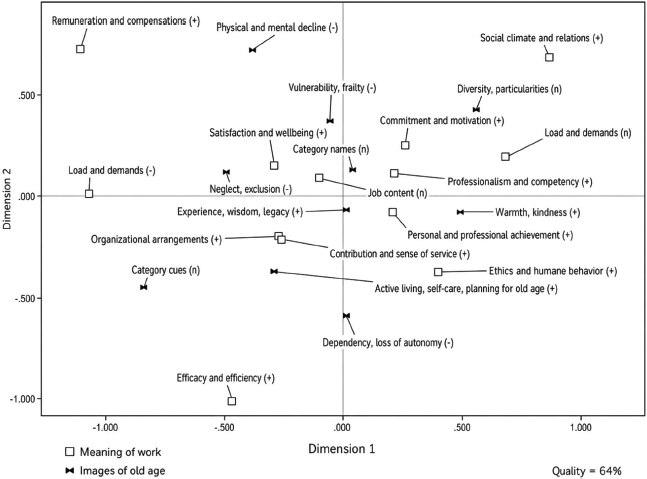
At the center, five categories cluster tightly around the origin: neutral Job content, positive Personal and professional achievement, positive Professionalism and competency, neutral Category names, and positive Experience, wisdom, and legacy. Their proximity to the axes suggests that these categories function as structural anchors in the semantic field—highly shared ideas that are conceptually stable across participants. This region is labeled “Formality,” as these categories denote formal aspects of work and aging (skills, roles, status labels, qualifications, and accumulated experience).
On the upper-left quadrant, six categories—positive Satisfaction and wellbeing, positive Remuneration and compensations, negative Load and demands, negative Neglect and exclusion, negative Vulnerability and frailty, and negative Physical and mental decline—form a cluster marked by instrumental exchanges, scarcity, and strain. Labeled “Transaction,” this sector captures meanings in which work is evaluated through personal outcomes (satisfaction, remuneration) and aging is framed through deficits or insufficient resources. Notably, it contains the largest number of negatively valenced IOA categories.
The upper-right quadrant, labeled “Relationships”, includes positive Commitment and motivation, neutral Load and demands, positive social climate and relations, and positive Diversity and particularities. These categories reflect relational engagement and interpersonal variability: work is seen as collaborative, meaningful, and socially embedded, whereas aging is recognized as diverse and multifaceted.
The lower-right quadrant, labeled “Compassion,” groups positive Ethics and humane behavior with positive Warmth and kindness and negative Dependency and loss of autonomy. This sector represents the moral and affective framing of care, where ethical responsibility and emotional warmth coexist with recognition of older adults’ vulnerability.
Finally, the lower-left quadrant, labeled “Results”, includes positive Organizational arrangements, positive Contribution and sense of service, positive Efficacy and efficiency, positive Active living, self-care, and planning for old age, and neutral Category cues. These categories reflect a performance -and outcome- oriented interpretation of both work and aging. Aging is seen through functional indicators and active self-management, while work is framed in terms of coordination, effectiveness, and productive service.,
Together, these five sectors illustrate how workers organize the meanings of work and aging along coherent symbolic logics—ranging from moral engagement and interpersonal connection to performance, exchange, and structural formality.
Overall, the distribution of MoW and IOA descriptors—and their organization into coherent semantic sectors—indicates that frontline workers develop meaning structures that combine relational, ethical, organizational, and decline-related elements. The Correspondence Analysis map suggests that workers do not think about their work and about older adults in isolation, but that these two representational domains are tightly intertwined through shared linguistic and symbolic associations.
DISCUSSION
The core objective of this study was to identify the semantic structures linking the Meaning of Work (MoW) and the Images of Old Age (IOA) among personnel in elderly-related services. Although quantitative measures of well-being and engagement provided contextual background, the most substantive insights emerged from the analysis of open descriptors, which offered a window into how workers linguistically construct their occupational identities and their views of older adults.
MoW descriptors with the highest frequencies—responsibility, satisfaction, love, commitment—reflect a strong tendency to conceptualize care work through psychological, ethical, and affective meanings. This aligns with prior research showing that workers frequently frame their roles through narratives of purpose, emotional engagement, and professional identity (Häggström et al., 2005; Kamp, 2012; Kamp & Bottrup, 2009). IOA descriptors likewise revealed a dual structure: experience, wisdom, love, and tenderness attest to positive, relational images, while terms such as sickness and loneliness reflect well-documented perceptions of decline. This ambivalence is consistent with the Stereotype Content Model (Cuddy et al., 2005) and with Palmore’s (1999) longstanding observation that positive symbolic associations coexist with negative images of frailty, dependency, or illness.
The categorization of descriptors further clarified these patterns. MoW categories with the highest frequencies centered on wellbeing, motivation, and ethical conduct, suggesting an orientation toward morally grounded and emotionally meaningful work. IOA categories were more concentrated, dominated by Experience, wisdom and legacy and Warmth and kindness, two highly salient dimensions also noted in studies where professionals view older adults through relational or moral lenses.
Correspondence Analysis revealed five distinct semantic sectors—Formality, Transactions, Relationships, Compassion, and Results—that capture how MoW and IOA are connected in practice. Importantly, these sectors are not mutually exclusive attitudes but discursive repertoires that workers can draw from to explain or justify their practices. The coexistence of moral/relational sectors (Relationships and Compassion) with performance- or efficiency-oriented sectors (Transactions and Results) reflects similar tensions described in the literature on “empathy at distance” (Liveng, 2012), the rationality of caring (Waerness, 1984), and the organizational ambivalences faced by care workers in restructured systems (Kamp & Bottrup, 2009). Thus, the empirical findings align with and extend prior theoretical work by demonstrating how these tensions appear in the semantic fabric of workers’ language.
This study contributes to the literature by bringing MoW and IOA together within a unified analytic framework—something that previous studies have rarely attempted. Research on IOA has largely focused on stereotypes or context-specific representations (Adams-Price & Morse, 2009; Ansello, 1978; Palmore, 1999; Sarabia Cobo & Castanedo Pfeiffer, 2015), while MoW research has examined work meaning through psychological or sociological dimensions (Morse & Weiss, 1955; MOW International Research Team, 1987; Rosso et al., 2010). The present findings suggest that these domains are mutually constitutive: how workers imagine older adults shapes how they imagine their work, and vice versa.
The five semantic sectors provide a novel conceptualization of this interdependence. Relationships and Compassion echo caring rationalities described by Kari Waerness (1984) and by narrative-practice approaches (Buckley et al., 2014), whereby emotional engagement and moral concern become central organizing principles. Transactions and Results correspond to more technocratic, managerial logics associated with efficiency, performance, and organizational control—similar to the ambivalences identified by Kamp & Bottrup (2009). The coexistence of these sectors thus illustrates how workers navigate—and linguistically reconcile—contradictory expectations embedded in elderly-care institutions.
Furthermore, the corpus-based approach used here complements existing qualitative and quantitative frameworks by demonstrating that semantic associations can reveal meaning structures that are not directly observable through interviews or standardized scales. This methodological contribution echoes calls for more fine-grained, language-centered research on the symbolic dimensions of care work (e.g., Sahagún Padilla et al., 2015).
Several practice-oriented insights follow from these findings. (1) Given the prominence of relational and moral descriptors, interventions should strengthen ethical reflection, emotional support, and interpersonal competencies, consistent with person-centered models of care (Buckley et al., 2014; Dewar & Nolan, 2013). (2) While positive IOA descriptors were more frequent, negative images of dependency, decline, or exclusion also emerged. Training programs should encourage workers to critically reflect on these images and explore more nuanced understandings of aging, consistent with work by Anna Kornadt et al. (2016) and Anna Kornadt & Klaus Rothermund (2011). (3) The tension between caring rationalities and efficiency-oriented expectations—visible in the Transactions and Results sectors—suggests that organizational arrangements should support a balance between quality of interaction and performance requirements. (4) Workers derive meaning not only from tasks but also from interpreting and narrating their work (Häggström et al., 2005; Kamp, 2012). Structured opportunities for reflection can help maintain well-being and reduce the risks associated with emotional strain (Wassermann et al., 2014). (5) Finally, the salience of descriptors related to wisdom, warmth, and individuality underscores the need for care models that recognize older adults as whole persons with histories, preferences, and evolving needs.
As with any corpus-based study, several limitations should be acknowledged. First, the exclusion of low-frequency categories—necessary for statistical clarity—may obscure emergent or marginal representations. These descriptors warrant further qualitative exploration (Wang, 1999). Second, the study was conducted in a medium-sized Mexican city, which may raise questions about generalizability. Nonetheless, examining contexts outside dominant research settings broadens the cultural lens of elderly-care scholarship and contributes to a more globally nuanced understanding of care work. Third, demographic subgroup analyses were not performed because the descriptor—rather than the individual—is the analytic unit in corpus-based semantic approaches; subgroup comparisons would require methodological assumptions incompatible with this framework. Finally, although the data were collected in 2015, this temporal distance does not undermine the relevance of the findings. Research on social representations (Abric, 2001a) consistently shows that the core semantic structures through which people interpret social objects tend to be highly stable over time, with change occurring primarily at the periphery. From this perspective, the five semantic sectors identified in this study—Formality, Transactions, Relationships, Compassion, and Results—should be understood as enduring frames that organize MoW and IOA in a deep, structural manner. While specific descriptors may shift in response to new policies, organizational reforms, or cultural narratives, these sectors provide a robust baseline for interpreting how meanings of work and old age evolve. Rather than limiting the study, the temporal distance highlights the value of these findings as a reference point for future longitudinal or comparative research.
Future research should build on these findings by examining how the semantic structures linking Meaning of Work and Images of Old Age evolve across different organizational, cultural, and policy contexts. The five sectors identified here offer a useful baseline for longitudinal comparisons as elder-care systems undergo demographic, technological, and managerial changes. In addition, exploring how organizational reforms, staffing conditions, or care models (e.g., person-centered care) influence shifts in specific sectors may clarify how workers negotiate institutional pressures and moral commitments over time. Finally, investigating the perspectives of older adults themselves would enable a fuller mapping of the relational and symbolic dynamics that structure contemporary elder care.
CONCLUDING REMARKS
This study shows how the meanings that care workers attach to their jobs and the images they hold of older adults are interconnected. By analyzing open descriptors and their co-occurrence structures, we identified semantic patterns that reveal how care professionals draw simultaneously on ethical, relational, organizational, and decline-related frames to understand their everyday work. Mapping these meaning structures enhances our understanding of the symbolic foundations of elder care and offers a basis for developing interventions, training, and organizational practices that align with workers’ lived realities. Attending to the language used in care settings is therefore essential for promoting more humane, effective, and sustainable environments of care.
FUNDING
This research was supported by the Research Support Program of the Universidad Autónoma de Aguascalientes (project code PIPS15-4).
DECLARATION OF INTEREST STATEMENT
The authors declare that there are no conflicts of interest.
ACKNOWLEDGMENTS
The authors gratefully acknowledge the invaluable assistance of José Carlos Palacios Montoya, Diana Williams Reza, Nancy Texis Marín, Lucero Domínguez Martínez, Katia Flota Santos, Yliana Morales Rodríguez, and José Francisco Gómez Rangel in the development of this study. The authors are grateful for the reviewers’ and editor’s insightful comments, which have significantly improved the manuscript.
REFERENCES
Abric, Jean Claude. (1994). Pratiques sociales et représentations. Presses Universitaires de France.
Abric, Jean Claude. (2001a). A structural approach to social representations. In Kay Deaux & Gina Philogène (Eds.), Representations of the social: Bridging theoretical traditions (pp. 42–47). Blackwell.
Abric, Jean Claude. (2001b). Metodología de recolección de las representaciones sociales. In Jean Claude Abric (Ed.), Prácticas sociales y representaciones (pp. 53–74). Ediciones Coyoacán.
Adams-Price, Carolyn E., & Morse, Linda W. (2009). Dependency stereotypes and aging: The implications for getting and giving help in later life. Journal of Applied Social Psychology, 39(12), 2967–2984. https://doi.org/10.1111/j.1559-1816.2009.00557.x
Altameemi, Yaser, & Altamimi, Mohammed. (2023). A corpus-based method for understanding themes/topics using concordance lines. Applied Sciences, 13(5), 3308. https://doi.org/10.3390/app13053308
Angus, Jocelyn, & Reeve, Patricia. (2006). Ageism: A threat to “aging well” in the 21st century. Journal of Applied Gerontology, 25(2), 137–152. https://doi.org/10.1177/0733464805285745
Ansello, Edward F. (1978). Ageism: The subtle stereotype. Childhood Education, 54(3), 118–122. https://doi.org/10.1080/00094056.1978.10728378
Ben-Arie, Ayala, & Iecovich, Esther. (2014). Factors explaining the job satisfaction of home care workers who left their older care recipients in Israel. Home Health Care Services Quarterly, 33(4), 211–228. https://doi.org/10.1080/01621424.2014.956958
Blanch, Josep M.; Sahagún, Miguel; Cantera, Leonor, & Cervantes, Genís. (2010). Cuestionario de Bienestar laboral general: Estructura y propiedades psicométricas. Revista de Psicología del Trabajo y de las Organizaciones, 26(2), 157–170. https://doi.org/10.5093/tr2010v26n2a7
Blomberg, Karin; James, Inger, & Kihlgren, Annica. (2013). Meanings over time of working as a nurse in elderly care. Open Nursing Journal, 7(1), 107–113. https://doi.org/10.2174/1874434620130726005
Buckley, Catherine; Mccormack, Brendan, & Ryan, Assumpta. (2014). Valuing narrative in the care of older people: A framework of narrative practice for older adult residential care settings. Journal of Clinical Nursing, 23(17–18), 2565–2577. https://doi.org/10.1111/jocn.12472
Bustillos-López, Antonio, & Fernández-Ballesteros, Rocío. (2012). Efecto de los estereotipos acerca de la vejez en la atención a adultos mayores. Salud Pública de México, 54(2), 104–105. https://doi.org/10.1590/S0036-36342012000200003
Coghlan, David. (2000). Appreciative inquiry: Rethinking human organization toward a positive theory of change. Team Performance Management, 6(7–8), 140–140. https://doi.org/10.1108/tpm.2000.6.7_8.140.1
Cuddy, Amy J. C.; Norton, Michael I., & Fiske, Susan T. (2005). This old stereotype: The pervasiveness and persistence of the elderly stereotype. Journal of Social Issues, 61(2), 267–285. https://doi.org/10.1111/j.1540-4560.2005.00405.x
Dewar, Belinda, & Nolan, Mike. (2013). Caring about caring: Developing a model to implement compassionate relationship centred care in an older people care setting. International Journal of Nursing Studies, 50(9), 1247–1258. https://doi.org/10.1016/j.ijnurstu.2013.01.008
Ellis, Kathryn. (2015). Personalisation, ambiguity and conflict: Matland’s model of policy implementation and the “transformation” of adult social care in England. Policy and Politics, 43(2), 239–254. https://doi.org/10.1332/030557312X655828
Engeström, Yrjö. (2014). Learning by expanding: An activity-theoretical approach to developmental research (2nd ed.). Cambridge University Press. https://doi.org/10.1017/CBO9781139814744
Esmaeilzadeh, Samineh, & Oz, Faith. (2020). Effect of psychosocial care model applied in an “elderly day care center” on loneliness, depression, quality of life, and elderly attitude. Nigerian Journal of Clinical Practice, 23(2), 189. https://doi.org/10.4103/njcp.njcp_366_19
Figueroa, Jesús G.; González, Esther G., & Solís, Víctor M. (1976). An approach to the problem of meaning: Semantic networks. Journal of Psycholinguistic Research, 5(2), 107–115. https://doi.org/10.1007/BF01067252
Franco, Mireya; Villarreal, Enrique; Vargas, Emma R.; Martinez, Lidia, & Galicia, Liliana. (2010). Estereotipos negativos de la vejez en personal de salud de un hospital de la Ciudad de Querétaro, México. Revista Medica de Chile, 138(8), 988–993. https://www.revistamedicadechile.cl/index.php/rmedica/article/view/197
Gallo, Ester, & Scrinzi, Francesca. (2016). Outsourcing elderly care to migrant workers: The impact of gender and class on the experience of male employers. Sociology, 50(2), 366–382. https://doi.org/10.1177/0038038515573688
García Santesmases, José M. (1984). Análisis factorial de correspondencias. In Juan Javier Sánchez Carrión (Ed.), Introducción a las técnicas de análisis multivariable aplicadas a las ciencias sociales (pp. 75–105). CIS.
Greenacre, Michael J. (2007). Correspondence analysis in practice (2nd ed.). Chapman & Hall/CRC.
Hadjistavropoulos, Thomas; LaChapelle, Diane; Hale, Carla, & MacLeod, Farley K. (2000). Age- and appearance-related stereotypes about patients undergoing a painful medical procedure. Pain Clinic, 12(1), 25–33. https://doi.org/10.1163/156856900750228060
Häggström, Elisabeth; Skovdahl, Kirsti; Fläckman, Birgitta; Kihlgren, Anika L., & Kihlgren, Mona. (2005). Work satisfaction and dissatisfaction – caregivers’ experiences after a two-year intervention in a newly opened nursing home. Journal of Clinical Nursing, 14(1), 9–19. https://doi.org/10.1111/j.1365-2702.2004.00977.x
Kamp, Annette. (2012). The quest for the meaning of work: competing concepts of meaning. In Annette Kamp & Helge Hvid (Eds.), Elderly care in transition: Management, meaning and identity at work: a Scandinavian perspective (pp. 51–82). Copenhagen Business School Press DK.
Kamp, Annette, & Bottrup, Pernille. (2009). Meaning in work identity and learning in the elderly care Kamp. Paper presented at the The 6th international conference on research work and learning, Roskilde, Denmark.
Kane, Michael N.; Hamlin, Elwood R., & Hawkins, Wesley E. (2004). How adequate do social workers feel to work with elders with Alzheimer’s disease? Social Work in Mental Health, 2(4), 63–84. https://doi.org/10.1300/J200v02n04_04
Killick, Campbell, & Taylor, Brian J. (2009). Professional decision making on elder abuse: Systematic narrative review. Journal of Elder Abuse & Neglect, 21(3), 211–238. https://doi.org/10.1080/08946560902997421
Kinnear, Deborah; Williams, Veronika, & Victor, Christina. (2014). The meaning of dignified care: An exploration of health and social care professionals’ perspectives working with older people. BMC Research Notes, 7(1), 854. https://doi.org/10.1186/1756-0500-7-854
Kornadt, Anna E.; Meissner, Franziska, & Rothermund, Klaus. (2016). Implicit and explicit age stereotypes for specific life domains across the life span: Distinct patterns and age group differences. Experimental Aging Research, 42(2), 195–211. https://doi.org/10.1080/0361073x.2016.1132899
Kornadt, Anna E., & Rothermund, Klaus. (2011). Contexts of aging: Assessing evaluative age stereotypes in different life domains. Journals of Gerontology - Series B Psychological Sciences and Social Sciences, 66 B(5), 547–556. https://doi.org/10.1093/geronb/gbr036
Kossek, Ellen E.; Thompson, Rebecca J.; Lawson, Katie M.; Bodner, Todd; Perrigino, Matthew B.; Hammer, Leslie B.; Buxton, Orfeu M.; Almeida, David M.; Moen, Phyllis; Hurtado, David A.; Wipfli, Brad; Berkman, Lisa F., & Bray, Jeremy W. (2019). Caring for the elderly at work and home: Can a randomized organizational intervention improve psychological health? Journal of Occupational Health Psychology, 24(1), 36–54. https://doi.org/10.1037/ocp0000104
Landis, J. Richard, & Koch, Gary G. (1977). The measurement of observer agreement for categorical data. Biometrics, 33(1), 159–174. https://pubmed.ncbi.nlm.nih.gov/843571/
Lipsky, Michael. (2010). Street-level bureaucracy: Dilemmas of the individual in public services (30th anniversary expanded ed.). Russell Sage Foundation.
Liveng, Anne. (2012). Why do care workers withdraw from elderly care? Researcher’s language as a hermeneutical key. Journal of Research Practice, 8(2). Article M4. https://www.scopus.com/inward/record.uri?eid=2-s2.0-84871689471&partnerID=40&md5=202a0c4d5380d677d842d7b89a52446b
Lyman, Elizabeth L. (1955). Occupational differences in the value attached to work. American Journal of Sociology, 61(2), 138–144. https://doi.org/10.1086/221695
Maupin, James R. (1993). Control, efficiency, and the street-level bureaucrat. Journal of Public Administration Research and Theory, 3(3), 335–357. https://doi.org/10.1093/oxfordjournals.jpart.a037174
Morse, Nancy C., & Weiss, Robert S. (1955). The function and meaning of work and the job. American Sociological Review, 20(2), 191–198. https://doi.org/10.2307/2088325
MoW International Research Team. (1987). The meaning of working. Academic Press.
Müller, Ralph; Pérez, Cristhian, & Ramirez, Luis. (2013). Estructura factorial y consistencia interna de la Utrech Work Engagement Scale (UWES) 17 entre trabajadores sanitarios de Chile. Liberabit, 19(2), 163–171. https://www.redalyc.org/articulo.oa?id=68629471002
Naldini, Manuela; Pavolini, Emmanuele, & Solera, Cristina. (2016). Female employment and elderly care: The role of care policies and culture in 21 European countries. Work, Employment & Society, 30(4), 607–630. https://doi.org/10.1177/0950017015625602
Narushima, Miya. (2004). A gaggle of raging grannies: The empowerment of older Canadian women through social activism. International Journal of Lifelong Education, 23(1), 23–42. https://doi.org/10.1080/0260137032000172042
Operario, Don, & Fiske, Susan T. (2003). Stereotypes: Content, structures, processes, and context. In Rupert Brown & Sam L. Gaertner (Eds.), Blackwell handbook of social psychology: Intergroup processes (pp. 22–44). Blackwell Publishers Ltd.
Ortega, Adriana; Gomes Carneiro, Isabella, & Flyvholm, Mari-Ann. (2010). A descriptive study on immigrant workers in the elderly care sector. Journal of Immigrant and Minority Health, 12(5), 699–706. https://doi.org/10.1007/s10903-009-9257-4
Palmore, Erdman B. (1999). Ageism: Negative and positive (2nd ed.). Springer Pub.
Pratt, Michael G., & Ashforth, Blake E. (2003). Fostering meaningfulness in working and at work. In Kim Cameron, Jane E. Dutton, & Robert E. Quinn (Eds.), Positive organizational scholarship: Foundations of a new discipline (pp. 308–327). Berrett-Koehler.
Riloff, Ellen, & Shepherd, Jessica. (1997). A corpus-based approach for building semantic lexicons. Proceedings of the Second Conference on Empirical Methods in Natural Language Processing, 117–124. https://arxiv.org/abs/cmp-lg/9706013
Romanov, Artemi. (2014). Comparative analysis of stereotypical traits of elderly people in Russian and American jokes. Russian Journal of Communication, 6(3), 288–307. https://doi.org/10.1080/19409419.2014.954598
Rosso, Brent D.; Dekas, Kathryn H., & Wrzesniewski, Amy. (2010). On the meaning of work: A theoretical integration and review. Research in Organizational Behavior, 30, 91–127. https://doi.org/10.1016/j.riob.2010.09.001
Sahagún Padilla, Miguel Angel; Palacios Salas, Pedro; Vitores González, Anna; Méndez Sánchez, Cecilia; Hermosillo de la Torre, Alicia E., & Elejabarrieta, Fran. (2015). Del contenido al sentido: Estereotipos de la vejez como prácticas discursivas. Investigación y Práctica en Psicología del Desarrollo, 1, 325–334. https://doi.org/10.33064/ippd1664
Sarabia Cobo, Carmen M., & Castanedo Pfeiffer, Cristina. (2015). Modificación de estereotipos negativos en la vejez en estudiantes de enfermería. Gerokomos, 26(1), 10–12. https://doi.org/10.4321/S1134-928X2015000100003
Sawchuk, Dana. (2009). The raging grannies: Defying stereotypes and embracing aging through activism. Journal of Women & Aging, 21(3), 171–185. https://doi.org/10.1080/08952840903054898
van Iersel, Margriet; Latour, Corine H. M.; de Vos, Rien; Kirschner, Paul A., & Scholte op Reimer, Wilma J. M. (2016). Nursing students’ perceptions of community care and other areas of nursing practice – A review of the literature. International Journal of Nursing Studies, 61, 1–19. https://doi.org/10.1016/j.ijnurstu.2016.05.011
Vergès, Pierre. (1992). L’évocation de l’argent: Une méthode pour la définition du noyau central d’une représentation. Bulletin de Psychologie, 45(405), 203–209. https://www.persee.fr/doc/bupsy_0007-4403_1992_num_45_405_14128
Waerness, Kari. (1984). The rationality of caring. Economic and Industrial Democracy, 5(2), 185–211. https://doi.org/10.1177/0143831X8452003
Wällstedt, Niklas. (2017). Client focus, cooperation, and coherence: (Re)professionalising processes for elderly care. Financial Accountability & Management, 33(1), 3–26. https://doi.org/10.1111/faam.12103
Wang, Frank T. (1999). Resistance and old age: The subject behind the American seniors’ movement. In Adriene S. Chambon, Allan Irving, & Laura Epstein (Eds.), Reading Foucault for social work (pp. 189–219). Columbia University Press.
Wassermann, Maria; Hoppe, Annekatrin; Reis, Dorota, & Von Uthmann, Leonie. (2014). Meaning-making as a personal resource among elderly care nurses: Direct and moderating effects on emotional exhaustion and vigor. Zeitschrift Fur Arbeits- Und Organisationspsychologie, 58(2), 51–63. https://doi.org/10.1026/0932-4089/a000142
Wrzesniewski, Amy; Dutton, Jane E., & Debebe, Gelaye. (2003). Interpersonal sensemaking and the meaning of work. Research in Organizational Behavior, 25, 93–135. https://doi.org/10.1016/S0191-3085(03)25003-6
MIGUEL ÁNGEL SAHAGÚN PADILLA
Ph.D. in Social Psychology from the Autonomous University of Barcelona. Professor and researcher at the Autonomous University of Aguascalientes; Level I member of the National Research System (SNI). Specialist in the social psychology of aging, caregiving practices, and intergenerational relationships. Author of La práctica de reminiscencias en la convivencia cotidiana con adultos mayores (2026).
miguel.sahagun@edu.uaa.mx
https://orcid.org/0000-0002-8836-1358
PAOLA DEL ROCÍO VILLALOBOS CÁRDENAS
Ph.D. in Sociocultural Studies with a focus on Gender Studies. Professor and researcher in the Department of Psychology at the Autonomous University of Aguascalientes. Her work examines gender dimensions in caregiving practices, violence, and human relationships in contexts involving the care of vulnerable populations.
paola.villalobos@edu.uaa.mx
https://orcid.org/0000-0002-6261-7087
Formato de citación
Sahagún-Padilla, Miguel Angel & Villalobos Cárdenas, Paola del Rocío. (2026). Meaning of Work and Images of Old Age in Elderly-Related Services through Open Descriptors. Quaderns de Psicologia, 28(2), e2301. https://doi.org/10.5565/rev/qpsicologia.2301
Historia editorial
Recibido: 2025-03-25
1ª revisión: 2025-10-23
2ª revisión: 2025-10-29
Aceptado: 2025-12-17
Publicado: 2026-08-17