Quaderns de Psicologia | 2026, Vol. 28, Nro. 2, e2271 | ISSN: 0211-3481 | 
 https://doi.org/10.5565/rev/qpsicologia.2271

The Role of Emotional Intelligence on Pre-Competitive Anxiety and Motivation in Brazilian College Athletes
El papel de la inteligencia emocional en la ansiedad precompetitiva y la motivación en atletas universitarios brasileños
José Roberto Andrade do Nascimento Junior
Air Force University
Gabriel Lucas Morais Freire
State University of Maringá
Karlla Emanuelle Ferreira Lima
Federal University of Vale do São Francisco
Daniel Vicentini de Oliveira
State University of Maringá
José Fernando Vila Nova de Moraes
Federal University of Vale do São Francisco
Lenamar Fiorese
State University of Maringá
Yara Lucy Fidelix
Federal University of Vale do São Francisco
Abstract
This study investigated the predictive role of emotional intelligence (EI) on pre-competitive anxiety and motivation among 407 Brazilian college athletes. The instruments used were the Schutte Emotional Intelligence Scale for Sport, Sport Motivation Scale II, and Competitive State Anxiety Inventory-2R. Data analysis was conducted using Pearson’s Correlation, multiple regression, cluster analysis, and Multivariate Analysis of Variance (p < 0.05). The results revealed that EI explained a significant amount of the motivation regulations (R² = 0.01-0.14), contributing positively to external, introjected, identified, integrated and intrinsic regulations (β = 0.13-0.38). EI also explained positively self-confidence (β = 0.43). College athletes in the cluster with high EI had higher scores in regulations closer to autonomous motivation and higher self-confidence when compared to athletes with moderate and low EI. It is concluded that, for Brazilian college athletes, the EI proved to be a predictor of the autonomous motivation and self-confidence.
Keywords: Emotions; Sport psychology; Motivation; Anxiety
Resumen
Este estudio investigó el papel predictivo de la inteligencia emocional (IE) sobre la ansiedad y la motivación precompetitivas entre 407 atletas universitarios brasileños. Los instrumentos utilizados fueron la Escala de Inteligencia Emocional para el Deporte de Schutte, la Escala de Motivación Deportiva II y el Inventario de Ansiedad del Estado Competitivo-2R. El análisis de los datos se realizó mediante correlación de Pearson, regresión múltiple, análisis de conglomerados y análisis multivariado de varianza (p < 0,05). Los resultados revelaron que la IE explicó una cantidad significativa de las regulaciones motivacionales (R² = 0,01 a 0,14), contribuyendo positivamente a las regulaciones externas, introyectadas, identificadas, integradas e intrínsecas (β = 0,13 a 0,38). La IE también explicó positivamente la confianza en uno mismo (β = 0,43). Los atletas universitarios con IE alta obtuvieron puntuaciones más altas en regulaciones más cercanas a la motivación autónoma y mayor confianza en sí mismos en comparación con los atletas con IE moderada y baja. Se concluye que, para los atletas universitarios brasileños, la IE resultó ser un predictor de la motivación autónoma y de la confianza en sí mismo.
Palabras clave: Emociones; Psicología del deporte; Motivación; Ansiedad
Introduction
Athletes must be supported in various aspects of the sports context, including physical, technical, tactical, and psychological factors (Campo et al., 2018). Different sports disciplines present distinct characteristics, making it essential to monitor and manage emotional responses throughout training and competition (Bueno & Marchi Júnior, 2020).
Like all sports events, whether in school, recreational, or competitive settings, college sports elicit a wide range of emotions and serve as an educational practice that integrates leisure, socialization, and competition (Camargo & Mezzadri, 2018). In this context, emotional intelligence (EI) plays a determinant role in shaping athletes’ emotional regulation strategies, thereby fostering psychological adaptation in competitive environments (Shen et al., 2019).
EI is defined as the ability to perceive, understand, and regulate one’s own emotions as well as those of others (Campo et al., 2019). Initially conceptualized in the 1990s (Goleman, 2020), EI encompasses recognizing emotions, managing them effectively, and applying emotional knowledge to facilitate reasoning and behavior (Salovey & Mayer, 1990). Research on EI in sports gained prominence in the early 21st century (Ribeiro et al., 2018). Studies have explored its associations with psychological well-being in college sports (Corella et al., 2021), mental health in athletes and non-athletes (Edwards & Froehle, 2023), and emotional regulation across various sports disciplines and competitive levels (Ribeiro et al., 2018). Investigations have also examined how EI contributes to adaptive psychological responses in competitive settings, including its links to motivation and anxiety (Campo et al., 2016).
Motivation has been identified as a key variable associated with EI in sports. The Self-Determination Theory (SDT) is one of the most widely used frameworks for understanding motivational processes in sports (Ryan & Deci, 2017, 2020). According to SDT, motivation is driven by innate tendencies to seek enjoyment and fulfillment, which interact with both personality traits and environmental influences (Nascimento Júnior et al., 2017, 2019). SDT categorizes motivation into three types: amotivation (lack of self-determination), extrinsic motivation (regulated by external rewards or pressures), and intrinsic motivation (self-determined engagement in activities for personal satisfaction). Among these, intrinsic motivation is most strongly linked to positive emotional experiences in sports (Ryan & Deci, 2020). Empirical studies indicate that EI positively correlates with motivation and serves an adaptive function for athletes (Rutkowska & Gierczuk, 2020). Research with basketball players has shown that self-reported EI abilities, such as perceiving and managing emotions, are significantly associated with intrinsic motivation (Sukys et al., 2019). These findings suggest that athletes with higher EI may develop more effective emotional regulation strategies, thereby sustaining motivation in competitive contexts.
Another critical psychological factor in sports is pre-competitive anxiety. The Multidimensional Theory of Competitive Anxiety conceptualizes this phenomenon in three components: cognitive anxiety (negative thoughts and self-doubt), somatic anxiety (physiological symptoms such as muscle tension and rapid breathing), and self-confidence (belief in one’s ability to succeed) (Marenucci et al., 2020; Paludo et al., 2016). Pre-competitive anxiety can manifest as excessive worry and discomfort, potentially disrupting an athlete’s focus and psychological readiness (Fortes et al., 2017; Freire et al., 2020). Evidence suggests that EI plays a role in mitigating anxiety in sports. Studies have reported that athletes with higher EI tend to experience lower levels of anxiety across different sports, including soccer (Castro-Sánchez et al., 2019) and combat sports (Fernández et al., 2020). Additionally, research on group and individual sports has shown that EI may contribute to better emotional regulation, reducing anxiety before competitions (Castro-Sánchez et al., 2018).
Despite existing research on the interplay between EI, motivation, and anxiety in sports, there is a lack of studies focusing specifically on competitive college athletes, particularly in Brazil, where college sports have been expanding in recent years. The Brazilian University Games (Jogos Universitários Brasileiros — JUBs) are the largest and most traditional university sports competition in Brazil, playing a fundamental role in promoting sports, education, and social integration among young athletes. Organized annually by the Brazilian University Sports Confederation (Confederação Brasileira do Desporto Universitário — CBDU), the event brings together thousands of students from higher education institutions across the country, competing in a wide range of individual and team sports. The JUBs competition serves as a significant talent pool for national sports, with many participants advancing to represent Brazil in international university championships and other major sporting events. Highlighting the importance of balancing academic and athletic pursuits, the JUBs contribute to the holistic development of student-athletes, reinforcing the connection between education and sportsmanship.
This study aims to address this gap by examining the predictive role of EI in motivation and pre-competitive anxiety among Brazilian college athletes. The findings will provide valuable insights for researchers and practitioners seeking to enhance psychological support in college sports. By emphasizing a holistic approach that integrates mental and emotional aspects, this research contributes to the growing field of sports and exercise psychology, promoting the well-being and development of athletes in collegiate sports programs.
Methods
Study design
This study employs a descriptive, cross-sectional design (Ato et al., 2013) and was conducted in accordance with the guidelines outlined in the Strengthening the Reporting of Observational Studies in Epidemiology (STROBE) statement (Malta et al., 2010).
Data collection and ethical considerations
Initially, the researchers contacted the Brazilian Confederation of College Sports to obtain authorization to conduct the study with athletes participating in the 2019 Brazilian College Games. Subsequently, the research protocol was submitted to the Research Ethics Committee of the Federal University of Vale do São Francisco and was approved under protocol number 3,576,805, in compliance with the ethical guidelines established in Resolution No. 466/12 of the Brazilian Health Council.
Data collection took place in hotels and other accommodation facilities where the athletes and teams were housed during the competition, held in the second half of 2019. The questionnaires were administered collectively in a private room, ensuring that coaches were not present. Participants completed the questionnaires individually, with the entire process taking approximately 30 minutes. To minimize order effects, the sequence of questionnaire administration was randomized among participants.
Participants
The study sample consisted of athletes who competed in the final stage of the 2019 Brazilian College Games. The minimum required sample size was determined using the finite population formula, considering a 95% confidence level, a 5% margin of error, and an estimated proportion of 50% (Richardson et al., 2012). Given a total of approximately 3500 athletes registered for the competition, the minimum required sample size was estimated at 346 participants, accounting for potential sample loss. Ultimately, 407 athletes (225 men and 182 women) from all regions of Brazil who had competed at state, national, and/or international levels were recruited. All recruited athletes voluntarily agreed to participate in the study, and no incentives or rewards were offered.
A total of 407 university athletes of both sexes participated in the study. Among the participants (see Table 1), 44.47% were from the Northeastern region of Brazil (n = 181); however, they were not necessarily born in that region, as the Brazilian educational system allows for cultural diversity among states. A total of 224 athletes competed at the national level, representing 55.04% of the sample. Furthermore, 17.94% of the participants were track and field athletes (n = 72). Most athletes (53.81%; n = 219) practiced only one sport, whereas 46.19% (n = 188) engaged in multiple sports.
Table 1. Characteristics of the Participants Regarding Region, Competitive Level, Sport, and Practitioner or not of Other Sports
Participants’ Characteristics |
n |
% |
Regions |
||
North |
62 |
15.23 |
Northeast |
181 |
44.47 |
Midwest |
41 |
10.07 |
Southeast |
68 |
16.71 |
South |
55 |
13.51 |
Competitive level |
||
State |
143 |
35.14 |
National |
224 |
55.04 |
International |
40 |
9.83 |
Sports |
||
Track and Field |
73 |
17.94 |
Badminton |
6 |
1.47 |
Basketball |
44 |
10.81 |
E-sports |
17 |
4.18 |
Soccer |
38 |
9.34 |
Futsal |
36 |
8.85 |
Handball |
61 |
14.99 |
Jiu-jitsu |
2 |
0.49 |
Judo |
10 |
2.46 |
Karate |
4 |
0.98 |
Kung fu |
3 |
0.74 |
Wrestling |
2 |
0.49 |
Swimming |
37 |
9.09 |
Modern Pentathlon |
2 |
0.49 |
Rugby |
2 |
0.49 |
Taekwondo |
2 |
0.49 |
Triathlon |
4 |
0.98 |
Volleyball |
55 |
13.51 |
Beach Volleyball |
3 |
0.74 |
Chess |
6 |
1.47 |
Practitioner of other sports |
||
Yes |
188 |
46.19 |
No |
219 |
53.81 |
Participants had a mean age of 22.77 years (SD = 3.72), an average tenure with their current coach of 42.57 months (SD = 44.05), a mean weekly training volume of 8.60 hours (SD = 8.85), and an average duration of sports practice of 118.13 months (SD = 60.77). The inclusion criteria were as follows: (1) being at least 18 years old, (2) having engaged in sports practice for a minimum of six months, and (3) having participated in at least one official competition between 2018 and 2019. Only athletes aged 18 or older were recruited to avoid ethical and logistical complications associated with obtaining parental/guardian consent during the competition.
Instruments
Sociodemographic data were collected to characterize the sample, including age, sex, sport, weekly training hours, and years of experience.
Schutte Self-Report Emotional Intelligence Test (P-SSEIT): Originally developed by Nicola S. Schutte et al. (1998) for the general population, this instrument was adapted and validated for the Brazilian sports context by Lima et al. (2022). The adapted version consists of 26 items, is unidimensional, and assesses emotional intelligence using a five-point Likert scale ranging from (1) “totally disagree” to (5) “totally agree”. The final score is obtained by summing all responses, yielding a total score between 26 and 130, with higher scores indicating greater emotional intelligence.
Sport Motivation Scale II (SMS-II): Developed by Luc G. Pelletier et al. (2013) and validated for the Brazilian context by Jose Roberto A. Nascimento Junior et al. (2014), this instrument comprises 18 items distributed across six subscales: intrinsic regulation, integrated regulation, identified regulation, introjected regulation, external regulation, and amotivation. It measures athletic motivation levels using a seven-point Likert scale ranging from (1) “does not correspond at all” to (7) “corresponds exactly”.
Competitive State Anxiety Inventory-2 Revised (CSAI-2R): Athletes responded to the Brazilian version (Fernandes et al., 2013) of the CSAI-2R, the reduced form of the original CSAI-2 (Martens et al., 1990). This instrument comprises 16 items assessing three dimensions of anxiety: cognitive anxiety (items 1, 4, 6, 8, and 12), somatic anxiety (items 2, 5, 9, 11, 13, and 15), and self-confidence (items 3, 7, 10, 14, and 16). The CSAI-2R evaluates anxiety along three dimensions: direction, frequency, and intensity. In this study, the frequency dimension was utilized, with responses provided on a seven-point Likert scale ranging from (1) “never” to (7) “frequently”.
Data analysis
Data analysis was conducted using SPSS 23.0 (IBM Corp, 2015), including preliminary analyses, descriptive statistics, correlations, and multiple regression analyses. Pearson’s correlation was used to examine associations between emotional intelligence, motivational regulation types, and anxiety dimensions among college athletes. Regression analysis was employed to determine whether emotional intelligence predicted motivational regulations and anxiety dimensions. Ten separate regression models were tested using the enter method to include independent variables, assessing the predictive role of emotional intelligence on the subscales of motivation and anxiety. No significant multicollinearity issues were identified among the predictor variables. The analyses involving correlations and regressions were conducted using raw scores for each instrument, as these methods do not require identical scales for meaningful interpretation.
Given the classification of emotional intelligence scores, a clustering approach was used to categorize athletes. A hierarchical cluster analysis employing the nearest neighbor method was initially conducted, using squared Euclidean distance as a measure of dissimilarity. The R² criterion was used to determine the optimal number of clusters, leading to the retention of three clusters. To validate and refine the classification, a subsequent non-hierarchical cluster analysis was performed. In the clustering procedure, standardization (z-score transformation) was applied to all variables to ensure that differences in scale range did not influence the classification of athletes into different groups. According to Jennifer Cumming and Joan L. Duda’s (2012) classification criteria, z-scores below -0.5 were considered low, scores between -0.5 and +0.5 were classified as moderate, and scores above +0.5 were considered high.
Differences among the identified clusters in terms of motivational regulation and competitive anxiety were analyzed using Multivariate Analysis of Variance (MANOVA). Given the differences in scale ranges, we focused not only on statistical significance but also on effect sizes to interpret the strength of associations, ensuring that meaningful patterns were identified beyond numerical scale differences. Effect sizes were calculated to quantify the magnitude of differences between groups, following Cohen’s (1977) classification: small (η² = .01), medium (η² = .06), and large (η² = .13).
Results
Descriptive statistics, intercorrelations and internal consistency
The analysis of correlations between EI, motivation regulations, and anxiety dimensions (Table 2) revealed significant (p < 0.05), weak and positive associations between EI and external regulation (r = 0.13), introjected regulation (r = 0.22), identified regulation (r = 0.38), integrated regulation (r = 0.36), and intrinsic regulation (r = 0.36). Additionally, EI showed a significant (p < 0.05), moderate and positive correlation with self-confidence (r = 0.44). Conversely, amotivation was significantly (p < 0.05), weakly and positively correlated with somatic anxiety (r = 0.25) and cognitive anxiety (r = 0.19), and weakly negatively correlated with self-confidence (r = -0.10). External regulation demonstrated a significant (p < 0.05), weak and positive association with cognitive anxiety (r = 0.10), whereas introjected regulation showed a significant (p < 0.05), weak and positive correlations with all anxiety dimensions (r = 0.10; r = 0.13; r = 0.14). Furthermore, intrinsic and identified regulations were significantly (p < 0.05) weakly and positively correlated with somatic anxiety (r = 0.11 for both) and weakly to moderately positively correlated with self-confidence (r = 0.26 and r = 0.24, respectively). Finally, integrated regulation exhibited a significant (p < 0.05) weak to moderate positive correlation with self-confidence (r = 0.27).
Table 2. Correlation Between EI, Regulations of Motivation and Dimensions of Anxiety in College Athletes
Variables |
EI |
Regulations of Motivation |
Anxiety |
|||||||
1 |
2 |
3 |
4 |
5 |
6 |
7 |
8 |
9 |
10 |
|
1. Emotional Intelligence |
- |
0.01 |
0.13** |
0.22** |
0.38** |
0.36** |
0.36** |
0.01 |
-0.01 |
0.44** |
2. Amotivation |
- |
0.48** |
0.02 |
-0.13** |
-0.10* |
-0.09 |
0.25** |
0.19** |
-0.10* |
|
3. External Regulation |
- |
0.20** |
0.12* |
0.15** |
0.09 |
0.10* |
0.09 |
0.06 |
||
4. Introjected Regulation |
- |
0.61** |
0.60** |
0.62** |
0.10* |
0.13** |
0.14** |
|||
5. Identified Regulation |
- |
0.82** |
0.80** |
0.06 |
0.11* |
0.26** |
||||
6. Integrated Regulation |
- |
0.70** |
0.05 |
0.08 |
0.27** |
|||||
7. Intrinsic Regulation |
- |
0.01 |
0.11* |
0.24** |
||||||
8. Cognitive Anxiety |
- |
0.65** |
-0.10* |
|||||||
9. Somatic Anxiety |
- |
-0.04 |
||||||||
10. Self-confidence |
- |
|||||||||
Mean |
101.95 |
2.26 |
2.35 |
4.95 |
5.79 |
5.71 |
5.72 |
4.05 |
3.81 |
4.85 |
Standard Deviation |
16.46 |
1.46 |
1.53 |
1.48 |
1.47 |
1.46 |
1.40 |
1.45 |
1.21 |
1.30 |
Cronbach’s Alpha |
0.93 |
0.71 |
0.74 |
0.75 |
0.73 |
0.76 |
0.75 |
0.70 |
0.71 |
0.78 |
Regression analysis
The multiple regression analyses (Tables 3 and 4) examined emotional intelligence (EI) as a predictor of motivational regulations and competitive anxiety dimensions among college athletes. Overall, the regression models explained a significant proportion of the variance in most motivational regulations (R² = 0.01 to 0.14, p < 0.05), except for amotivation, and in self-confidence (R² = 0.19, p < 0.001). However, EI did not significantly predict cognitive or somatic anxiety. Regarding motivational regulations (Table 3), EI positively predicted all forms of regulation, including external regulation (β = 0.13, p < 0.05), introjected regulation (β = 0.21, p < 0.001), identified regulation (β = 0.38, p < 0.001), integrated regulation (β = 0.36, p < 0.001), and intrinsic regulation (β = 0.36, p < 0.001). The strongest associations were observed for the more autonomous forms of motivation, particularly identified, integrated, and intrinsic regulation, indicating that athletes with higher EI are more likely to participate in sport because it is personally meaningful, aligned with their values, and inherently enjoyable. Regarding anxiety dimensions (Table 4), EI was only a significant positive predictor of self-confidence (β = 0.43, p < 0.001). This finding suggests that athletes with higher EI tend to report greater confidence in their ability to perform successfully in competitive situations.
Table 3. EI as a Predictor of the Regulation of Motivations of College Athletes
Predictor |
Amotivation |
External Regulation |
Introjected Regulation |
Identified Regulation |
Integrated Regulation |
Intrinsic Regulation |
β (CI) |
β (CI) |
β (CI) |
β (CI) |
β (CI) |
β (CI) |
|
EI |
0.01 (-0.01; 0.01) |
0.13 (0.00; 0.02)* |
0.21 (0.01; 0.02)*** |
0.38 (0.02; 0.04)*** |
0.36 (0.02; 0.04)*** |
0.36 (0.02; 0.03)*** |
R² |
0.00 |
0.01 |
0.04 |
0.14 |
0.13 |
0.12 |
F |
0.078 |
7.352* |
20.436*** |
68.206*** |
62.722*** |
59.830*** |
Note: Only the standardized regression coefficients lower than the level of significance (p < 0.05) are in bold. β = Standardized regression coefficient. CI = Confidence interval of 95%. * p < 0.05. ** p < 0.01. *** p < 0.001.
Table 4. EI as a Predictor of the Dimensions of Anxiety in College Students
Predictor |
Cognitive Anxiety |
Somatic Anxiety |
Self-confidence |
β (CI) |
β (CI) |
β (CI) |
|
EI |
0.01 (-0.01; 0.01) |
-0.1 (-0.01; 0.01) |
0.43 (0.02; 0.04)*** |
R² |
0.00 |
0.00 |
0.19 |
F |
0.038 |
0.61 |
96.089*** |
Note: Only the standardized regression coefficients lower than the level of significance (p < 0.05) are in bold. β = Standardized regression coefficient. CI = Confidence interval of 95%. *** p < 0.001.
Cluster analysis
The cluster analysis identified three distinct groups of athletes based on their EI scores, confirming the robustness of the classification (Figure 1). Cluster 1 (High EI), which included the largest proportion of participants (n = 243), was characterized by elevated EI scores. Cluster 2 (Moderate EI) consisted of n = 127 athletes with intermediate EI levels, while Cluster 3 (Low EI) was composed of n = 37 athletes with the lowest EI scores. The identification of these clusters highlights the variability in EI among college athletes, suggesting the presence of different psychological profiles within the sample. The distribution of participants across clusters indicates that while most athletes demonstrate moderate to high EI, a smaller subset presents low levels, which may be relevant for understanding individual differences in motivation and anxiety responses.
Figure 1. Graphic Representation of the Profiles of EI of College Athletes Using Cluster Analysis
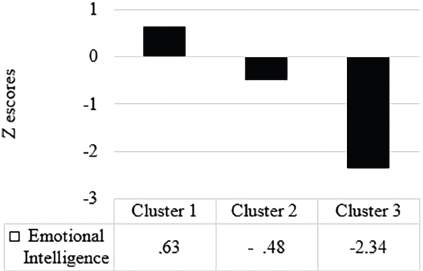
When comparing motivation regulations and the dimensions of pre-competitive anxiety among college athletes based on their EI profiles (Table 5), significant differences were observed between groups in introjected regulation (p < 0.001), identified regulation (p < 0.001), integrated regulation (p < 0.001), and intrinsic regulation (p < 0.001). It is noteworthy that university athletes with high EI exhibited higher scores in these motivation regulations compared to those with moderate and low EI. Regarding pre-competitive anxiety, significant differences between groups were found only in the self-confidence dimension (p < 0.001), indicating that university athletes with high EI demonstrated higher self-confidence scores.
Table 5. Comparison of the Regulations of Motivation and Dimensions of Anxiety According to the Profiles of EI of College Athletes
Variable |
High EI (n=243) |
Moderate EI (n=127) |
Low EI (n=37) |
P |
η2 |
M (SD) |
M (SD) |
M (SD) |
|||
Motivation |
|||||
Amotivation |
2.24 (1.50) |
2.22 (1.29) |
2.46 (1.77) |
0.660 |
0.002 |
External Regulation |
2.38 (1.65) |
2.42 (1.43) |
1.87 (0.93) |
0.136 |
0.010 |
Introjected Regulation |
5.18 (1.41)a |
4.77 (1.38) |
4.09 (1.88) |
< 0.001* |
0.050 |
Identified Regulation |
6.14 (1.23)a |
5.59 (1.41) |
4.21 (1.92) |
< 0.001* |
0.144 |
Integrated Regulation |
6.07 (1.16)a |
5.43 (1.56) |
4.29 (1.79) |
< 0.001* |
0.134 |
Intrinsic Regulation |
6.00 (1.18)a |
5.64 (1.30) |
4.18 (1.92) |
< 0.001* |
0.134 |
Anxiety |
|||||
Cognitive Anxiety |
4.12 (1.48) |
4.02 (1.25) |
3.69 (1.86) |
0.247 |
0.007 |
Somatic Anxiety |
3.87 (1.23) |
3.75 (1.08) |
3.58 (1.46) |
0.317 |
0.006 |
Self-confidence |
5.24 (1.22)a |
4.48 (1.04) |
3.57 (1.45) |
< 0.001* |
0.165 |
Note: * Significant difference (MANOVA). *p<0.05. aDifference between High EI and Moderate EI and Low EI.
Discussion
The present study sought to address a gap in the literature regarding the role of EI in motivation and pre-competitive anxiety among Brazilian college athletes. The findings highlight that athletes with higher EI levels exhibit superior emotional management, higher motivation, and reduced anxiety before competitions. These results underscore the predictive role of EI in fostering autonomous motivation and self-confidence, two critical psychological components for athletic performance and well-being. Given the relevance of these psychological constructs in sports, the present study contributes to the scientific community and to professionals involved in collegiate athletics by offering a deeper understanding of the psychological mechanisms underlying sports participation.
One of the most significant findings of this study was the predictive role of EI in motivation regulation, particularly for regulations aligned with autonomous motivation (Table 3). This suggests that athletes who are more adept at recognizing and regulating their emotions, both their own and those of others, are more likely to engage in sports for intrinsic reasons, such as enjoyment and personal satisfaction. These results align with the Self-Determination Theory (SDT) (Ryan & Deci, 2020), which posits that autonomous motivation is driven by internalized values and personal goals. Prior research supports this interpretation, showing that EI fosters self-motivation by directing emotions toward goal attainment (Castro-Sánchez et al., 2018). Similar findings have been reported in various sports contexts, including studies that demonstrate EI’s significant role in motivation regulation (Galarraga et al., 2017; Sukys et al., 2019). Moreover, research with wrestlers (Rutkowska & Gierczuk, 2020) found that higher EI levels were associated with higher motivation and an adaptive psychological profile, reinforcing the notion that EI plays a crucial role in athletic engagement and persistence.
The positive relationship between EI and self-confidence represents another noteworthy finding. Athletes with higher EI levels not only manage their emotions more effectively but also develop a greater sense of competence and preparedness, even under stressful conditions. This aligns with prior research indicating that athletes with elevated EI experience lower anxiety levels and greater psychological resilience in competition settings (Castro-Sánchez et al., 2019). These results suggest that EI enables athletes to interpret pre-competitive stress as a challenge rather than a threat, a factor that has been linked to enhanced performance outcomes.
The cluster analysis further reinforced these findings, revealing three distinct athlete profiles based on EI levels. Notably, motivation regulations and anxiety levels varied significantly among these clusters, providing further insight into the role of EI in shaping psychological responses to competition. The cluster analysis revealed distinct psychological profiles among athletes based on their levels of EI.
Cluster 1 (High EI) comprised athletes with the highest EI scores, who also exhibited stronger self-determined motivation (intrinsic regulation) and higher self-confidence. These athletes experienced lower levels of pre-competitive anxiety, indicating that emotionally intelligent individuals are better equipped to manage stress and perform under pressure. These findings align with previous research demonstrating that higher EI is associated with enhanced psychological well-being, improved sports performance, and prolonged athletic engagement (Nascimento Junior et al., 2017; Niven, 2017). In contrast, Cluster 2 (Moderate EI) included athletes with intermediate EI levels, who showed a higher reliance on external regulation, meaning their motivation was more dependent on external rewards or encouragement from others (e.g., coaches, teammates, or family members) (Weinberg & Gould, 2023). This group also exhibited moderate levels of cognitive and somatic anxiety, which could hinder decision-making and overall performance in competitive settings. These findings suggest that moderate EI levels may not always provide sufficient emotional regulation under stress, reinforcing prior research indicating that EI can play a dual role in pre-competitive anxiety (Parmar et al., 2017). Lastly, Cluster 3 (Low EI) consisted of athletes with the lowest EI levels, who also demonstrated lower intrinsic motivation and self-confidence. This group exhibited heightened levels of anxiety, which may act as a performance-limiting factor by increasing fear of failure and decision-making paralysis during competition (Tamminen et al., 2019). The pronounced cognitive and somatic anxiety observed in this group underscores the negative impact of poor emotional regulation on psychological readiness, reinforcing the protective role of EI against maladaptive anxiety responses and highlighting its significance as a crucial psychological skill in sports settings.
The observed differences between clusters further support SDT and the Multidimensional Theory of Anxiety (Martens et al., 1990). These theoretical frameworks suggest that motivation and anxiety interact to influence athletic performance, with EI serving as a buffer against anxiety-related impairments. While athletes in the High EI cluster exhibited self-determined motivation and greater psychological resilience, those in the Low EI cluster were more vulnerable to performance-impairing anxiety states. This aligns with prior research showing that athletes with higher self-confidence experience lower cognitive anxiety and perform better in high-pressure situations (Ouyang et al., 2020).
Additionally, research on EI training programs has demonstrated partial success in enhancing EI and psychological skills among athletes (Campo et al., 2016). Although the present study did not employ an intervention design, the identification of distinct EI profiles suggests that targeted psychological training programs could be beneficial, particularly for athletes in the Moderate and Low EI clusters. Previous studies indicate that the effectiveness of such interventions may vary depending on competitive level (amateur vs. elite) and sport type (individual vs. team sports) (Hagar et al., 2017), highlighting the need for further investigation in the college sports context.
Limitations and future directions
Despite its contributions, the present study has some limitations that should be acknowledged. First, the cross-sectional design restricts causal inferences, meaning that the relationships observed between EI, motivation, and anxiety cannot be interpreted as causal effects. Future longitudinal studies are needed to determine the directionality of these associations. Additionally, the study did not differentiate between team and individual sports, which may represent an important factor in the interaction between EI and psychological responses to competition. Given that individual sports often impose greater psychological demands, future research should explore whether EI’s protective effects differ across sport types.
Another avenue for future research involves intervention studies aimed at enhancing EI among college athletes. Since EI is a trainable skill, investigating its development through psychological training programs could provide valuable insights into its role in long-term athletic performance and psychological well-being. Understanding whether targeted EI interventions can improve motivation, reduce anxiety, and enhance self-confidence in athletes could have meaningful implications for sports psychology and collegiate athletic programs.
Conclusion
The findings of the present study highlight the relevant role of EI in motivation and pre-competitive anxiety among college athletes. The regression analysis demonstrated that EI is a significant predictor of autonomous motivation and self-confidence, while the cluster analysis identified distinct EI profiles that affect motivation regulations and anxiety responses. These findings reinforce the importance of EI as a psychological resource in sports performance, suggesting that higher EI levels are associated with greater intrinsic motivation, lower anxiety, and improved self-confidence.
For sports professionals and practitioners, these results underscore the potential benefits of EI training in collegiate sports. Implementing psychological skill development programs aimed at enhancing EI could help athletes regulate their emotions, reduce performance-related anxiety, and sustain long-term engagement in sports. Given the psychological demands of competitive sports, fostering emotional intelligence may be a key factor in optimizing both mental well-being and athletic performance in the college sports context.
Disclosure statement
No potential conflict of interest was reported by the author(s)
Funding
The author(s) reported there is no funding associated with the work featured in this article.
References
Ato, Manuel; López-García, Juan J., & Benavente, Ana. (2013). Un sistema de clasificación de los diseños de investigación en psicología. Anales de Psicología, 29(3), Article 3. https://doi.org/10.6018/analesps.29.3.178511
Bueno, Igor A. S., & Marchi Júnior, Wanderley. (2020). O gerenciamento/administração das emoções nos atletas brasileiros. Revista Brasileira de Sociologia da Emoção, 19(55), 213–225.
Camargo, Philipe R., & Mezzadri, Fernando M. (2018). A organização e configuração do esporte universitário no Brasil (1940–1980). Motrivivência, 30(53), 52–68. https://doi.org/10.5007/2175-8042.2018v30n53p52
Campo, Mickael; Laborde, Sylvain; Martinent, Guillaume; Louvet, Benoit, & Nicolas, Michel. (2019). Emotional intelligence (EI) training adapted to the international preparation constraints in rugby: Influence of EI trainer status on EI training effectiveness. Frontiers in Psychology, 10. https://www.frontiersin.org/articles/10.3389/fpsyg.2019.01939
Campo, Mickael; Laborde, Sylvain, & Mosley, Emma. (2016). Emotional intelligence training in team sports: The influence of a season long intervention program on trait emotional intelligence. Journal of Individual Differences, 37(3), 152–158. https://doi.org/10.1027/1614-0001/a000201
Campo, Mickael; Martinent, Guillaume; Pellet, Julien; Boulanger, Jérémie; Louvet, Benoit, & Nicolas, Michel. (2018). Emotion–performance relationships in team sport: The role of personal and social identities. International Journal of Sports Science & Coaching, 13(5). https://doi.org/10.1177/1747954118785256
Castro-Sánchez, Manuel; Lara-Sánchez, Amador J.; Zurita-Ortega, Félix, & Chacón-Cuberos, Ramón. (2019). Motivation, anxiety, and emotional intelligence are associated with the practice of contact and non-contact sports: An explanatory model. Sustainability, 11(16), Article 16. https://doi.org/10.3390/su11164256
Castro-Sánchez, Manuel; Zurita-Ortega, Félix; Chacón-Cuberos, Ramón; López-Gutiérrez, Carlos J., & Zafra-Santos, Edson. (2018). Emotional intelligence, motivational climate and levels of anxiety in athletes from different categories of sports: Analysis through structural equations. International Journal of Environmental Research and Public Health, 15(5), 894. https://doi.org/10.3390/ijerph15050894
Cohen, Jacob. (1977). Statistical power analysis for the behavioral sciences, Rev. Lawrence Erlbaum Associates, Inc.
Corella, Cristina; Abarca-Sos, Alberto; Gallardo, Laura O.; Martin-Albo, Jose, & Zaragoza, Javier. (2021). Longitudinal study of physical activity in college students: Testing self-determination theory based on stages of change. Current Psychology, 41, 1–10. https://doi.org/10.1007/s12144-020-01269-z
Cumming, Jennifer, & Duda, Joan L. (2012). Profiles of perfectionism, body-related concerns, and indicators of psychological health in vocational dance students: An investigation of the 2× 2 model of perfectionism. Psychology of Sport and Exercise, 13(6), 729–738. https://doi.org/10.1016/j.psychsport.2012.05.004
Edwards, Brian, & Froehle, Andrew. (2023). Examining the incidence of reporting mental health diagnosis between college student athletes and non-athlete students and the impact on academic performance. Journal of American College Health, 71(1), 69–75. https://doi.org/10.1080/07448481.2021.1874387
Fernandes, Marcos G.; Nunes, Sandra A. N. N.; Raposo, José V.; Fernandes, Helder M., & Brustad, Robert. (2013). The CSAI-2: An examination of the instrument’s factorial validity and reliability of the intensity, direction and frequency dimensions with Brazilian athletes. Journal of Applied Sport Psychology, 25(4), 377–391.
Fernández, Maria M.; Brito, Ciro J.; Miarka, Bianca, & Díaz-de-Durana, Alfonso L. (2020). Anxiety and emotional intelligence: Comparisons between combat sports, gender and levels using the trait meta-mood scale and the inventory of situations and anxiety response. Frontiers in Psychology, 11. https://www.frontiersin.org/articles/10.3389/fpsyg.2020.00130
Fortes, Leonardo S.; Costa, Bruna D. V.; Paes, Pedro P.; Nascimento Júnior, Jose Roberto A.; Fiorese, Lenamar, & Ferreira, Maria E. C. (2017). Influence of competitive-anxiety on heart rate variability in swimmers. Journal of Sports Science & Medicine, 16(4), 498–504. https://www.ncbi.nlm.nih.gov/pmc/articles/PMC5721179/
Freire, Gabriel L. M.; Costa, Nathan L. G.; Xavier, Sherdson E.; Moreira, Janine F.; Ribeiro, Laura; Granja, Carla T. L.; Oliveira, Daniel V., & Nascimento Junior, Jose Roberto A. (2020). Ansiedade pré-competitiva entre atletas de lutas e handebol. Research, Society and Development, 9(9), e447997523. https://doi.org/10.33448/rsd-v9i9.7523
Galarraga, Silvia A.; Saies, Ekaitz; Cecchini, Jose A.; Arruza, Jose A., & Luis de Cos, Izaskun. (2017). The relationship between emotional intelligence, self-determined motivation and performance in canoeists. Journal of Human Sport and Exercise, 12. https://doi.org/10.14198/jhse.2017.123.07
Goleman, Daniel. (2020). Emotional intelligence (25th anniversary edition). Bantam Books.
Hagan Jr, John E.; Pollmann, Dietmar, & Schack, Thomas. (2017). Elite athletes’ in-event competitive anxiety responses and psychological skills usage under differing conditions. Frontiers in Psychology, 8, 2280. https://doi.org/10.3389/fpsyg.2017.02280
IBM Corp (2015) IBM SPSS Statistics for Windows, Version 23.0. IBM Corp, Armonk, NY.
Lima, Karlla E. F.; Freire, Gabriel L. M.; Sousa, Vinícius C.; Contreira, Andressa R.; Moraes, José Fernando V. N., & Nascimento Junior, José Roberto A. (2022). Adaptation and psychometric properties of the Self Report Emotional Intelligence Test (SSEIT) among Brazilian athletes. Acta Colombiana de Psicología, 25(1), 121–136. https://doi.org/10.14718/ACP.2022.25.1.9
Malta, Monica; Cardoso, Leticia O.; Bastos, Francisco I.; Magnanini, Monica M. F., & Silva, Cosme M. F. P. (2010). STROBE initiative: Guidelines on reporting observational studies. Revista de Saúde Pública, 44(3), 559–565. https://doi.org/10.1590/S0034-89102010000300021
Marenucci, Naellen R.; Oliveira, Daniel V.; Freire, Gabriel M.; Nascimento Júnior, José Roberto A.; Bennemann, Rose M., & Acêncio, Fabio R. (2020). Ansiedade pré-competitiva, coesão de grupo e resiliência em atletas de Futsal feminino. RBFF - Revista Brasileira de Futsal e Futebol, 12(48), Article 48. http://www.rbff.com.br/index.php/rbff/article/view/916
Martens, Rainer; Vealey, Robin S., & Burton, Damon. (1990). Development and validation of the Competitive State Anxiety Inventory-2 (CSAI-2). In Rainer Martens, Robin S. Vealey, & Damon Burton (Eds.), Competitive anxiety in sport (pp. 127–140). Human Kinetics.
Nascimento Júnior, Jose Roberto A.; Granja, Carla T. L.; Silva, Adson A.; Fortes, Leonardo S.; Gonçalves, Marina P.; Oliveira, Daniel V., & Fiorese, Lenamar. (2019). Association between basic psychological needs of the self-determination theory and perception of group cohesion among high-performance futsal athletes. Revista Brasileira de Cineantropometria & Desempenho Humano, 21, e57369. https://doi.org/10.5007/1980-0037.2019v21e57369
Nascimento Junior, Jose Roberto A.; Pizzo, Gislaine C.; Granja, Carla T. L.; Oliveira, Daniel V.; Amorim, Adolpho C., & Vieira, Lenamar F. (2017). Suporte parental e motivação dos jogadores da seleção brasileira de Futsal. RBFF - Revista Brasileira de Futsal e Futebol, 9(34), Artigo 34. http://www.rbff.com.br/index.php/rbff/article/view/491
Nascimento Junior, Jose Roberto A.; Vissoci, Joao R. N.; Balbim, Guilherme M.; Moreira, Caio R.; Pelletier, Luc G., & Vieira, Lenamar F. (2014). Adaptação transcultural e análise das propriedades psicométricas da Sport Motivation Scale-II no contexto brasileiro. Journal of Physical Education, 25(3), Article 3. https://periodicos.uem.br/ojs/index.php/RevEducFis/article/view/24855
Niven, Karen. (2017). The four key characteristics of interpersonal emotion regulation. Current Opinion in Psychology, 17, 89–93. https://doi.org/10.1016/j.copsyc.2017.06.015
Ouyang, Yiyi; Wang, Kun; Zhang, Tingran; Peng, Li; Song, Gan, & Luo, Jiong. (2020). The influence of sports participation on body image, self-efficacy, and self-esteem in college students. Frontiers in Psychology, 10. https://www.frontiersin.org/articles/10.3389/fpsyg.2019.03039
Paludo, Ana C.; Nunes, Sandra A. N.; Simões, Antonio C., & Fernandes, Marcos F. (2016). Relação entre ansiedade competitiva, autoconfiança e desempenho esportivo: Uma revisão ampla da literatura. Psicologia Argumento, 35, 156.
Parmar, Devender S.; Kumari, Geeta, & Rathore, Shashank. (2017). Importance of sports psychologist for team performance in sports. International Journal of Yogic, Human Movement and Sports Sciences, 2(2), 345–347. https://www.theyogicjournal.com/archives/2017/2/2/G/2-2-67
Pelletier, Luc G.; Rocchi, Meredith A.; Vallerand, Robert J.; Deci, Edward L., & Ryan, Richard M. (2013). Validation of the revised sport motivation scale (SMS-II). Psychology of Sport and Exercise, 14(3), 329–341. https://doi.org/10.1016/j.psychsport.2012.12.002
Ribeiro, Paulo; Lacerda, Adriana; Melo, Raquel; Habib, Leonardo R., & Filgueiras, Alberto. (2018). Psicoeducação baseada em evidências no esporte: Revisão bibliográfica e proposta de intervenção para manejo emocional. Revista Brasileira de Psicologia do Esporte, 8(1). https://doi.org/10.31501/rbpe.v8i1.8847
Richardson, Robert J.; Peres, José Augusto S.; Wanderley, José Carlos V.; Correia, Lindoya M., & Peres, Maria H. M. (2012). Pesquisa social: métodos e técnicas. Atlas.
Rutkowska, Katarzyna, & Gierczuk, Dariusz. (2020). Achievement motivation and emotional intelligence in elite female and male wrestlers. Ido Movement for Culture, 20(1), 14–22. https://doi.org/10.14589/ido.20.1.2
Ryan, Richard M., & Deci, Edward L. (2017). Self-determination theory: Basic psychological needs in motivation, development, and wellness. The Guilford Press. https://doi.org/10.1521/978.14625/28806
Ryan, Richard M., & Deci, Edward. L. (2020). Intrinsic and extrinsic motivation from a self-determination theory perspective: Definitions, theory, practices, and future directions. Contemporary educational psychology, 61, 101860. https://doi.org/10.1016/j.cedpsych.2020.101860
Salovey, Peter, & Mayer, John D. (1990). Emotional intelligence. Imagination, Cognition and Personality, 9(3), 185–211. https://journals.sagepub.com/doi/10.2190/DUGG-P24E-52WK-6CDG
Schutte, Nicola S.; Malouff, John M.; Hall, Lena E.; Haggerty, Donald J.; Cooper, Joan T.; Golden, Charles J., & Dornheim, Liane. (1998). Development and validation of a measure of emotional intelligence. Personality and Individual Differences, 25(2), 167–177. https://doi.org/10.1016/S0191-8869(98)00001-4
Shen, Chih-Chien; Yang, Chin-Cheng; Lin, Ching-Te, & Chang, Ting-Hsiang. (2019). The relationship on university basketball coach’s emotional intelligence, leadership behavior, leadership effectiveness and athletic performance. Journal of Computational and Theoretical Nanoscience, 16(7), 2880–2886.
Sukys, Saulius; Tilindienė, IIlona; Cesnaitiene, Vida J., & Kreivyte, Rasa. (2019). Does emotional intelligence predict athletes’ motivation to participate in sports? Perceptual and Motor Skills, 126(2), 305–322. https://doi.org/10.1177/0031512518825201
Tamminen, Katherine A.; Page-Gould, Elizabeth; Schellenberg, Benjamin; Palmateer, Tess; Thai, Sabrina; Sabiston, Catherine M., & Crocker, Peter R. E. (2019). A daily diary study of interpersonal emotion regulation, the social environment, and team performance among university athletes. Psychology of Sport and Exercise, 45, 101566. https://doi.org/10.1016/j.psychsport.2019.101566
Weinberg, Robert, & Gould, Daniel. (2023). Foundations of sport and exercise psychology. Human Kinetics. https://us.humankinetics.com/products/foundations-of-sport-and-exercise-psychology-8th-edition-with-hkpropel-access
José Roberto Andrade do Nascimento Junior
José Roberto Andrade do Nascimento Junior is a researcher at the Air Force University in Brazil. His research focuses on sports psychology, motivation, and emotional intelligence in athletes. He contributed significantly to investigating emotional intelligence and pre-competitive anxiety in this study.
jroberto.jrs01@gmail.com
https://orcid.org/0000-0003-3836-6967
Gabriel Lucas Morais Freire
Gabriel Lucas Morais Freire is a researcher at the State University of Maringá. Holding a PhD in Physical Education, his work specializes in sports psychology, evidence-based public policies, and data analysis. He also brings extensive experience in sports management and Paralympic sports development.
bi88el@gmail.com
https://orcid.org/0000-0003-0589-9003
Karlla Emanuelle Ferreira Lima
Karlla Emanuelle Ferreira Lima is a researcher affiliated with the Federal University of Vale do São Francisco. Her academic work emphasizes sports psychology and emotional regulation in athletic contexts, contributing to the assessment of emotional intelligence among Brazilian college athletes.
karlla-emanuelle@hotmail.com
https://orcid.org/0000-0003-1613-9624
Daniel Vicentini de Oliveira
Daniel Vicentini de Oliveira is an academic researcher at the State University of Maringá. His scholarly contributions focus on sports science and psychology, particularly examining the psychological factors that influence athletic performance, motivation, and pre-competitive anxiety in university-level sports.
d.vicentini@hotmail.com
https://orcid.org/0000-0002-0272-9773
José Fernando Vila Nova de Moraes
José Fernando Vila Nova de Moraes is a researcher at the Federal University of Vale do São Francisco. His research explores exercise psychology and the intersection of emotional intelligence with motivational regulations, providing vital insights into the psychological well-being of athletes.
josefernando.moraes@univasf.edu.br
https://orcid.org/0000-0002-7394-7700
Lenamar Fiorese
Lenamar Fiorese is a researcher and academic based at the State University of Maringá. Her research investigates the psychological dimensions of sports and exercise, with a specific focus on motivation, group dynamics, and the impact of emotional intelligence on competitive athletes.
lenamarfiorese@gmail.com
https://orcid.org/0000-0003-1610-7534
Yara Lucy Fidelix
Yara Lucy Fidelix is a researcher at the Federal University of Vale do São Francisco. Her academic expertise centers on physical education, sports psychology, and the promotion of psychological well-being in collegiate sports, playing a key role in analyzing emotional intelligence in this research.
yara.fidelix@univasf.edu.br
https://orcid.org/0000-0003-2390-0565
Formato de citación
Nascimento Junior, José Roberto Andrade do; Freire, Gabriel Lucas Morais; Lima, Karlla Emanuelle Ferreira; Oliveira, Daniel Vicentini de; Moraes, José Fernando Vila Nova de; Fiorese, Lenamar, & Fidelix, Yara Lucy. (2026). The Role of Emotional Intelligence on Pre-Competitive Anxiety and Motivation in Brazilian College Athletes.
Quaderns de Psicologia, 28(2), e2271.
https://doi.org/10.5565/rev/qpsicologia.2271
Historia editorial
Recibido: 2025-01-15
1ª revisión: 2025-02-18
Aceptado: 2025-02-25
Publicado: 2026-08-17