Quaderns de Psicologia | 2026, Vol. 28, Nro. 1, e2222 | ISSN: 0211-3481 | 
 https://doi.org/10.5565/rev/qpsicologia.2222

Life Satisfaction in Peruvian Emerging Adults: The Greater Impact of Socioemotional Over Financial Factors
Satisfacción con la vida en adultos emergentes peruanos: Mayor impacto de factores socioemocionales sobre financieros
Alejandra Romero-Durán
Brenda Sifuentes-Villanueva
Alvaro Okumura-Clark
Universidad de Lima
ABSTRACT
Research on socioemotional and financial factors associated with life satisfaction among emerging adults in Latin American contexts is limited. This study aims to fill this gap by examining the influence of emotion dysregulation, perceived social support, and financial well-being constructs on life satisfaction in a Peruvian sample. 322 emerging adults (ages ranging from 18 to 29 years) participated in this study. It was determined that perceived social support and emotion dysregulation significantly influenced life satisfaction. In the case of financial well-being, it would not be a central predictor for life satisfaction. By stratifying the sample by gender, clinical status, and age ranges, women and people aged 20 to 24 presented more predictors. A deeper understanding of the determinants of life satisfaction among Peruvian emerging adults was accomplished for future research and practical applications in enhancing well-being within this population.
Keywords: Youth; Life satisfaction; Socioeconomic factors; Emotion regulation
RESUMEN
La investigación sobre factores socioemocionales y financieros asociados a la satisfacción con la vida en adultos emergentes en Latinoamérica es escasa. Se buscó llenar este vacío examinando la influencia de los constructos de desregulación emocional, apoyo social percibido y bienestar financiero sobre la satisfacción con la vida en una muestra peruana. 322 adultos emergentes (18 a 29 años) participaron. El apoyo social percibido y la desregulación emocional fueron predictores significativos para la satisfacción con la vida. Acerca del bienestar financiero, este no sería un predictor central para la satisfacción con la vida. Estratificando la muestra por género, estatus clínico y rangos de edad, las mujeres y personas de 20 a 24 años presentaron más predictores significativos. Una comprensión más profunda de los determinantes de la satisfacción con la vida en la población adulta emergente peruana fue desarrollada para futuras investigaciones y aplicaciones prácticas para fortalecer el bienestar en esta población.
Palabras clave: Juventud; Satisfacción con la vida; Factores socioeconómicos; Regulación emocional
INTRODUCTION
Nowadays, there has been a gradual decline in the number of young people completing their studies, working, becoming financially independent from parents, and establishing the conditions to form a family (Arnett, 2011). Based on this, another period of development between the ages of 18 and 29, called emerging adulthood, has been proposed (Arnett, 2000), characterized by a series of complex and multifaceted changes to adapt to the requirements of adulthood (Vosylis & Klimstra, 2022). As a result, they must learn to generate and employ their resources effectively in a less structured environment (Wood et al., 2018). Therefore, this period is characterized by ambivalence, as young individuals often struggle to envision themselves as adults, primarily because they grapple with an extended period of self-discovery in their pursuit of establishing personal identities and avoiding fixed long-term commitments (Siqueira et al., 2016). Furthermore, the lack of support networks and work opportunities and the insufficient quality of education create more adverse contexts for the transition to adult life (Torrecilla de las Heras & Melendro, 2023).
According to Jeffrey Arnett’s theoretical framework (Arnett et al., 2014), U.S. emerging adults have five distinctive characteristics. Prolonged identity exploration is when emerging adults discover who they are, what they want, and what roles they will play. Instability involves abrupt changes in professional, academic, residential, and interpersonal domains. Self-focus consists of development within an environment of heightened freedom and independence. Feeling in-between refers to the feeling of being overwhelmed due to changes between adolescence and full adulthood. Finally, perceived possibilities or optimism about the future relate to a sense of a wide range of opportunities and paths to take in life.
A sixth category was identified in the Latin American context: developing and maintaining relational ties with family, friends, and a partner. In Chile, emerging adults greatly emphasize relational ties despite various changes during this period (Barrera-Herrera & Vinet, 2017). Similarly, research in Brazil highlights that, while autonomy and the ability to make individual decisions are valued in the labor market, emerging adults also tend towards high familial support (Dutra-Thomé et al., 2019). In Venezuela, studies show a direct link between increasing age and greater financial independence, social stability, and positive emotions during emerging adulthood (García-Álvarez et al., 2022). Meanwhile, in Peru, social support from friends has been identified as a significant predictor of effective emotional management among young migrants (Espinoza et al., 2022).
Although these studies contribute valuable insights into the Latin American context, there is still a gap in the literature regarding the impact of emotional, social, and financial factors on life satisfaction within this demographic. Consequently, this study focuses on perceived social support, emotional dysregulation, and economic well-being as predictors of life satisfaction. Emotional dysregulation is an intrinsic indicator of emotion management, which significantly influences one’s perception of their life (González et al., 2023; Guerrini-Usubini et al., 2023; Kraiss et al., 2020). Conversely, financial well-being and perceived social support represent two important extrinsic factors associated with a person’s social environment and economic status. These factors are internalized and modulated by an individual’s perception, which is an intrinsic component (Barrera & Flores, 2020; Sirgy, 2018). Measuring the impact of these variables on life satisfaction is beneficial because they align with the subjective perception of one’s experiences at social, emotional, and economic levels.
The Current State of the Art of Life Satisfaction in Emerging Adulthood and its Possible Contextualization to the Peruvian Reality
Life satisfaction represents the degree of cognitive satisfaction one has with one’s life, which is associated with feelings of gratification regarding personal experiences (Diener, 1994). It provides essential information about an individual’s psychological well-being and functioning (Diener, 1984). Previous research has identified that dimensions (mainly instability, identity exploration, and clarity of values) of emerging adulthood can predict the degree of life satisfaction (Kohútová et al., 2021).
In the Peruvian context, Oscar Mamani-Benito et al. (2023) found that low levels of life satisfaction in university students can negatively affect their positive expectations about the future. Social factors within emerging adulthood, such as socializing with friends, age, and parental income, are significant predictors of life satisfaction (Temizkan et al., 2023).
Furthermore, Peruvians are navigating a complex landscape marked by a new phase of economic and political crises characterized by governmental instability and the pervasive effects of global economic challenges. However, resilience, a long-standing trait of the Peruvian population, continues to play a crucial role in addressing these issues. Research by Otto Regalado (2024) highlights the importance of community solidarity, creativity, and self-management as key resources for overcoming crises. Moreover, Silvia Romio et al. (2022) draw connections between today’s collective responses and those during previous periods of vulnerability, such as the violence of the 1980s and 1990s and the recent COVID-19 health crisis. These studies demonstrate that the social, psychological, and community strategies developed in Peru’s history remain relevant and effective in helping individuals and communities adapt to contemporary challenges.
LITERATURE REVIEW
Life Satisfaction and Financial Well-Being
Financial well-being presents different nuances in its definition. Many investigations focus on an individual’s financial background (Aubrey et al., 2022; Keyes et al., 2002), while other proposals consider it to be tied to the fulfillment of expectations economically set by the individual, considering that financial freedom can be maintained in the face of various current and unforeseen needs (Brüggen et al., 2017). Additionally, younger individuals associate financial well-being with independence, achieving a desired lifestyle, and “making ends meet”, while older adults base their financial well-being on sufficient financial stability for the future (Riitsalu et al., 2024).
This study adopts the definition provided by the Consumer Financial Protection Bureau (2015) which includes four key aspects: control over one’s finances (i.e., being able to pay monthly debts and not having unmanageable debts), the ability to solve unexpected financial shocks (i.e., related to having savings and being able to solve unanticipated situations, e.g., illness), having and gradually meeting financial goals (e.g., loans, educational debts, etc.) and acquiring the economic opportunity to indulge (e.g., vacations, going out to eat, shopping, advanced education, among others).
Several studies have explored the predictive association between financial well-being and life satisfaction. In this regard, benefits have been identified, including greater satisfaction of needs and desires (Yeo & Lee, 2019), improved quality of life, mental and physical health (Ortiz et al., 2019), and even higher levels of happiness (Camacho & Horta, 2022). Conversely, unemployment, which impacts an individual’s economic situation, may increase life dissatisfaction (Camacho & Horta, 2022).
Even though several research studies confirm the association between life satisfaction and financial well-being, the existence of a predictive linear relationship remains debatable. In this regard, Ed Diener, Derrick Wirtz et al. (2010) stated that, while there is a relationship between well-being and financial situation, it is not always a significant predictor, as its influence varies according to different contexts and individual characteristics and relates separately to distinct types or components of well-being. Recent research by Matthew Killingsworth et al. (2023) found that emotional well-being generally increases with higher income without a clear stabilization point. This increase is more noticeable among individuals who already report high levels of well-being. In contrast, unhappy people do not experience significant mood improvements from higher income, indicating that their sources of unhappiness may not be alleviated by financial means. Additionally, Ruut Veenhoven (2016) suggests that, while income is relevant to well-being, its impact is influenced by psychological, social, and cultural factors, which can have a more significant and lasting effect on life satisfaction than income alone. These findings emphasize the nuanced and complex relationship between financial status and overall well-being.
Life Satisfaction and Emotion Dysregulation
Emotion dysregulation is defined as difficulty in managing emotional responses, characterized by problems with emotional expression and suppression (Gross & John, 2003; Herts et al., 2012), a slower return to emotional baseline (Moehler et al., 2022), poor adaptation in behavioral repertoires and social norms (Shaw et al., 2014), and behavioral interference with goal pursuit (Linehan, 1993; Thompson, 1994). Kim Gratz and Lizabeth Roemer (2004) describe it as lacking the skills to manage intense emotions due to difficulty identifying, labeling, and accepting emotions, along with the inability to regulate behavior based on the impulse to the action of emotion.
Emotional dysregulation significantly impacts well-being in clinical samples (Ben-dor Cohen et al., 2021). In non-clinical samples, difficulties in emotion regulation led to procrastination and failure to achieve valued goals (González et al., 2023). Along these lines, in young Italians (20 to 35 years old), it may be a significant contributor to higher levels of psychological distress (Guerrini-Usubini et al., 2023). This suggests that emotional dysregulation often precedes psychological difficulties, so its diagnosis and intervention are essential for the individual’s personal development (Bailen & Thompson, 2023).
Gender differences also shape how emotional dysregulation affects psychological well-being. Women tend to use more emotion regulation strategies for depressive symptoms than men, with acceptance emerging as a consistent strategy throughout their lives (Kwon et al., 2013). In Spanish emerging adults, women’s expressive traits have been considered a substantial predictor for psychological well-being, while this pattern has not been observed in men (Matud et al., 2021). These differences may stem from social norms associating masculinity with anger expression and aggressive behavior (i.e., more significant emotion dysregulation) compared to femininity, which involves more expressive and accepting emotional tendencies (DeSalvo, 2023).
Life Satisfaction and Perceived Social Support
Perceived social support involves multiple aspects. It includes feeling affection, appreciation, and recognition from different social groups to which the individual belongs (Zimet et al., 1988) and the subjective perception of the quality of that support (Ong et al., 2018). Gregory Zimet et al. (1988) developed a theoretical proposal distinguishing support from family, friends, and significant others. Previous research has certified the structure of this model through studies in different Latin American populations (Navarro-Loli et al., 2019), including samples of Peruvian internal migrants and Venezuelan migrants residing in Peru (Espinoza et al., 2022).
Among young adults, perceived support from friends and family promotes greater life satisfaction (Kasprzak, 2010). Furthermore, both hedonic well-being (i.e., immediate sensations of pleasure, happiness, and enjoyment) and eudaimonia (i.e., consequences of self-growth and self-knowledge) are significantly associated with familiar and peer-perceived social support (Cobo-Rendón et al., 2020). Similar results in South Korean samples show that partner and friend support predict greater happiness and lower psychological distress related to depression (Shin & Park, 2022). In clinical contexts, epilepsy patients demonstrated a direct relationship between perceived social support and psychological well-being (Nazir et al., 2023).
In Latin America, family support is especially vital for emerging adults due to cultural values prioritizing family interdependence (Arnett, 2008). Unlike Anglo-Saxon cultures, where independence is seen as a sign of maturity, Latin cultures view staying home longer as a way to strengthen family bonds (Barrera-Herrera & Vinet, 2017). Studies from Chile, Colombia, and Venezuela show that family support enhances emotional well-being and buffers against anxiety and stress (Barrera-Herrera et al., 2019). This cultural emphasis on close family ties contrasts with Western ideals of independence, where family support may persist but tends to lack the same depth of emotional engagement (Arnett, 2008).
Life Satisfaction and Sociodemographic Variables
In current Peruvian studies, associations between life satisfaction (i.e., well-being, happiness) and sociodemographic variables (i.e., gender, age, marital status, educational level, and socioeconomic level) have been highly considered. In that sense, based on a representative adult sample recollected from the 2012 Epidemiological Mental Health Study in Lima (capital of Peru), Javier Saavedra (2020) found that non-economically disadvantaged people are 2.54 times more likely to feel happiness compared to those who are in extreme poverty.
First, men are 1.79 times more likely to report higher happiness levels than women. Additionally, employees show greater life satisfaction than self-employed individuals, students, domestic workers, and the unemployed. This suggests that a supportive work environment and being recognized materially and morally are fundamental factors in life satisfaction (Calizaya et al., 2020). Regarding marital status, Saavedra (2020) describes that separated, widowed, or divorced people are less likely to experience high happiness levels than those who are married or cohabiting. However, Jose Calizaya et al. (2020) found that widowed individuals reported better life satisfaction than divorced, single, married, and cohabiting people, possibly due to protective factors like greater resilience and social support.
Education also plays a significant role: People with higher education levels are 3.18 times more likely to report greater happiness or well-being (Saavedra, 2020). Finally, Esther Durand-Sánchez et al. (2023) found that life satisfaction decreases in middle adulthood but increases in the elderly stage of life. This is related to more excellent stability and frequent positive emotions, except for those facing economic hardships or health issues.
PURPOSE OF THE STUDY
Given that emerging adulthood is primarily influenced by the sociocultural context, social, emotional, and financial factors could be considered fundamental predictors of life satisfaction in this population (Hidalgo-Fuentes et al., 2021; Ortiz et al., 2019; Yeo & Lee, 2019). In that sense, the mediation role of emotion regulation/dysregulation (Demichelis et al., 2023) and sociodemographic factors such as age (Thomas, 2010) in the association between social components and life satisfaction have been highly studied.
Based on this proposal, the main aim of the current study is to determine the predictive role of perceived social support, emotion dysregulation, financial well-being, and sociodemographic factors on life satisfaction in Peruvian emerging adults. To reach that primary objective, it is necessary to determine the psychometric properties of all the tests and to identify the degree of associations between variables.
Under these premises, our main research hypotheses are the following:
H1: Financial well-being, perceived social support, and emotion dysregulation are significant predictive factors for life satisfaction in emerging Peruvian adults.
H2: The predictive role of financial well-being, perceived social support, and emotion dysregulation on life satisfaction might differ based on gender (males/females), clinical status (currently or not receiving psychological/psychiatric treatment), and age ranges (18-19 years, 20-24 years, and 25-29 years).
METHODOLOGY
Participants
Non-probabilistic sampling was utilized for the current study. Initially, a total of 339 individuals participated in the data collection. However, seventeen participants were excluded due to not meeting the inclusion criteria (i.e., having Peruvian nationality, residing in the same country, and being in the emerging adult age range [18-29 years]). The final sample comprised 322 emerging adults aged between 18 and 29 years old (M = 21.8, DS = 2.82). Most of the sample identified as females (65.8%; males, 34.2%), reported being single (30.4%) or without a current partner (68.3%), with incomplete or ongoing university studies (54.0%), not currently with a labor status (i.e., not currently working, 62.7%) and without a clinical status (i.e., currently not receiving psychological/psychiatric treatment, 63.7%).
A power analysis was computed with G*Power 3.1.9.7: “Linear Multiple Regression: Fixed model, R2 deviation from 0” module. Considering three predictors, an alpha level of 5%, very high power (95%), and a minimal detectable small to medium effect size (f2 = .10), the total sample size recommended is 176 participants to reach the abovementioned conditions.
Measures
Sociodemographic variables
A record was applied to require sociodemographic data such as gender, age, marital status, educational level, clinical status (i.e., whether they have attended a psychological or psychiatric consultation during the last 12 months), working status, and academic status.
Before the measurement tools description, it is essential to note that these were chosen based on the length of the instrument, as it is a factor that can influence promoting greater viability of data collection (Sleep et al., 2021), and that these versions have demonstrated psychometric performance according to current standards in the young Peruvian population (Blancas-Guillen et al., 2024; López-Angulo et al., 2021; Oliver et al., 2018). In the case of the CFPB, one of the objectives of this research has been to demonstrate its functioning in this community.
Life Satisfaction
The Spanish-adapted version of the Satisfaction with Life Scale (SWLS) evaluates people’s global assessment of their lives. The test has a unidimensional structure and contains five items (e.g., “The conditions of my life are excellent”) scaled with seven Likert-type response options, ranging from totally disagree (0) to totally agree (7). Previous Peruvian studies with a sample similar to the one from this study have corroborated the factor structure of the test through a confirmatory factor analysis (χ2[5] = 19.464, p < .001, CFI = .985, RMSEA = .075) (Oliver et al., 2018). In the same study, the instrument showed adequate reliability through an internal consistency method (α = .78).
Financial Well-Being
The Spanish version of the CFPB Financial Well-being Scale (Consumer Financial Protection Bureau, 2015) evaluates an individual’s perception of their financial situation. This test has ten items and assumes a unidimensional proposal (e.g., “I could cope with a significant unforeseen expense”). The latent variable of financial well-being revolves around four primary characteristics: control over one’s finances, the ability to solve unexpected financial shocks, meeting financial goals, and having financial freedom to make decisions that allow one to enjoy life. In addition, the items have a Likert-type scale with five response options that go from not describing me at all (0) to completely describing me (4). Evidence validity based on the relationship with other variables (convergent/concurrent validity) was obtained in the original study. Because IRT was used as a reliability method, they considered the marginal reliability statistics, which consisted of the ratio of actual score variance to observed score variance, obtaining coefficients of .89 to .90 (Consumer Financial Protection Bureau, 2015).
Emotion Dysregulation
The abbreviated version of the Difficulties of Emotion Regulation Scale (DERS) assesses emotional regulation difficulties conceptualized as the lack of various core skills for emotional management. The test comprises 18 items and five response options (1 = almost never, 5 = almost always). Based on the Peruvian adaptation of the test through confirmatory factor analysis in samples of similar ages (Blancas-Guillen et al., 2024), there are two factorial structures regarding DERS. The first one consists of 6 dimensions that are classified as Awareness (e.g., “I pay attention to how I feel”), Clarity (e.g., “I have no idea how I feel”), Non-acceptance (e.g., “When I am emotionally bad [either angry, sad, anxious, etc.], I feel ashamed for feeling that way”), Goals/Objectives (e.g., “When I am emotionally bad [whether angry, sad, anxious, etc.], I have difficulty doing my work”), Impulsivity (e.g., “When I am emotionally bad [whether angry, sad, anxious, etc.], I have difficulty controlling my behavior”) and Strategies (e.g., “When I am emotionally bad [whether angry, sad, anxious, etc.], I think I can’t do anything other than let myself be carried away by that feeling) with good fit indices (χ2[gl] = 241.38[120], p < .001, CFI = .99, TLI = .99, WRMR = .76, RMSEA = .05). The second model consists of a bifactor proposal that considers five dimensions (excluding Clarity) and a general factor denominated as emotion dysregulation, with also good fit indices (χ2[gl] = 162.65[75], p < .001, CFI = .99, TLI = .99, WRMR = .72, RMSEA = .06). In this final model, an acceptable internal consistency index was obtained for the general factor (ωH = .83).
Perceived Social Support
The Multidimensional Scale of Perceived Social Support (MSPSS) assesses perceived social support from three sources (family, friends, and significant others). The test is composed of 12 items and three factors called Family (e.g., “I receive the emotional support I need from my family”), Friends (e.g., “I can count on my friends when things go wrong”), and Significant Other (e.g., “I count on a special person when I am in a difficult situation”). The scale has seven Likert-type response options, ranging from totally disagree (0) to totally agree (7). Previous studies with similar samples confirm the second-order factorial structure of the instrument with three underlying components, as aforementioned before, through confirmatory factor analysis (χ2[gl] = 387.913[51], p < .001, CFI = .961, TLI = .950, SRMR = .034, RMSEA = .058) (López-Angulo et al., 2021). In that study, through Cronbach’s alpha and omega coefficients, the test showed good reliability indices that ranged between .86 and .93, with internal consistency being adequate for each factor.
PROCEDURE
The present study was previously approved by the Research and Ethics Committee (CIE) of the Faculty of Psychology of the University of Lima on September 11th, 2023. Regarding the tests, there is free access to SWLS, CFPB, and MSPSS for research purposes. In the case of DERS, we obtained written permission to utilize the Peruvian abbreviated version of DERS with the corresponding author. Due to the greater ease of accessibility to the sample, it was collected through virtual means, using the Google Forms platform. The forms were presented in the following order: informed consent, SWLS, MSPSS, DERS, CFPB, and socio-demographic record. The form was shared through social networks (Instagram, Facebook, and LinkedIn) and academic and university spaces. The informed consent described the objective of the research, the inclusion criteria, and the principles of autonomy (i.e., withdraw at the time considered appropriate without any personal harm), confidentiality, and privacy, in addition to specifying that there would be no individual return as it is a proposal of research and not a diagnosis. No financial benefit was offered for participating in the present study. Those participants who accepted that their results could be used for future research projects and that they could be used in open-access databases have been published under that name at the following link: https://osf.io/z23f5/ (Okumura-Clark, 2024).
DATA ANALYSIS
After examining basic descriptive statistics, a psychometric analysis of the measures was conducted to determine the methodological functioning of tests within this sample. Validity evidence based on the internal structure was obtained through confirmatory factor analysis (CFA). Using the SEM module of Jamovi v. 1.6.23, fit indices were computed. Based on María Escobedo et al. (2016), Christine DiStefano et al. (2018), and Daire Hooper et al. (2008), the following were considered as indicative of adequate fit for CFA: χ2/df < 3, CFI = > .95, TLI = > .95, SRMR < .080, and RMSEA = < .08. These elements were considered as central determinants for the analysis by providing a comprehensive evaluation of the models, taking into account different perspectives; for example, CFI is responsible for comparing the proposed model with a null, while the TLI works for the same parameters as the CFI but gives preference to models with greater parsimony (Bentler, 1990; Tucker & Lewis, 1973). On the other hand, the SRMR and RMSEA indices allow a direct analysis of the model’s fit (Hu & Bentler, 1999). On the other hand, two estimators, MLR and WLSMV, were considered based on the non-normality of score distribution; however, WLSMV is more recommended due to the ordinal nature of the variables (Escobedo et al., 2016; Ruiz et al., 2010; Hooper et al., 2008). In assessing the reliability of the derived scores, Selim Kiliç (2016) and Carme Viladrich et al. (2017) propose that the values should be greater than .80.
Once each test’s factorial structure was determined, a polychoric correlation matrix was applied to ascertain the relationships between variables. The analysis of this matrix is critical as it is a fundamental element for constructing explanatory models (Hair et al., 2010). Thus, evaluating the associations among observed data is crucial, as it is an essential precedent for hypothesized relationships within the models based on preliminary results (Kline, 2011). Verifying the feasibility and viability of testing causal relationships with the available data is also an essential consequence of the correlation matrix results (Schumacker & Lomax, 2004). Based on the proposals of Jacob Cohen (1988), the effect sizes of the correlations were classified as low (varying around .10), medium (varying around .30), and large (varying more than .50).
Then, the structural equation modeling methodology was used to comprehend the variables’ associations and the degree of prediction (Kline, 2016). The five corresponding stages were carried out to implement this methodology: a) Specification, which includes establishing hypothetical relationships between latent and observed variables. To this end, the background and theory that support the initial proposal of the model were previously reviewed; b) Identification: according to Leonardo Medrano and Roger Muñoz-Navarro (2017), this phase can only be carried out if the models are clarified; c) Estimation: determination of the calculation method for the process of minimizing the discrepancy between the theoretical and empirical matrices; d) Assessment: the fit of the model is evaluated using fit indices taking into account the corresponding cut-off points; and e) Re-specification: the modification of the model is considered based on a review of the adjustment or modification indices. The considered estimator was Maximum Robust Likelihood (MLR), which assesses the fitness of the model under conditions of inferential non-normality and in large samples and provides more robust inferences in the presence of violations of multivariate normal distribution assumptions (Muthén & Muthén, 2017). That implies that the conclusions derived from SEM analysis are more reliable and generalizable since they are based on robust estimates that are less susceptible to biases caused by a lack of normality in the data (Rhemtulla et al., 2012).
A path analysis of observable and latent variables was evaluated since it is part of the multivariate analysis family of equation modeling structure (Keith, 2015). Regarding the goodness of fit indices, the guidelines proposed by Miguel Ruiz et al. (2010) were followed, which stipulated that the Chi-square/Degree of freedom (χ2/df) must be less than 3; the Comparative Fit Index (CFI) and the Tucker-Lewis Index (TLI) must be greater than or equal to .95; and the Root Mean Square Residual of Approximation (RMSEA) and Standardized Root Mean Square Residual (SRMR) must be less than .08. Finally, for analyzing the influences between variables in a bivariate manner, the regressions obtained (β) were used, which must be statistically significant (p < .05) (Ato & Vallejo, 2011).
RESULT
Psychometric Properties
To respond to the central hypotheses of the research, it is of utmost importance to identify the psychometric functioning of the tests. In this sense, in Table 1, life satisfaction, perceived social support, and emotion dysregulation scales demonstrated a satisfactory fit. MLR and WLSMV estimators were considered for psychometric analysis (Escobedo et al., 2016; Ruiz et al., 2010; Hooper et al., 2008), and concerning the DERS, models 1 and 2 explored the author’s original proposal, while model 3 excluded the Awareness dimension (Blancas-Guillen et al., 2024). Model 3 presented superior fit indices and higher reliability. The Financial Well-Being Scale shows that models 1 and 2 fell below the anticipated minimum threshold for a good fit (Escobedo et al., 2016; Ruiz et al., 2010; Hooper et al., 2008). After a respecification by covarying items bf2 ~ bf4 and bf1 ~ bf2, modification indices were higher (MI = 16.49 and IM = 14.65, respectively), leading to better-fit indices (model 3). However, it should be noted that assuming correlations between errors is an artificial way to improve a model (Domínguez-Lara, 2019). Given this, eliminating items 1 and 2 based on their low factor loadings was finally considered. With these results, model 4 is proposed without covariances and with only eight items with optimal fit indices. Finally, the reliability of all scales is above the minimum required (see Table 2) (Kiliç, 2016; Viladrich et al., 2017).
Table 1. Confirmatory factor analysis results for the study measures
Confirmatory Factor Analysis |
|||||||
Measurement |
Model |
χ2/gl |
CFI |
TLI |
SRMR |
RMSEA |
Estimator |
SWLS |
1 |
2.74 |
0.99 |
0.98 |
0.02 |
0.07 |
MLR |
2 |
0.38 |
0.99 |
0.99 |
0.02 |
0.00 |
WLSMV |
|
MSPSS |
1 |
3.09 |
0.97 |
0.97 |
0.03 |
0.08 |
MLR |
2 |
0.20 |
1.00 |
1.00 |
0.02 |
0.00 |
WLSMV |
|
CFPB |
1 |
7.25 |
0.74 |
0.67 |
0.08 |
0.14 |
MLR |
2 |
3.54 |
0.93 |
0.90 |
0.09 |
0.09 |
WLSMV |
|
3 |
2.43 |
0.96 |
0.94 |
0.07 |
0.07 |
WLSMV |
|
4 |
2.30 |
0.97 |
0.96 |
0.06 |
0.06 |
WLSMV |
|
DERS |
1 |
2.43 |
0.96 |
0.95 |
0.05 |
0.07 |
MLR |
2 |
0.56 |
0.99 |
0.99 |
0.04 |
0.00 |
WLSMV |
|
3 |
0.68 |
0.99 |
0.99 |
0.03 |
0.00 |
WLSMV |
|
Note: χ2/gl = Chi-square divided by degrees of freedom; CFI = Comparative Fit Index; TLI = Tucker-Lewis Index; SRMR = Standardized Root Mean Square Residual; RMSEA = Root Mean Square Error of Approximation; MLR = Maximum Likelihood Robust; WLSMV = Weighted Least Square Mean and Variance Adjusted.
Table 2. Reliability estimates for the study measures
Reliability |
|||
Measurement |
α |
ω |
|
SWLS |
General Scale |
0.86 |
0.87 |
MSPSS |
Family |
0.92 |
0.93 |
Friends |
0.95 |
0.95 |
|
Significant Other |
0.94 |
0.94 |
|
General Scale |
0.94 |
0.94 |
|
CFPB |
CFPB Scale (10 items) |
0.82 |
0.82 |
CFPB Scale (8 items) |
0.80 |
0.81 |
|
DERS |
Awareness* |
0.80 |
0.81 |
Clarity |
0.87 |
0.87 |
|
Non acceptance |
0.87 |
0.88 |
|
Goals/Objectives |
0.90 |
0.90 |
|
Impulsivity |
0.89 |
0.89 |
|
Strategies |
0.85 |
0.86 |
|
General Scale |
0.89 |
0.89 |
|
General Scale without Awareness |
0.93 |
0.93 |
|
Note: α = Cronbach’s alpha; ω = Omega.; * = Omitted factor in DERS’ model 3.
While changes in item deletion could have essential implications for validity evidence related to the internal structure of the test, when reviewing the items, these two consist of the evaluation of external factors that could affect financial well-being in the general adult population, which may not be priority aspects in an emerging adult (e.g., I am securing my financial future) (Barrera-Herrera & Vinet, 2017). Under these conditions, eliminating the items would have a theoretical and methodological justification (i.e., due to the psychometric analyses described).
Inferential Analysis
On the other hand, determining the degree of association between variables is essential before responding to the central hypotheses of this research. In that sense, life satisfaction was significantly associated with financial well-being (r = .37, p < .001), emotion dysregulation (r = -.34, p < .001), and perceived social support (family: r = .41, p < .001; friends: = .34, p < .001; significant other: r = .44, p < .001) with a medium to large effect size. Specifically, most emotion dysregulation factors were negatively associated with life satisfaction, with a medium effect size (Cohen, 1988). The association between the main variables in this study is detailed in Table 3.
Table 3. Correlation matrix of the main study variables
1 |
2 |
3 |
4 |
5 |
6 |
||
1 |
Life satisfaction |
— |
|||||
2 |
Financial well-being (10 items) |
.39*** |
— |
||||
3 |
Financial well-being (8 items) |
.37*** |
.97*** |
— |
|||
4 |
Perceived social support |
.47*** |
.30*** |
.31*** |
— |
||
5 |
Emotion dysregulation (6 factors) |
-.32*** |
-.37*** |
-.36*** |
-.23*** |
— |
|
6 |
Emotion dysregulation (5 factors) |
-.34*** |
-.40*** |
-.39*** |
-.28*** |
0.99*** |
— |
Note: * p < .05, ** p < .01, *** p < .001
Table 4 presents explicative models developed with life satisfaction as the endogenous variable to answer the first hypothesis of the research. At the same time, financial well-being, emotion dysregulation, and perceived social support are exogenous variables. In Model 1, tested as previously described, the CFI and TLI coefficients fell below the anticipated minimum threshold for a good fit, as proposed by Escobedo et al. (2016). Model 2 involved the removal of the Financial Well-Being Scale’s items 1 and 2, resulting in CFI and TLI coefficients that remained below the threshold (Escobedo et al., 2016). Model 3 considered the adjustments mentioned above and the integration of the DERS 5-dimension proposal (Blancas-Guillen et al., 2024). Good fit indices were determined based on χ2/gl, CFI, TLI, and RMSEA values. Furthermore, excellent fit indexes were identified in Model 4 by only considering perceived social support and emotion dysregulation as exogenous variables.
Table 4. Explicative models (general sample)
Models |
X²/gl |
CFI |
TLI |
SRMR |
RMSEA |
Model 1 |
2.68 |
0.867 |
0.851 |
0.075 |
0.072 |
Model 2 |
2.46 |
0.897 |
0.882 |
0.073 |
0.067 |
Model 3 |
2.18 |
0.921 |
0.909 |
0.058 |
0.060 |
Model 4 |
1.58 |
0.981 |
0.976 |
0.043 |
0.043 |
Model 5 |
1.532 |
0.967 |
0.958 |
0.054 |
0.058 |
Model 6 |
1.419 |
0.973 |
0.966 |
0.055 |
0.051 |
Model 7 |
1.543 |
0.949 |
0.936 |
0.064 |
0.071 |
Note: Model 1: with the original internal structure of SWLS, CFPB, DERS, and MSPSS; Model 2: without considering CFPB’s items 1 and 2; Model 3: without considering DERS’ awareness factor; Model 4: without considering CFPB; Model 5: Multigroups regarding gender without CFPB; Model 6: Multigroups regarding clinical status without CFPB; Model 7: Multigroups regarding age groups without CFPB; CFI = Comparative Fit Index; TLI = Tucker-Lewis Index; SRMR = Standardized root mean square residual; RMSEA = Root mean squared error of approximation.
Additionally, based on the second research hypothesis, good fit indexes were identified in explicative proposals conformed by multigroups regarding gender (model 5), clinical status (model 6), and age ranges (model 7). Finally, Figure 1 offers a visual representation of the better-fit model (i.e., model 4) with the total sample (χ2/gl = 1.58, CFI = .981, TLI = .976, SRMR = .043, RMSEA = .043).
Figure 1. Explicative model n°4
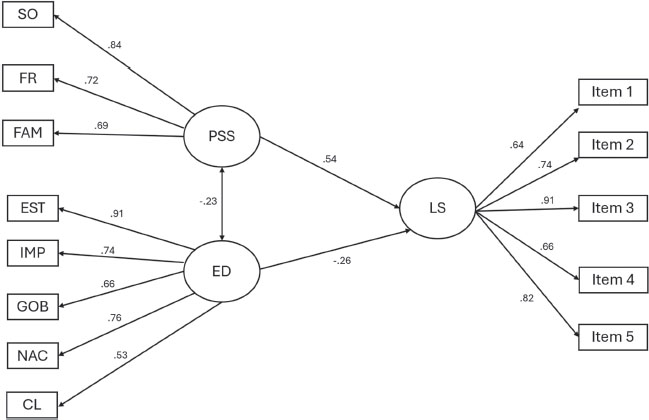
Note: PSS = Perceived Social Support; ED = Emotion Dysregulation; LS = Life Satisfaction; SO = Significant other; FR = Friends; FAM = Family; EST = Strategies; IMP = Impulsivity; GOB = Goals/objectives; NAC = Non-Acceptance; CL = Clarity
Table 5 presents the outcomes of simple regressions based on the models outlined in Table 4. Models 1 and 2 were excluded since fit indices fell below the anticipated minimum threshold for a satisfactory fit. Consequently, model 3 determined that perceived social support (β = .514, p < .001) and emotion dysregulation (β = -.227, p < .01) emerged as significant predictors of life satisfaction, whereas financial well-being (β = .107, p = .145) did not present the same predictive capability. In line with these findings, perceived social support (β = .543, p < .001) and emotion dysregulation (β = -.265, p < .001) were identified as significant predictors of life satisfaction in model 4. These results allow us to answer the first hypothesis of our research partially.
Table 5. Simple regressions based on explicative models
Model |
Sample |
Criterion |
Predictor |
β |
z |
p |
1 |
General |
Life satisfaction |
Perceived social support |
0.535 |
8.02 |
< .001 |
Emotion dysregulation |
-0.217 |
2.04 |
0.041 |
|||
Financial well-being |
0.117 |
1.60 |
0.109 |
|||
2 |
General |
Life satisfaction |
Perceived social support |
0.543 |
8.11 |
< .001 |
Emotion dysregulation |
-0.228 |
2.10 |
0.036 |
|||
Financial well-being |
0.087 |
1.22 |
0.222 |
|||
3 |
General |
Life satisfaction |
Perceived social support |
0.514 |
7.65 |
< .001 |
Emotion dysregulation |
-0.227 |
-2.79 |
0.005 |
|||
Financial well-being |
0.107 |
1.22 |
0.145 |
|||
4 |
General |
Life satisfaction |
Perceived social support |
0.543 |
8.62 |
< .001 |
Emotion dysregulation |
-0.265 |
-3.68 |
< .001 |
|||
5 |
Females |
Life satisfaction |
Perceived social support |
0.535 |
6.79 |
< .001 |
Emotion dysregulation |
-0.307 |
-3.28 |
0.001 |
|||
Males |
Life satisfaction |
Perceived social support |
0.559 |
3.59 |
< .001 |
|
Emotion dysregulation |
-0.138 |
-1.19 |
0.235 |
|||
6 |
With Clinical Status |
Life satisfaction |
Perceived social support |
0.478 |
4.95 |
< .001 |
Emotion dysregulation |
-0.330 |
-2.27 |
0.023 |
|||
Without clinical status |
Life satisfaction |
Perceived social support |
0.642 |
6.58 |
< .001 |
|
Emotion dysregulation |
-0.173 |
-2.08 |
0.037 |
|||
7 |
18-19 years |
Life satisfaction |
Perceived social support |
0.676 |
5.17 |
< .001 |
Emotion dysregulation |
-0.197 |
-1.25 |
0.212 |
|||
20 - 24 years |
Life satisfaction |
Perceived social support |
0.602 |
7.46 |
< .001 |
|
Emotion dysregulation |
-0.208 |
-2.51 |
0.012 |
|||
25-29 years |
Life satisfaction |
Perceived social support |
0.182 |
1.04 |
0.298 |
|
Emotion dysregulation |
-0.475 |
-1.79 |
0.073 |
Upon introducing gender analysis to model 5, differences in the influences were observed. In that sense, perceived social support (β = .535, p < .001) and emotion dysregulation (β = -.307, p < .001) had a significant influence on life satisfaction in women; conversely, only perceived social support (β = .559, p < .001) had that property within the male sample. In the case of clinical status (model 6), there is a more significant negative influence of emotion dysregulation on life satisfaction in people receiving psychological/psychiatric services (β = -.330, p < .05) compared to those who were not (β = -.173, p < .05). Finally, when stratified by age (model 7), perceived social support emerged as a protective factor within the age groups of 18-19 years (β = 676, p < .001) and 20-24 years (β = 602, p < .001), while not in the later emerging adulthood years (β = .182, p = .298). These results identify differential patterns based on gender, clinical status, and age group, accepting the second hypothesis.
DISCUSSION
Life satisfaction is a fundamental component of an individual’s personal development due to the tremendous support this factor provides for the subject’s emotional, social, and economic aspects (Kohútová et al., 2021). Since emerging adulthood is a period of significant changes, life satisfaction generates crucial repercussions for the life of the future intermediate adult (Vosylis & Klimstra, 2022). Considering that the study of these concepts in Latin America has been currently relatively scarce, it was deemed proposed to determine the predictive role of intrinsic factors associated with economic (financial well-being), social (perceived social support), and emotional (emotion dysregulation) domains on life satisfaction in Peruvian emerging adults. It is important to note that various cultural factors may have influenced the results, especially the counterintuitive findings discussed later.
Before analyzing the associated factors with life satisfaction, the internal structure of each measurement instrument was determined while considering the models previously identified in Peruvian contexts and original studies. Through confirmatory factor analysis, internal structures of life satisfaction (Oliver et al., 2018), perceived social support (López-Angulo et al., 2021), and emotional dysregulation (Blancas-Guillen et al., 2024) tests were replicated similarly with adequate adjustment indices. In the case of the instrument that assessed financial well-being (Consumer Financial Protection Bureau, 2015), it was decided to eliminate the first two items and consider a single-factor proposal to comply with the minimum standards at a psychometric level. Acceptable internal consistency coefficients were also determined to assess the precision of the derived scores (McNeish, 2018).
Under these premises, intrinsic and extrinsic factors impact life satisfaction. Emotional factors play an extremely relevant role in the individual’s personal development. If they do not know how to manage these sensations, it has significant repercussions in different areas of their lives (Herts et al., 2012). Faced with this, emotion dysregulation would be conceptualized mainly as an intrinsic factor. On the other hand, social and economic factors are primarily associated with external factors when considered contextual components. However, the subject’s perception of their social networks and economic status presents ideographic nuances, which are associated with the life experiences and expectations that the emerging adult has in their life (Barrera & Flores, 2020; Sirgy, 2018).
Firstly, perceived social support presented the highest predictive power about satisfaction with life in emerging Peruvian adults. This could be due to a cultural factor because, just like it was found in Latin American contexts, unlike the American ones, bonds that were built to be an essential part of their goals during this stage are valued (Barrera-Herrera & Vinet, 2017; Dutra-Thomé et al., 2019). It would also be explained by the condition of generally being an emerging adult since there is interest in socializing with peers and responding to family expectations, so if they receive support from their network, they will feel a higher well-being level. In addition, being in a period in which they experience uncertainty because of adulthood demands, social support would dampen crises (Barrera-Herrera et al., 2019). This way, those who count on this support would yield higher satisfaction in their lives.
Similarly, emotion dysregulation significantly impacts how satisfied young people are with their lives. Instability and little clarity of identity are characteristics of emerging adults, as well as a lower level of resilience and a feeling of lacking value; this is why it would result in more challenging for them to be satisfied with their lives (Limonero et al., 2012). Also, emotional dysregulation would affect expectations about the future, being more negative than positive, in a way that does not help the individual’s personal development and general well-being (Limonero et al., 2012). On the contrary, there would be a more significant psychological discomfort that would limit the person from generating new resources to face the requirements of adulthood and perceive their lives as valuable.
Although financial well-being significantly correlates with satisfaction with life, this study did not identify it as a predictive factor in this Peruvian sample. This was an interesting result since a debate about whether this factor has a predictive association with life satisfaction was previously described, considering that the most surveyed emerging adults in the sample still live with their families, do not work, come from moderate-income households, and are still studying. In other words, the financial burden of their household is divided among the family members, and the satisfaction of their essential needs on an economic level still depends on their parents. Hence, this construct may be irrelevant to them during the data collection. That is likely why, in comparison to the two other constructs, this had the lowest predictive capacity.
On the other hand, these results may be attributed to the significant influence of cultural dynamics on the perceptions of life satisfaction among Peruvian emerging adults. This demographic, navigating the transition toward full adulthood, encounters numerous economic and employment challenges within a context characterized by political and social instability. Nevertheless, the resilience that Peruvians have historically developed in response to ongoing national crises, combined with strong familism, provides both emotional and practical support that enables adaptation and redefinition of well-being expectations (Barrera-Herrera & Vinet, 2017; Romio et al., 2022). Consequently, rather than primarily valuing financial success as a determinant of life satisfaction, Peruvian emerging adults tend to prioritize family support and emotional stability. This underscores the argument that in contexts marked by high uncertainty, family, and community networks assume a central role in their overall well-being, diminishing the significance of financial factors as predictors of life satisfaction and emphasizing the impact of cultural values. Besides, just like was mentioned in the research of Ed Diener, Derrick Wirtz et al. (2010) and Veenhoven (2016), it would depend on many variables from the person if the financial status were associated with someone’s level of happiness, like cultural, cognitive, and affective factors, so financial well-being would not necessarily have a predictive role.
When considering the sociodemographic variables of gender, clinical status, and age groups, interesting results were found. Depending on gender, emotion dysregulation was not a significant risk factor for life satisfaction in men; conversely, it was in the case of women. Gender differences have been identified in this sense since, socially, men are allowed expressions of anger or aggressiveness, being normalized and reinforced by being associated with being “masculine” (DeSalvo, 2023). Associated with this, in Peru, there are marked social stereotypes about gender expressions of masculinities in the sense that men can present violent and aggressive patterns (i.e., low levels of emotion regulation) and be socially “adaptive” (Villa-Palomino, 2022). In the case of clinical status, emotion dysregulation was a much more significant risk factor in the sample, with psychological/psychiatric treatment accounting for life satisfaction. Under these premises, most clinical cases manifest difficulties in managing their emotions, which generates a series of repercussions in their lives, leading to not feeling as comfortable with their current situation (Ben-Dor Cohen et al., 2021). Finally, in the case of age ranges, perceived social support is no longer a protective predictor in adults aged 25 to 29 compared to adolescents and young adults. This can be explained by the fact that these have personally developed, so factors such as social approval would not be as relevant compared to adolescents and young people between 20 and 24 years old (Arnett, 2011).
The present study identified the predictive factor of various emotional, social, and economic variables on life satisfaction in Peruvian emerging adults. Among the main findings, it was determined that perceived social support has a greater degree of association with well-being. In the case of emotion dysregulation, it was also identified as a statistically relevant risk factor. Finally, financial well-being proved to be a not-so-relevant factor for individual satisfaction, which was justified in previous paragraphs. When analyzing the differences in models based on sociodemographic variables, it was determined that emotion dysregulation varies as a predictor for life satisfaction. At the same time, perceived social support varies as a predictor while age groups are considered.
As a counterpart, there are some limitations to this study’s results. Firstly, the sampling was non-probabilistic and intentional, promoting that the sample was not necessarily heterogeneous, so the results could not be generalized to Peruvian emerging adulthood. Furthermore, in the proposal, other relevant psychological factors could have been considered, such as personality traits, social skills, resilience, and coping styles. Finally, the sample size was relatively small compared to other studies in emerging adult populations. Other vital limitations are those associated with administering tests virtually and not considering economic status as a sociodemographic factor as a predictor.
Despite these achievements, this study presents a series of implications relevant to current scientific research and practical applications in the field of positive psychology and well-being. This would be the first Peruvian and Latin American proposal that considers a structural equation model for studying emotional, social, and economic factors as predictor variables of life satisfaction in emerging adult samples. In that sense, we are collaborating through a preliminary study in this community that could be classified as vulnerable due to the changes and social demands they must go through to achieve desirable living standards. Likewise, the study of financial well-being from these psychological perspectives is relatively scarce, so a more exhaustive review is required in the scientific field. Future proposals can be made under these models; for example, the comparison of samples through interprovincial studies and the immigration status of emerging adults would be possible future trends to consider for researchers interested in this field of study.
From a practical standpoint, the findings highlight the urgent need for focused treatments to improve social support and treat emotional dysregulation among emerging adults. Policymakers, educators, and mental health practitioners can use these data to help build programs that support this population’s well-being and sense of fulfillment in life. Under this logic, implementing social programs that include evidence-based interventions (e.g., Dialectical Behavior Therapy) that focus on effective emotional management and establishing healthy social relationships would be specific ideas that public policies could consider in the country.
This research has also had a methodological impact, as psychometric and statistical methods have been implemented. For instance, a structural equation model has been developed to analyze relevant components associated with life satisfaction. Regarding psychometrics, validity, and reliability evidence were obtained in every measurement. Other pertinent considerations could be proposals associated with longitudinal studies to determine the dynamics of the variables during the emerging adulthood stage.
This study allows us to conclude that emotional factors (namely emotion dysregulation) and social factors (namely perceived social support) are significant predictors of life satisfaction. Counterintuitively, financial well-being would not be a central predictor of life satisfaction, and this background is a precursor for future research to determine further explanations for these findings. These results have sought to contribute to understanding the dynamics between various factors relevant to the quality of life and psychological well-being of a vulnerable population that has been little studied in Latin American contexts.
DECLARATION OF CONFLICTING INTERESTS
The authors declared no potential conflicts of interest concerning this article’s research, authorship, and/or publication.
FUNDING
This study has not been funded by any institution.
ETHICAL STATEMENT
Ethical approval: The present study was previously approved by the Comité de Investigación y Ética (CIE) of the Facultad de Psicología de la Universidad de Lima on September 11th, 2023.
Informed Consent: Written informed consent was given by all the participants (for further details regarding the sample selection).
DATA AVAILABILITY
The dataset is available with those participants that accept the conditions that their information could be used for future research proposals and be published in secondary datasets. The information is in the following link: https://osf.io/z23f5/ (Okumura-Clark, 2024).
REFERENCES
Arnett, Jeffrey J. (2000). Emerging adulthood: A theory of development from the late teens through the twenties. American Psychologist, 55(5), 469–480. https://doi.org/10.1037/0003-066X.55.5.469
Arnett, Jeffrey J. (2008). Adolescencia y adultez emergente: Un enfoque cultural (3rd ed.). Pearson Educación.
Arnett, Jeffrey J. (2011). Emerging adulthood(s): The cultural psychology of a new life stage. In Lene Arnett Jensen (Ed.), Bridging cultural and developmental approaches to psychology: New synthesis in theory, research, and policy (pp. 255–275). Oxford University Press. https://doi.org/10.1093/acprof:oso/9780195383430.003.0012
Arnett, Jeffrey J.; Žukauskienė, Rita, & Sugimura, Kazumi. (2014). The new life stage of emerging adulthood at ages 18–29 years: Implications for mental health. The Lancet Psychiatry, 1(7), 569–576. https://doi.org/10.1016/s2215-0366(14)00080-7
Ato, Manuel, & Vallejo, Guillermo. (2011). Los efectos de terceras variables en la investigación psicológica [The effects of third variables in psychological research]. Anales de Psicología, 27(2), 550–561. https://revistas.um.es/analesps/article/view/123201
Aubrey, Marc; Morin, Alexandre; Fernet, Claude, & Carmonneau, Noémie. (2022). Financial well-being: Capturing an elusive construct with an optimized measure. Frontiers in Psychology, 13, 1–18. https://doi.org/10.3389/fpsyg.2022.935284
Bailen, Natasha H., & Thompson, Renee J. (2023). Treatment of psychosocial risk factors in depression. American Psychological Association. https://doi.org/10.1037/0000332-009
Barrera, Mónica L., & Flores, Mirta M. (2020). Apoyo social percibido y salud mental positiva en hombres y mujeres universitarios [Perceived social support and positive mental health in university men and women]. Voces y Silencios: Revista Latinoamericana de Educación, 11(2), 67–83. https://doi.org/10.18175/vys11.2.2020.4
Barrera-Herrera, Ana; Neira-Cofré, Mariajosé; Raipán-Gómez, Paola; Riquelme-Lobos, Patricio, & Escobar, Bertha. (2019). Apoyo social percibido y factores sociodemográficos en relación con los síntomas de ansiedad, depresión y estrés en universitarios chilenos [Perceived social support and sociodemographic factors in relation to symptoms of anxiety, depression and stress in Chilean university students]. Revista de Psicopatología y Psicología Clínica, 24(2), 105–115. https://doi.org/10.5944/rppc.23676
Barrera-Herrera, Ana, & Vinet, Eugenia V. (2017). Adultez emergente y características culturales de la etapa en universitarios chilenos [Emerging adulthood and cultural characteristics of the stage in Chilean university students]. Terapia Psicológica, 35(1), 47–56. https://doi.org/10.4067/s0718-48082017000100005
Ben-Dor Cohen, Maayan; Eldar, Eran; Maeir, Adina, & Nahum, Mor. (2021). Emotional dysregulation and health related quality of life in young adults with ADHD: A cross sectional study. Health and Quality of Life Outcomes, 19, 1–11. https://doi.org/10.1186/s12955-021-01904-8
Bentler, Peter M. (1990). Comparative fit indexes in structural models. Psychological Bulletin, 107(2), 238–246. https://doi.org/10.1037/0033-2909.107.2.238
Blancas-Guillen, Jesus; Arroyo-Pizarro, Pedro; Quintana, Edson; Tupa-Belizario, Rosa S., & Valencia, Pablo D. (2024). Escala de dificultades en la regulación emocional: Análisis psicométrico de sus versiones breves en universitarios peruanos [Difficulties in emotional regulation scale: Psychometric analysis of its brief versions in Peruvian university students]. Revista Argentina de Ciencias del Comportamiento, 16(2), 60–73. https://doi.org/10.32348/1852.4206.v16.n2.36158
Brüggen, Elisabeth C.; Hogreve, Jens; Holmlund, Maria; Kabadayi, Sertan, & Löfgren, Martin. (2017). Financial well-being: A conceptualization and research agenda. Journal of Business Research, 79, 228–237. https://doi.org/10.1016/j.jbusres.2017.03.013
Calizaya, Jose M.; Monzón, Gloria I.; Miaury, Ana R.; Pinto, Hilda L., & Evangelista, Jose L. (2020). Satisfacción con la vida en grupos etarios de la ciudad de Arequipa, Perú [Satisfaction with life in age groups of the city of Arequipa, Peru]. Universidad, Ciencia y Tecnología, 24(107), 56–62. https://doi.org/10.47460/uct.v24i107.414
Camacho, Micaela, & Horta, Roberto. (2022). Bienestar y felicidad: impactos del ingreso, la riqueza y el empleo en el bienestar subjetivo en el ámbito urbano. El caso de Montevideo [Well-being and happiness: impacts of income, wealth and employment on subjective well-being in the urban environment. The case of Montevideo]. Estudios Generales, 38(163), 161–171. https://doi.org/10.18046/j.estger.2022.163.4802
Cobo-Rendón, Rubia; López-Angulo, Yaranay; Pérez-Villalobos, María V., & Díaz-Mujica, Alejandro. (2020). Perceived social support and its effects on changes in the affective and eudaimonic well-being of Chilean university students. Frontiers in Psychology, 11, 1–12. https://doi.org/10.3389/fpsyg.2020.590513
Cohen, Jacob. (1988). Statistical power analysis for the behavioral sciences (2nd ed.). Lawrence Erlbaum Associates.
Consumer Financial Protection Bureau. (2015). Financial well-being scale. https://www.consumerfinance.gov/data-research/research-reports/financial-well-being-scale/
Demichelis, Olivia P.; Grainger, Sarah A.; Hubbard, Ruth E., & Henry, Julie D. (2023). Emotion regulation mediates the relationship between social frailty and stress, anxiety, and depression. Scientific Reports, 13(1), 1–8. https://doi.org/10.1038/s41598-023-33749-0
DeSalvo, Nathan. (2023). How gender shapes anger and aggression [Master’s dissertation, Rhode Island College]. Rhode Island College Library Repository. https://doi.org/10.28971/142023nN38
Diener, Ed. (1984). Subjective well-being. Psychological Bulletin, 95(3), 542–575. https://doi.org/10.1037/0033-2909.95.3.542
Diener, Ed. (1994). Assessing subjective well-being: Progress and opportunities. Social Indicators Research, 31(2), 103–157. https://doi.org/10.1007/BF01207052
Diener, Ed; Wirtz, Derrick; Tov, William; Kim-Prieto, Chu; Choi, Dong-won; Oishi, Shigehiro, & Biswas-Diener, Robert. (2010). New well-being measures: Short scales to assess flourishing and positive and negative feelings. Social Indicators Research, 97, 143–156. https://doi.org/10.1007/s11205-009-9493-y
DiStefano, Christine; Liu, J.; Jiang, Ning, & Shi, Dexin. (2018). Examination of the weighted root mean square residual: Evidence for trustworthiness. Structural Equation Modeling: A Multidisciplinary Journal, 25(3), 453–466. https://doi.org/10.1080/10705511.2017.1390394
Domínguez-Lara, Sergio. (2019). Correlación entre residuales en análisis factorial confirmatorio: Una breve guía para su uso e interpretación [Correlation between residuals in confirmatory factor analysis: A brief guide for its use and interpretation]. Interacciones, 5(3), 1–7. https://doi.org/10.24016/2019.v5n3.207
Durand-Sánchez, Esther; Ruiz-Alvarado, Carlos; Contreras-Valderrama, Ricardo; Morales-García, Wilter; Mamani-Benito, Oscar; Huancahuire-Vega, Salomón; Saintila, Jacksaint; Morales-García, Mardel, & Ruiz-Mamani, P. (2023). Aspectos sociodemográficos y comportamientos saludables asociados a la satisfacción vital percibida en profesionales de la salud [Sociodemographic aspects and healthy behaviors associated with perceived life satisfaction in health professionals]. Revista de Atención Primaria y Salud Comunitaria, 13, 1–10. https://doi.org/10.1177/21501319221148332
Dutra-Thomé, Luciana; Florêncio, Louise; Seidl-de-Moura, Maria L.; De Oliveira, Dandara, & Kollerd, Silvia. (2019). Autonomy development: Gender and age differences from adolescence to emerging adulthood. Acta de Investigación Psicológica, 9(2), 14–24. https://doi.org/10.22201/fpsi.20074719e.2019.2.259
Escobedo, María; Hernández, Jesús; Estebané, Virginia, & Martínez, Guillermina. (2016). Modelos de ecuaciones estructurales: Características, fases, construcción, aplicación y resultados [Structural equation models: Characteristics, phases, construction, application and results]. Revista Ciencia & Trabajo, 18(55), 16–22. http://doi.org/10.4067/S0718-24492016000100004
Espinoza, María; Gavidia-Payne, Susana, & Okumura, Alvaro. (2022). Understanding emotion regulation in Venezuelan immigrants to Peru and Peruvian internal migrants: a comparative study. Journal of Ethnic and Migration Studies, 49(1), 1–22. https://doi.org/10.1080/1369183X.2021.2011177
García-Álvarez, Diego; Rincón-Gill, Blanca, & Urdaneta-Barroeta, Maria Paula. (2022). Autopercepción de adultez emergente y sus relaciones con gratitud, ansiedad y bienestar [Self-perception of emerging adulthood and its relationships with gratitude, anxiety and well-being]. Revista de Estudios e Investigación en Psicología y Educación, 9(2), 186–206. https://doi.org/10.17979/reipe.2022.9.2.9085
González, Manuel; Rovella, Anna; Barrera, Andrea, & González, Mario. (2023). Relationships of emotion regulation to procrastination, life satisfaction and resilience to discomfort. Interacciones, 9, 1–8. http://doi.org/10.24016/2023.v9.278
Gratz, Kim L., & Roemer, Lizabeth. (2004). Multidimensional assessment of emotion regulation and dysregulation: Development, factor structure, and initial validation of the difficulties in emotion regulation scale. Journal of Psychopathology and Behavioral Assessment, 26(1), 41–54. https://doi.org/10.1023/B:JOBA.0000007455.08539.94
Gross, James, & John, Oliver. (2003). Individual differences in two emotion regulation processes: implications for affect, relationships and well-being. Journal of Personality and Social Psychology, 85, 348–362. https://doi.org/10.1037/0022-3514.85.2.348
Guerrini-Usubini, Anna; Cattivelli, Roberto; Scarpa, Alessandra; Musetti, Alessandro; Varallo, Giorgia; Franceschini, Christian, & Castelnuovo, Gianluca. (2023). The interplay between emotion dysregulation, psychological distress, emotional eating, and weight status: A path model. International Journal of Clinical and Health Psychology, 23(1), 1–8. https://doi.org/10.1016/j.ijchp.2022.100338
Hair Jr., Joseph F.; Black, William C.; Babin, Barry J., & Anderson, Rolph E. (2010). Multivariate data analysis. Pearson.
Herts, Kate L.; McLaughlin, Katie A., & Hatzenbuehler, Mark L. (2012). Emotion dysregulation as a mechanism linking stress exposure to adolescent aggressive behavior. Journal of Abnormal Child Psychology, 40(7), 1111–1122. https://doi.org/10.1007/s10802-012-9629-4
Hidalgo-Fuentes, Sergio; Tijeras-Iborra, Amparo; Martínez-Álvarez, Isabel, & Sospedra-Baeza, María J. (2021). El papel de la inteligencia emocional y el apoyo social percibido en la satisfacción vital de estudiantes universitarios ecuatorianos. Revista Argentina de Ciencias del Comportamiento, 13(3), 87–95. https://doi.org/10.32348/1852.4206.v13.n3.30421
Hooper, Daire; Coughlan, Joseph, & Mullen, Michael R. (2008). Structural equation modelling: Guidelines for determining model fit. Electronic Journal of Business Research Methods, 6(1), 53–60. https://doi.org/10.21427/D7CF7R
Hu, Li‐tze, & Bentler, Peter M. (1999). Cutoff criteria for fit indexes in covariance structure analysis: Conventional criteria versus new alternatives. Structural Equation Modeling, 6(1), 1–55. https://doi.org/10.1080/10705519909540118
Kasprzak, Elżbieta. (2010). Perceived social support and life-satisfaction. Polish Psychological Bulletin, 41(4), 144–154. https://doi.org/10.2478/v10059-010-0019-x
Keith, Timothy. (2015). Multiple regression and beyond: An introduction to multiple regression and estructural equation modeling (2nd ed.). Taylor & Francis.
Keyes, Corey L. M.; Shmotkin, Dov, & Ryff, Carol D. (2002). Optimizing well-being: the empirical encounter of two traditions. Journal of Personality and Social Psychology, 82, 1007–1022. https://doi.org/10.1037/0022-3514.82.6.1007
Kiliç, Selim. (2016). Cronbach’s alpha reliability coefficient. Psychiatry and Behavioral Sciences, 6(1), 47–48. https://doi.org/10.5455/jmood.20160307122823
Killingsworth, Matthew A.; Kahneman, Daniel, & Mellers, Barbara. (2023). Income and emotional well-being: A conflict resolved. Proceedings of the National Academy of Sciences of the United States of America, 120(10), e2208661120. https://doi.org/10.1073/pnas.2208661120
Kline, Rex B. (2011). Principles and practice of structural equation modeling (2nd ed.). Guilford Press.
Kline, Rex B. (2016). Principles and practice of structural equation modeling (4th ed.). Guilford Press.
Kohútová, Veronika; Špajdel, Marián, & Dědová, Mária. (2021). Emerging adulthood – an easy time of being? Meaning in life and satisfaction with life in the time of emerging adulthood. Studia Psychologica, 63(3), 307–321. https://doi.org/10.31577/sp.2021.03.829
Kraiss, Jannis T.; Ten Klooster, Peter M.; Moskowitz, Judith T., & Bohlmeijer, Ernst T. (2020). The relationship between emotion regulation and well-being in patients with mental disorders: A meta-analysis. Comprehensive Psychiatry, 102, 1–14. https://doi.org/10.1016/j.comppsych.2020.152189
Kwon, Hoin; Yoon, K. Lira; Joormann, Jutta, & Kwon, Jung-Hye. (2013). Cultural and gender differences in emotion regulation: relation to depression. Cognition & Emotion, 27(5), 769–782. https://doi.org/10.1080/02699931.2013.792244
Limonero, Joaquín T.; Tomás-Sábado, Joaquín.; Fernández-Castro, Jordi; Gómez-Romero, José, & Ardilla-Herrero, Amor. (2012). Estrategias de afrontamiento resilientes y regulación emocional: Predictores de satisfacción con la vida [Resilient coping strategies and emotional regulation: Predictors of life satisfaction]. Behavioral Psychology / Psicología Conductual, 20(1), 183–196. https://www.behavioralpsycho.com/producto/estrategias-de-afrontamiento-resilientes-y-regulacion-emocional-predictores-de-satisfaccion-con-la-vida/
Linehan, Marsha M. (1993). Cognitive-behavioral treatment of borderline personality disorder. Guilford Press.
López-Angulo, Yaranay; Pérez-Villalobos, M. Victoria; Bernardo, Ana; Cobo, Rubia; Sáez, Fabiola, & Díaz-Mujica, Alejandro. (2021). Propiedades psicométricas de la escala multidimensional de apoyo social percibido en estudiantes universitarios chilenos [Psychometric properties of the multidimensional scale of perceived social support in Chilean university students]. Revista Iberoamericana de Diagnóstico y Evaluación – e Avaliação Psicológica, 1(58), 127–140. https://doi.org/10.21865/ridep58.1.11
Mamani-Benito, Oscar; Carranza, Renzo F.; Caycho-Rodríguez, Tomás; Castillo-Blanco, Ronald; Tito-Betancur, Madona; Alfaro, Rosa, & Ruiz, Percy G. (2023). The influence of self-esteem, depression, and life satisfaction on the future expectations of Peruvian university students. Frontiers in Education, 8, 1–7. https://doi.org/10.3389/feduc.2023.976906
Matud, M. Pilar; Bethencourt, Juan Manuel; Ibáñez, Ignacio; Fortes, Demelza, & Díaz, Amelia. (2021). Gender differences in psychological well-being in emerging adulthood. Applied Research in Quality of Life, 17, 1001–1017. https://doi.org/10.1007/s11482-021-09943-5
McNeish, Daniel. (2018). Thanks coefficient alpha, we’ll take it from here. Psychological Methods, 23(3), 412–433. https://doi.org/10.1037/met0000144
Medrano, Leonardo Adrián, & Muñoz-Navarro, Roger. (2017). Aproximación conceptual y práctica a los modelos de ecuaciones estructurales [Conceptual and practical approach to structural equation models]. Revista Digital de Investigación en Docencia Universitaria, 11(1), 219–239. https://doi.org/10.19083/ridu.11.486
Moehler, Eva; Brunner, Romuald, & Sharp, Carla. (2022). Emotional dysregulation in children and adolescents. Frontiers in Psychiatry, 13, 1–2. https://doi.org/10.3389/fpsyt.2022.883753
Muthén, Linda K., & Muthén, Bengt O. (2017). Mplus: statistical analysis with latent variables: user’s guide (8th ed.). Muthén & Muthén.
Navarro-Loli, Jhonatan S.; Merino-Soto, Cesar; Dominguez-Lara, Sergio, & Lourenço, Abilio. (2019). Estructura interna de la Multidimensional Scale of Perceived Social Support (MSPSS) en adolescentes peruanos [Internal structure of the Multidimensional Scale of Perceived Social Support (MSPSS) in Peruvian adolescents]. Revista Argentina de Ciencias del Comportamiento, 11(1), 38–47. https://doi.org/10.32348/1852.4206.v11.n1.21532
Nazir, Nazia; Zafar, Muhammad S.; Akram, Muhammad N.; Khokhar, Maryam, & Yousaf, Iqra. (2023). Perceived social support and psychological well-being among patients with epilepsy. JPMA. The Journal of the Pakistan Medical Association, 73(3), 635–637. https://doi.org/10.47391/jpma.5288
Okumura-Clark, Alvaro. (2024, September 13). Emerging adults - Life Satisfaction. https://doi.org/10.17605/OSF.IO/Z23F5
Oliver, Amparo; Galiana, Laura, & Bustos, Varinia. (2018). Validación de la escala de satisfacción con la vida y su relación con las dimensiones del autoconcepto en universitarios peruanos [Validation of the Satisfaction with Life Scale and its relationship with the dimensions of self-concept in Peruvian university students]. Persona, 21(2), 29–39. https://doi.org/10.26439/persona2018.n021.3018
Ong, Hui L.; Vaingankar, Janhavi A.; Abdin, Edimansyah; Sambasivam, Rajeswari; Fauziana, Restria; Tan, Min-en; Chong, Siow A.; Goveas, Richard R.; Chiam, Peak C., & Subramaniam, Mythily. (2018). Resilience and burden in caregivers of older adults: moderating and mediating effects of perceived social support. BMC Psychiatry, 18(1), 1–9. https://doi.org/10.1186/s12888-018-1616-z
Ortiz, Elías S.; Lobos, Germán, & Guevara, Daniel. (2019). Determining factors of financial well-being and its relation to quality of life in a sample of professional workers of Guayaquil, Ecuador. Información Tecnológica, 30(1), 121–132. https://doi.org/10.4067/s0718-07642019000100121
Regalado, Otto. (2024, 17 de enero). La incierta mirada al 2024: ¿el año de la resiliencia y la superación? Conexión ESAN. https://www.esan.edu.pe/conexion-esan/la-incierta-mirada-al-2024-el-ano-de-la-resiliencia-y-la-superacion
Rhemtulla, Mijke; Brosseau-Liard, Patricia É., & Savalei, Victoria. (2012). When can categorical variables be treated as continuous? A comparison of robust continuous and categorical SEM estimation methods under suboptimal conditions. Psychological Methods, 17(3), 354–373. https://doi.org/10.1037/a0029315
Riitsalu, Leonore; Sulg, Rene; Lindal, Henri; Remmik, Marvi, & Vain, Kristiina. (2024). From security to freedom—the meaning of financial well-being changes with age. Journal of Family and Economic Issues, 45, 56–69. https://doi.org/10.1007/s10834-023-09886-z
Romio, Silvia; Rivera, Miryam; Delmotte, Céline; Arenas, Eric; Grard de Dubois, Christine, & Piccoli, Emmanuelle. (2022). Resiliencia y memorias en Perú durante la pandemia: Innovaciones y continuidades en barrios y comunidades [Resilience and memories in Peru during the pandemic: Innovations and continuities in neighborhoods and communities]. Debates en Sociología, (55), 5–34. https://doi.org/10.18800/debatesensociologia.202202.00
Ruiz, Miguel A.; Pardo, Antonio, & San Martín, Rafael. (2010). Modelos de ecuaciones estructurales [Structural equation models]. Papeles del Psicólogo, 31(1), 34–45. http://www.redalyc.org/articulo.oa?id=77812441004
Saavedra, Javier E. (2020). Factores sociodemográficos y eventos de vida tempranos asociados con la felicidad en adultos de Lima Metropolitana [Sociodemographic factors and early life events associated with happiness in adults in Metropolitan Lima]. Revista Peruana de Medicina Experimental y Salud Pública, 37(1), 42–50. https://doi.org/10.17843/rpmesp.2020.371.4580
Schumacker, Randall E., & Lomax, Richard G. (2004). A beginner’s guide to structural equation modeling (2nd ed.). Taylor & Francis.
Shaw, Philip; Stringaris, Argyris; Nigg, Joel, & Leibenluft, Ellen. (2014). Emotion dysregulation in attention deficit hyperactivity disorder. The American Journal of Psychiatry, 171(3), 276–293. https://doi.org/10.1176/appi.ajp.2013.13070966
Shin, Huiyong, & Park, Chaerim. (2022). Social support and psychological well-being in younger and older adults: The mediating effects of basic psychological need satisfaction. Frontiers in Psychology, 13, 1–14. https://doi.org/10.3389/fpsyg.2022.1051968
Siqueira, Anderson; Dutra-Thomé, Luciana, & Helena, Silvia. (2016). Habilidades sociais e fatores de risco e proteção na adultez emergente [Social skills and risk and protective factors in emerging adulthood]. Psico, 47(4), 268–278. https://doi.org/10.15448/1980-8623.2016.4.23398
Sirgy, M. Joseph. (2018). The psychology of material well-being. Applied Research in Quality of Life, 13, 273–301. https://doi.org/10.1007/s11482-017-9590-z
Sleep, Chelsea E.; Lynam, Donald R., & Miller, Joshua D. (2021). A comparison of the validity of very brief measures of the big five/five-factor model of personality. Assessment, 28(3), 739–758. https://doi.org/10.1177/1073191120939160
Temizkan, Ege; Köse, Barkin, & Şahin, Sedef. (2023). Social determinants of life satisfaction in emerging adults. Children and Youth Services Review, 151, 107050. https://doi.org/10.1016/j.childyouth.2023.107050
Thomas, Patricia A. (2010). Is it better to give or to receive? Social support and the well-being of older adults. The Journals of Gerontology: Series B, Psychological Sciences and Social Sciences, 65(3), 351–357. https://doi.org/10.1093/geronb/gbp113
Thompson, Ross A. (1994). The development of emotion regulation: Biological and behavioural considerations. University of Chicago Press.
Torrecilla de las Heras, Eugenio, & Melendro, Miguel. (2023). Las habilidades sociales en jóvenes en riesgo de exclusión social: una revisión sistemática [Social skills in young people at risk of social exclusion: a systematic review]. Aula Abierta, 52(2), 175–183. https://doi.org/10.17811/rifie.52.2.2023.175-183
Tucker, Ledyard R., & Lewis, Charles. (1973). A reliability coefficient for maximum likelihood factor analysis. Psychometrika, 38(1), 1–10. https://doi.org/10.1007/BF02291170
Veenhoven, Ruut. (2016). What we have learnt about happiness. In Filomena Maggino (Ed.), A life devoted to quality of life (pp. 151–170). Springer. https://doi.org/10.1007/978-3-319-20568-7_10
Viladrich, Carme; Angulo-Brunet, Ariadna, & Doval, Eduardo. (2017). A journey around alpha and omega to estimate internal consistency reliability. Anales de Psicología, 33(3), 755–782. https://doi.org/10.6018/analesps.33.3.268401
Villa-Palomino, Julio. (2022). Masculinidades peruanas: una revisión. Anthropologica, 40(49), 211–235. https://doi.org/10.18800/anthropologica.202202.010
Vosylis, Rimantas, & Klimstra, Theo. (2022). How does financial life shape emerging adulthood? Short-term longitudinal associations between perceived features of emerging adulthood, financial behaviors, and financial well-being. Emerging Adulthood, 10(1), 90–108. https://doi.org/10.1177/2167696820908970
Wood, David; Crapnell, Tara; Lau, Lynette; Bennett, Ashley; Lotstein, Debra; Ferris, Maria, & Kuo, Alice. (2018). Emerging adulthood as a critical stage in the life course. In Halfon Neal, Forrest Christopher B., Lerner Richard M. & Faustman Elaine M. (Eds.), Handbook of life course health development (pp. 123–143). Springer. https://doi.org/10.1007/978-3-319-47143-3_7
Yeo, JeongHee, & Lee, Yoon G. (2019). Understanding the association between perceived financial well-being and life satisfaction among older adults: Does social capital play a role? Journal of Family and Economic Issues, 40, 592–608. https://doi.org/10.1007/s10834-019-09634-2
Zimet, Gregory D.; Dahlem, Nancy W.; Zimet, Sara G., & Farley, Gordon K. (1988). The Multidimensional Scale of Perceived Social Support. Journal of Personality Assessment, 52(1), 30–41. https://doi.org/10.1207/s15327752jpa5201_2
ALEJANDRA ROMERO-DURÁN
Bachelor in Psychology with training in Acceptance and Commitment Therapy. Research interests include life satisfaction, socio-emotional variables, and well-being in young adults. Experience in psychological assessment, group workshops, and clinical interventions with children, adolescents, and adults.
alejandrauromerodu@gmail.com
https://orcid.org/0009-0001-9096-8247
BRENDA SIFUENTES-VILLANUEVA
Bachelor in Psychology with training in Dialectical Behavior Therapy. Research interests include positive psychology, emotional well-being, and positive discipline. Experience in multidisciplinary work, leading psycho-emotional workshops, and conducting psychological assessment and intervention in clinical and educational settings.
bsifuen@ulima.edu.pe
https://orcid.org/0009-0001-2474-7972
ALVARO OKUMURA-CLARK
Doctor in Psychology, master’s in clinical and health psychology, and psychotherapist specialized in contextual-behavioral approaches. College professor, trainer in psychotherapeutic centers, and researcher in socio-emotional variables, contextualbehavioral science, migration, and psychometrics.
aokumura@ulima.edu.pe
https://orcid.org/0000-0002-4132-8446
FORMATO DE CITACIÓN
Romero-Durán, Alejandra; Sifuentes-Villanueva, Brenda & Okumura-Clark, Alvaro. (2026). Life Satisfaction in Peruvian Emerging Adults: The Greater Impact of Socioemotional Over Financial Factors. Quaderns de Psicologia, 28(1), 2222. https://doi.org/10.5565/rev/qpsicologia.2222
HISTORIA EDITORIAL
Recibido: 10-9-2024
1ª revisión: 23-11-2024
Aceptado: 28-2-2025
Publicado: 25-04-2026